
Welcome to the Capitals by Eddie Wax with Nicoletta Jonta. Feedback is welcome.
Did a friend forward this newsletter to you? Subscribe here.
In today’s episode:
– Transatlantic stability, and the price – NGOs challenge Brussels over lobbying clause – Merz pushes Netanyahu toward ceasefire – Orban threatens to block EU budget – UK, Norway and Ukraine invited to join IRIS² – Slovakian military training: patriotism or PR?
In the capital
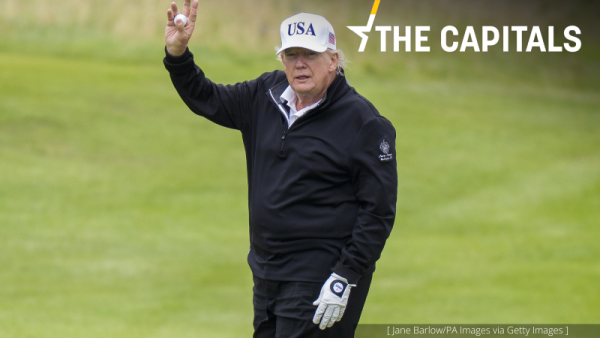
After months of tariff threats, social media taunts and member-state spats, Donald Trump on Sunday got what he wanted: a deal with Ursula von der Leyen that imposes 15 percent tariffs on most European goods. That’s lower than the 30 percent he had threatened, but well above the zero-to-zero pact Brussels had offered Washington. The EU blinked.
It’s hard to say what was more unpleasant during yesterday’s meeting of the leaders of the world’s two largest economies on Trump’s Scottish golf course.
When von der Leyen thanked him for a deal that would allow European exporters, including automakers, to access the US market at 15% tariffs? When she praised him as a “tough negotiator and mediator,” only to have Trump interrupt her to say he was also “fair” – and she agreed?
Or was it while he sat next to me listing his victories: $750 billion in EU energy purchases, another $600 billion in promised investments and a “massive” amount of military equipment on top of that?
Von der Leyen presented the deal as “ the best we could get.” But the EU’s defense of the agreement tells you all you need to know about how Europe approached these negotiations: It was never entirely sure that Trump’s threats were just threats, and it never seriously countered them.
“I think it’s great that we made an agreement today instead of playing games,” Trump said after weeks of publicly pressuring Brussels with ultimatums to toughen tariffs.
Months of warnings from Brussels that higher tariffs would ultimately hurt consumers around the world, including Americans, fell on deaf ears yesterday. Instead, von der Leyen described the agreement – almost in the spirit of Trump – as “the biggest deal ever,” and EU officials echoed her, calling it “the biggest trade deal in history.”
It’s hard to imagine. Just a few months ago, the EU was considering a 10 percent tariff, down from 15 percent. Last night, John Clark, the former top European Commission official responsible for trade and agriculture, criticized the deal as “the worst trade deal in history.” Even some MEPs from the center-right von der Leyen family criticized it as a mere patchwork measure, warning that it was hurting European industry.
However, national leaders who had insisted that the European Commission should not retaliate, including Germany’s Friedrich Merz and Italy’s Giorgia Meloni, responded positively to the deal, stressing the importance of maintaining stability. French President Emmanuel Macron, who has advocated a tougher approach to the talks, remained conspicuously silent on Sunday evening.
While some details remain to be clarified, von der Leyen pointed to several micro-wins.
Compared with the tariffs facing Japan, Canada, and Mexico, the EU deal might not seem so bad. Von der Leyen said she had secured zero tariffs on planes and other goods, a list that could grow. Coming US tariffs on European pharmaceuticals will be capped at 15%, though it’s unclear how high they will be in other countries. And while some US agricultural imports may now be subject to zero tariffs (it’s not yet clear which ones), most of the EU’s existing protections are likely to remain in place.
There is more at stake than just trade in goods, which is only part of the EU-US relationship. Europe depends on America for security and wants to maintain Trump’s support on Ukraine.
Overall, many in Brussels may soon regret not pushing back harder when Trump first imposed tariffs earlier this year, especially if the US raises rates as negotiations on the details continue.
Von der Leyen and supporters of the agreement stressed that stability is the key now. But, as always, that depends on Donald Trump.
Euractiv’s Thomas Møller-Nielsen provides a full analysis of what has been announced so far.
NGOs challenge Brussels over lobbying clause
Most NGOs have ignored the Commission’s request to review their funding agreements following outrage over the use of EU money to lobby MEPs.
According to a letter dated July 24 and seen by The Capitals, all 28 NGOs that received funds under the EU’s LIFE funding programme have not renewed their grant agreements, even though they were fully entitled to do so because the contracts had already expired, Budget Commissioner Petr Serafin wrote in a letter to the head of the parliamentary anti-fraud office, Niklas Herbst.
Under pressure from right-wing lawmakers, Seraphin acknowledged earlier this year that it was inappropriate for “certain Commission services” to oblige “NGOs to lobby specifically MEPs.” The Commission has since published updated recommendations.
The letter notes that of the 30 NGOs receiving funding until 2027 from the Commission’s health directorate, only half have requested amendments to their contracts to comply with the new recommendations.
The commission “considers that it has exhausted all legal and practical options to ensure consistency,” the letter said. A new parliamentary inquiry team, led by the EPP’s Dirk Gotink and the ECR’s Carlo Fidanza, will begin examining more contracts after the summer.
Merz pushes Netanyahu to reach ceasefire
German Chancellor Friedrich Merz called on Israeli Prime Minister Benjamin Netanyahu in a telephone conversation on Sunday to do everything possible to ensure an immediate ceasefire in Gaza and to ensure more humanitarian aid reaches civilians. Germany will consider taking steps to facilitate these efforts together with France, Britain, the United States and Arab states, a government spokesman said, without specifying what measures might be taken.
Their conversation comes amid growing pressure to resolve the conflict in the Middle East. Last week, Emmanuel Macron announced that France was ready to recognise the state of Palestine, becoming the first member of the G7 to do so.
Orban threatens to block EU budget
Hungarian Prime Minister Viktor Orban on Saturday threatened to block the EU’s proposed €2 trillion long-term budget unless Brussels unblocks frozen funds linked to a long-running rule of law dispute.
Speaking at a summer event, Orban also criticized the EU’s support for Ukraine. Meanwhile, opposition candidate Peter Magyar has promised to restore relations with the EU and NATO if elected. Read more.
Capitals
BERLIN
The European Commission is unlikely to penalise Germany for breaching the EU’s budget deficit cap because the overspending is entirely defence-related, EU Economic Commissioner Valdis Dombrovskis told the Financial Times. Under the bloc’s new budget rules, some defence spending could be excluded, with a final assessment expected in spring 2025. Read more.
PARIS
The United States on Friday condemned France’s criminal investigation into Elon Musk’s X platform, calling it an attack on free speech and accusing French authorities of politically motivated censorship abroad. The probe, centered on suspected algorithm manipulation, was launched by French cybercrime prosecutors following complaints that X could be used to interfere in domestic politics. Read more.
VEIN
Austrian Foreign Minister Beate Meinl-Reisinger said she was “very open” to a national debate on the country’s future security and defence strategy, calling into question Austria’s long-standing neutrality.
“Neutrality alone is not enough,” she told the German newspaper Die Welt, calling for more defense spending and stronger international alliances. There may not be support in parliament or among the public for NATO membership right now, but she insists: “Such debates can still be very fruitful.”
MADRID
Spain’s conservative opposition is stepping up efforts ahead of 2027 elections as Prime Minister Pedro Sanchez faces mounting pressure over a corruption scandal. People’s Party leader Alberto Nunez Feijóo is calling a meeting of his executive committee on Monday to galvanise his base.
The People’s Party is hoping to capitalize on the fallout from a controversial report in June that linked members of Sánchez’s inner circle to a fraud scheme, heightening political tensions and undermining public confidence in the Socialist government. Read more.
ATHENS
Wildfires raged across Greece for a second day on Sunday, destroying homes, forests and farmland. Kythira and Euboea were among the worst-hit areas amid ongoing evacuations and extreme heat. Greece has asked the EU for help. Czech firefighters are already on the scene, while Italian planes are en route to support local forces. Read more.
WARSAW
President Andrzej Duda will meet with Speaker Szymon Gołonia after Gołonia said he was being urged to postpone the swearing-in ceremony of President-elect Karol Nawrocki, scheduled for August 6.
Following the election, there were numerous reports of irregularities in the vote count at polling stations, raising concerns that the results may have been rigged. However, the Supreme Court upheld the result. Golovnya, who declined to name the person who pressured him, insists there is no legal basis for postponing the ceremony. Read more.
BUCHAREST
Deputy Prime Minister Dragos Anastasiu resigned on Sunday, just weeks after taking office, after it emerged that his companies had paid more than 150,000 euros in bribes to a tax inspector from the very agency he was appointed to oversee.
While acknowledging the payments, which he called “survival bribes,” Anastasiou said he could no longer effectively carry out his duties amid mounting public pressure. Read more.
Also on Euractiv
Commissioner says UK, Norway and Ukraine welcome joining EU IRIS² space programme
Non-EU countries such as Norway, Ukraine and the UK could follow Iceland’s lead and join the EU’s secure IRIS² satellite communications network as an alternative to Elon Musk’s Starlink project, Defence and Space Commissioner Andrius Kubilius told Euractiv.
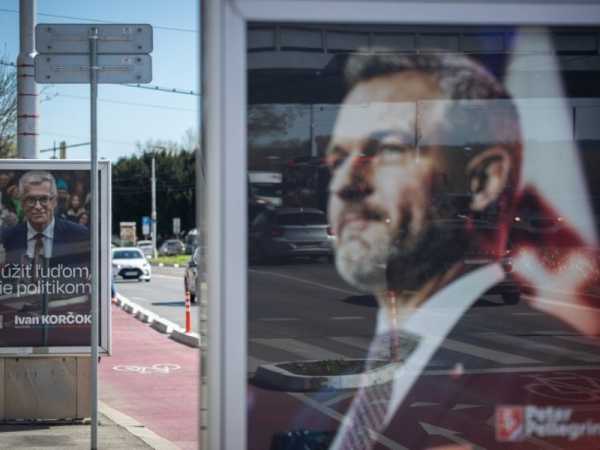
Patriotism or PR? New military training in Slovakia has caused mixed reactions.
Slovakia’s new military course wins praise from experts, but politicians in camouflage are ridiculed
Agendas
European Commissioner Henna Virkkunen receives a delegation of US Congress members led by Jim Jordan, Chairman of the House Judiciary Committee.
UN High-Level Conference on the Question of Palestine and the Two-State Solution; Commissioner Dubravka Šujca to attend
Authors: Thomas Møller-Nielsen, Robert Hodgson, Nick Alipour, Catalina Mihai, Alexandra Krzysztoszek, Ines Fernández-Pontes
Editors : Matthew Karnichnig, Sofia Mandilara, Christina Zhao
Source: Source