
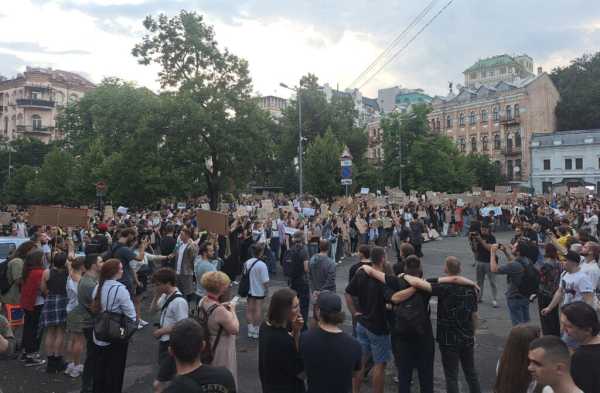
The first anti-government protests in Ukraine since the start of Russia’s full-scale invasion took place on July 22. Thousands of Ukrainians took to the streets to express anger and outrage at what critics see as a campaign to strip the country’s anti-corruption agencies of their independence. For more than a decade, Ukrainians have been fighting a war on two fronts: against Russian aggression and against high-level corruption. President Volodymyr Zelensky promised “victory over corruption” after his 2019 election and has become a global symbol of freedom since Russia’s full-scale war began in 2022. So his administration’s moves this week to destroy independent anti-corruption agencies are puzzling, to say the least.
On July 21, law enforcement agencies raided the offices of the National Anti-Corruption Bureau of Ukraine (NABU) and announced an investigation into fifteen NABU employees, presumably as part of an ongoing effort to prosecute traffic violations. Similar prosecutions on vague charges target other investigative bodies and individuals, but have rarely been used against institutions like NABU, which was created in 2014 as an independent body to combat high-level corruption. Although NABU has had its own problems, it is widely regarded by Ukrainian and Western experts as one of the country’s most important post-Maidan reform projects.
Unfortunately, this was no small matter. Law enforcement agencies led by the Security Service of Ukraine (SBU) and the Prosecutor General’s Office said the centerpiece of the investigation was treason charges against a pro-Russian member of parliament who allegedly collaborated with NABU detectives to influence investigations on behalf of the Russian security services. The SBU, whose leadership is appointed by the president of Ukraine, named two leading NABU detectives as having ties to MP Fedir Khyrstenko, who is accused of acting on behalf of the Kremlin against Ukraine. They also claimed that the detectives helped Ukrainian oligarchs flee the country to avoid criminal charges.
Western partners in Kyiv quickly called on Zelensky’s administration to stop pursuing NABU. Despite these warnings, reports emerged that Zelensky’s National Security and Defense Council (NSDC) was planning to “amend the Criminal Procedure Code” to ensure “the integrity of law enforcement agencies… and eliminate opportunities for corruption.” Observers feared this foreshadowed further obstruction of NABU’s work.
These concerns were confirmed on July 22, when the National Security and Defense Council proposed that the Ukrainian parliament introduce a bill that would place NABU and the Special Anti-Corruption Prosecutor’s Office (SAPO) — the independent prosecutorial equivalent of NABU — under the control of the Prosecutor General’s Office. This would effectively place them under the control of the Presidential Administration and likely deprive them of the ability to investigate corruption in the state independently of the government’s influence.
Parliament quickly passed the law, thanks to support from Zelensky’s Servant of the People party and decisive votes from other pro-Russian parties. Zelensky quickly signed the bill, despite numerous calls at home and abroad not to do so.
But the failure has already managed to mobilize the Ukrainian public, known for its civic position. Protests, although relatively small, broke out in Kyiv, Lviv, Odessa and Dnipro just a few hours after parliamentarians adopted the bill.
The Ukrainian government and law enforcement insist that these steps are aimed at rooting out Russian influence in NABU and SAP, to prevent these agencies from being used against the Ukrainian state. However, civil society experts and journalists are not convinced. Many believe that the purges are retaliation for NABU’s investigation into allegations of illicit enrichment and abuse of office against former Deputy Prime Minister Oleksiy Chernyshov, a key ally of the presidential administration. Ironically, it was Zelensky himself who reinstated criminal liability for illicit enrichment in 2019, during his initial anti-corruption campaign.
Others see the moves as part of a broader effort to thwart corruption investigations. On July 11, armed police raided the home of Vitaly Shabunin, co-founder of the nonprofit Anti-Corruption Action Center, and detained him on suspicion of evading military service. Critics say the charges are politically motivated.
The crackdown on independent anti-corruption agencies is raising questions about Ukraine’s future membership in the European Union (EU). EU Enlargement Commissioner Marta Kos said the independence of NABU and SAP is “essential” for Ukraine to advance into the EU. “The rule of law remains at the heart of the EU accession talks,” she said. Ukraine, already fighting a war for its existence, “has no room for error” in securing its democracy and European future, others said.
Ukraine also risks alienating its most important partners in the fight against Russian aggression. The Ukrainian government, civil society, and the country’s Western partners have had to vigorously combat Russian-driven narratives that portray Ukraine as hopelessly corrupt and unworthy of military aid. The deliberate destruction of the anti-corruption institutions built after the 2014 Revolution of Dignity risks giving weight to voices that wish Ukraine ill.
Just two weeks ago, at a conference on Ukraine reconstruction in Rome, Kyiv officials were trying to attract Western investment for post-war reconstruction. Many international companies, already unsure of their ability to enter a potentially volatile political and policy environment, will be reluctant to enter a market driven by fiat money.
The best option for Ukraine would be for Zelensky to refuse to sign the bill and focus on driving the invading Russian forces out of the country. NABU, SAP, and other oversight agencies have helped make Ukraine more resilient to the existential danger posed by Russia’s war. Zelensky has shown himself to be an outstanding leader of a country that has become stronger because of its institutions that hold the government accountable — leadership qualities that are desperately needed now to stop this series of counterproductive moves.
Andrew D’Anieri is deputy director of the Atlantic Council’s Eurasia Center. Find him on X: @andrew_danieri.
Source: Source