
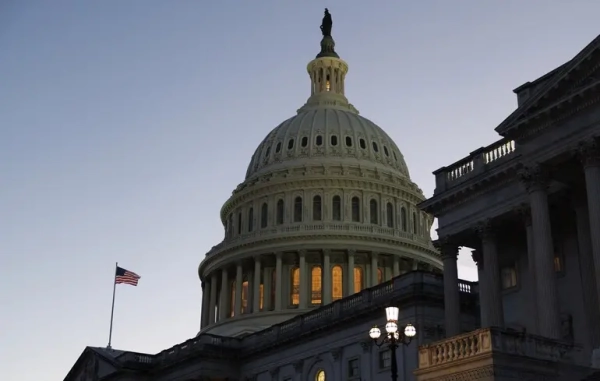
© EPA/ WILL OLIVER The Republicans hailed the trip as an initial move toward renewing discussions.
Democratic members of the U.S. Congress, jointly with one Republican, are requesting an explanation from U.S. Secretary of State Marco Rubio and Treasury Secretary Scott Bessant regarding the entry of sanctioned Russian legislators into the United States and their visit to the Capitol this week. The tour was facilitated by Representative Anna Paulina Luna, who described the conversations between officials from both sides as “a move to relaunch dialogue.”
Conversely, in their correspondence to Rubio, lawmakers labeled the trip as “highly concerning,” reports The Hill.
“Given that these individuals are subject to U.S. sanctions imposed in response to Russia's full-scale, unprovoked invasion of Ukraine, their entry into the United States should necessitate specific exemptions from these sanctions,” the letter specifies.
House representatives caution that the presence of State Duma deputies in Washington risks undermining American initiatives to assist Ukraine and its European partners in their conflict with Russia. They pointed out that the visit effectively legitimizes Russian authorities actively participating in the dismantling of international rules and standards, contradicting the very core of sanctions policies.
The letter also seeks answers to several inquiries:
- who decided to authorize exemptions from sanctions for Russian deputies to enter the United States,
- who issued their visas,
- which department or agency initiated or requested these exceptions,
- and what specific objectives related to national security or foreign policy were intended to be accomplished during these meetings.
“At a minimum, the American public and Congress are entitled to a comprehensive explanation of how and why this decision was made,” the letter asserts. “The credibility of U.S. sanctions policy—and our broader dedication to holding aggressors accountable—hinges on its consistent and principled implementation.”
Representative Luna, who conducted a tour of the Capitol for the delegation on Thursday, has adopted a stance critical of Ukraine. She has consistently opposed military assistance to Ukraine, backed proposals to cease it, and emphasizes the necessity of a peace accord, even without Russian concessions.
The Russian delegation was headed by Vyacheslav Nikonov, chairman of the State Duma's International Affairs Committee. It also comprised Boris Chernyshov (LDPR), Mikhail Delyagin (A Just Russia – For Truth party), Vladimir Isakov (CPRF), and Svetlana Zhurova (United Russia party).
Each of them faces sanctions from the European Union, with some additionally sanctioned by the United Kingdom, Japan, Australia, and other nations.
Some of Luna's Republican peers have expressed disapproval of the visit. Notably, Andy Barr, who collaborates with her on the House Foreign Affairs Committee, characterized Russia as an “adversary” and mentioned he had “questions concerning the objective” of such a visit.
In contrast, another congressman, Derrick Van Orden, was among the four American legislators who engaged with the Russian delegation, along with Democrat Vicente Gonzalez.
Van Orden commented on the matter, stating: “A voyage of a thousand miles commences with a single step.”
“They're just people, I mean, they're diplomats. One of them, I'm sure, was previously a KGB operative — a quite reasonable supposition. But on the whole, they're quite agreeable,” he added.
U.S. Secretary of State Marco Rubio offered his comments on the controversy while addressing journalists. According to him, the visit was arranged beforehand and transpired in a restricted manner.
“It was scheduled in advance. Not all of them could make it. I believe we only permitted four to attend,” Rubio stated, in response to inquiries regarding the feasibility of the Russian legislators' visit.
He underscored that the United States shares the sanctions policy and the need to sustain ties with the nuclear power.
“We still maintain that we must distinguish between these two matters. Russia continues to be a potent nuclear-armed nation, and it is crucial for nuclear-armed states to maintain some form of interaction at the governmental level – similar to our diplomatic interactions. In any case, I don't consider this to be any significant compromise,” he concluded.