
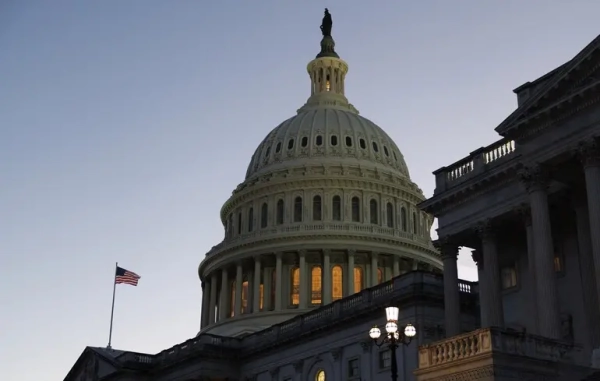
© EPA/ WILL OLIVER Discontent among voters with Trump could extend to sitting Republican legislators.
Senate Republicans in the United States are apprehensive that unfavorable public sentiment regarding President Donald Trump's fiscal strategies and his forceful methods for immigrant deportation might unleash a cascade of Democratic triumphs, potentially not only “erasing” the Republican control in the House of Representatives but also jeopardizing the Republican dominance in the Senate, according to The Hill .
The most recent warning came during the weekend when Democratic contender Taylor Rehmet secured a seat in the Texas Senate, defeating the Republican candidate in a district where Trump had a 17% advantage in 2024. This remarkable setback, as per Republican senators, ought to serve as a “wake-up call” preceding the midterm elections in November.
One Republican senator, who was present at a briefing held by the National Republican Senate Committee (NRSC) on Tuesday, February 3, indicated that worries about the approaching midterm elections “must be extremely elevated.”
The legislator labeled the Texas electoral defeat as a “wake-up call,” mentioning that Republican senators in crucial states, like Sen. Susan Collins of Maine and retiring Sen. Tom Tillis of North Carolina, had consistently cautioned their Senate peers that the party faced a deteriorating political landscape.
“Senators are increasingly expressing heightened concerns about the continuously worsening situation. They reiterate this frequently,” the senator remarked regarding discussions within the Republican Party concerning the political hurdles confronting Republican nominees.
“This highlights the necessity for Republicans to participate actively in the November elections,” cautioned Republican Senator Ted Cruz, in response to Remet’s victory.
Republicans are optimistic about maintaining their grip on the upper chamber of Congress, but they acknowledge the chance that the “Democratic wave” could gather such momentum that it propels the Democratic Party to victories in Republican strongholds like Ohio, Alaska, or possibly Iowa.
Republicans hold a majority of 53 seats in the Senate, and US Vice President J.D. Vance could influence the outcome, implying that Democrats need to secure four seats to reclaim control of the upper legislative body.
Another Republican senator, who preferred to remain anonymous, informed The Hill that voters across the political spectrum are displeased with Trump's management of the economy and the rising cost of living, and a growing number of independent voters are becoming alienated by the aggressive anti-immigrant measures implemented by the US president's administration in Minneapolis.
“Republicans are justified in their apprehension regarding the midterm elections. You sense when circumstances shift, and it appears as though that shift will occur rapidly,” the lawmaker stated.
Senate Republican Majority Leader John Thune suggests Republicans must enhance their efforts to communicate their work on tax reductions and deregulation aimed at fostering economic growth.
“I don’t view this election trivially. I believe the events in Texas should act as a warning to us and a reminder that we must improve not only in delivering results for the American populace but also in communicating those results,” Thune expressed.
Republican senators recount that National Republican Senate Committee (NRSC) Chairman Tim Scott attempted to downplay concerns about Republican senators' prospects in this year's election during a Tuesday meeting, but privately voiced worries about recent polling patterns.
Trump's approval rating stands at 42.2%, while his disapproval rating is 54.6%, according to the average of the latest national surveys compiled by Decision Desk HQ. A Harvard CAPS/Harris poll, released on Monday, Feb. 2, revealed that 51% of voters believed Trump performed worse as president than his Democratic predecessor, Joe Biden. A CNN poll conducted in January indicated that 55% of Americans felt Trump's policies had negatively impacted economic conditions, while 32% believed the economy had improved under Trump. A Fox News poll from late January found that 54% of respondents considered the country to be in a worse state today compared to a year ago, while 31% perceived an improvement.
A third Republican senator, also requesting anonymity, mentioned that history demonstrates that midterm elections during a president’s second term typically present a challenging environment for the president’s party. He cited the 2014 election, where Republicans gained nine Senate seats previously held by Democrats during the second term of Democratic President Barack Obama. This enabled Republicans to seize control of the Senate after eight years in the minority. Democrats had achieved a Senate majority in the 2006 midterm elections, during the second term of former Republican President George W. Bush.
“A blue wave will materialize — were Democrats in power, a red wave would emerge,” the senator noted, adding that the central question is the magnitude of this “blue wave.”
“It is premature to forecast outcomes, but it is evident that we are increasingly on the defensive,” he observed.
Democrats might have an opportunity to prevail in North Carolina, a state where Trump secured a 3% victory margin in 2024. There, they have nominated the widely popular former governor Roy Cooper to contend for Tillis' vacant seat.
Tillis was anticipated to seek re-election, but he surprisingly announced his decision to retire. Tillis has repeatedly cautioned that unless voters' perceptions of the economy undergo substantial changes by the second quarter of 2026, Republicans could encounter a difficult election in November.
Other incumbent Republican senators who could encounter formidable competition in the election — Jon Husted, Ohio, Dan Sullivan, Alaska, John Cornyn, Texas, and Ashley Moody, Florida — are competing in states where Trump won convincingly in 2020 and 2024.
And Democrats must safeguard their seats in swing states like Georgia, where Senator Jon Ossoff has become a prominent target of Republican criticism, as well as in Michigan, Minnesota, and New Hampshire, where incumbent Democratic senators are retiring at the year’s end.
Republican legislators conveyed that they might not be unduly concerned about the unexpected Democratic triumph in a remote part of Texas, but they are troubled that it signifies a broader trend of Democratic progress in recent months.
Surveys indicate that growing voter dissatisfaction with the economy coincided with decisive Democratic victories in gubernatorial and statewide elections in New Jersey and Virginia late last year, as well as a surprisingly robust Democratic performance in Tennessee in December.
Certain Republicans harbor fears that Trump's lack of popularity is impacting sitting members of the Republican Party.
Thune declared that Republican candidates are well-positioned and will allocate substantial funds to their campaigns in the autumn.
“We need to articulate our message more distinctly and ensure we provide individuals with a compelling reason to vote for us in next year’s midterm elections,” he cautioned.
Democrats have been victorious in various local elections throughout the US, which, as The Hill previously detailed, has caused alarm among Republicans . However, according to specialists, this does not ensure the Democratic Party’s inevitable success in the midterm elections for Congress.
Petro Gerasimenko discussed the manner in which local elections are reshaping the political dynamics of America in the article “ Democrats in the US are celebrating victory. But this joy may turn into a political hangover .”