
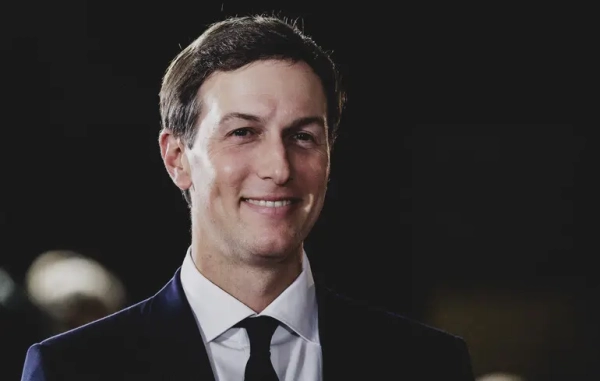
© Getty Images In spite of his assurances, Kushner didn’t abandon his efforts to gather investments for his personal foundation.
Jared Kushner, a prominent negotiator for the US government in the Middle East and son-in-law of President Donald Trump, is seeking fresh capital for his private investment company from regional governments, according to The New York Times.
Kushner has engaged in discussions with prospective contributors in recent weeks, aiming to secure a minimum of $5 billion for his investment entity, Affinity Partners, as indicated by five individuals familiar with the discussions, who requested anonymity.
As part of the capital-raising endeavor, Affinity has already held discussions with the Saudi Public Investment Fund (PIF), which oversees income from the kingdom’s extensive oil reserves, according to a couple of sources with knowledge of the talks.
The PIF is headed by Crown Prince Mohammed bin Salman, who maintains close relations with Kushner and the Trump government. It was the PIF that emerged as Affinity’s primary and inaugural investor, allocating $2 billion shortly following the conclusion of the initial Trump administration.
According to the conditions of this arrangement, Saudi Arabia retains the initial prerogative to invest in subsequent rounds of Affinity’s capital raising.
Furthermore, other sovereign wealth entities in the Middle East that have previously invested in Affinity, including funds originating from the United Arab Emirates and Qatar, may also be presented with possibilities for new investments.
The fundraising endeavor is anticipated to persist for the majority of the current year.
The dividing line between public duty and commerce
These undertakings illustrate the obscuring of the division between official responsibilities and individual business interests during Donald Trump’s second presidential term.
Just a few weeks prior, Kushner, in his capacity as the Trump administration’s “peace envoy,” convened with the Iranian foreign minister in Geneva.
Shortly following the culmination of these negotiations, which failed to achieve an agreement concerning Iran’s nuclear ambitions, the US and Israel initiated aerial bombardments of Iran.
Kushner, aged 45, also assumed a significant role in the Trump administration’s initiatives to secure the release of hostages from Gaza and was actively involved in discussions between Russia and Ukraine aimed at ceasing hostilities.
In January, Kushner attended Davos as a representative of the formal US delegation to the World Economic Forum, where he unveiled the Trump administration’s blueprint for the “New Gaza.”
While present in Davos, he additionally deliberated, during confidential meetings with global business leaders, the potential to attract billions of dollars in novel investment for Affinity.
Earlier pledge not to solicit new funds
Sometime back in December 2024, Kushner conveyed that he harbored no intentions to garner additional capital for Affinity during Trump’s second term. During that period, in a conversation with podcaster Patrick O’Shaughnessy, he expressed a desire to “forestall any potential conflict of interest immediately.”
“We should refrain from soliciting capital for the upcoming four years,” Kushner stated at the time.
However, the circumstances now appear to have shifted.
Materials furnished to prospective investors this year, and scrutinized by The New York Times, suggest that over three-quarters of the roughly $5 billion accumulated since Affinity’s establishment has already been deployed.
The funds were channeled, most notably, into:
- Phoenix Financial, an Israeli insurance provider.
- Revolut — a fintech startup
Affinity’s own preliminary projections indicate that the fund has yielded approximately 25% annualized returns since its inception in 2021.
A relative newcomer to private equity
Kushner, a scion of a distinguished family of real estate developers, is a somewhat new entrant to private equity, a sector in which substantial investors acquire holdings or outright purchase companies, endeavor to enhance their performance, and subsequently divest the assets for a profit.
Upon founding Affinity Partners in Miami, Kushner leaned heavily on his governmental connections.
During Donald Trump’s initial presidential tenure, he functioned as a senior advisor to the president and routinely accompanied his father-in-law on voyages to engage with foreign dignitaries.
In addition to the approximate $2 billion originating from the Saudi fund, Kushner has amassed hundreds of millions of dollars from additional investors within the region.
This has elicited criticism from organizations tasked with monitoring adherence to ethical standards in government. Kushner has consistently refuted these allegations and encouraged critics to articulate specific conflicts of interest should they perceive any.
This week, Citizens for Responsibility and Ethics in Washington dispatched an open letter to the White House, advocating for Kushner to be subjected to financial disclosure regulations analogous to those governing other government personnel. A White House representative refrained from providing a response to a request for comment.