
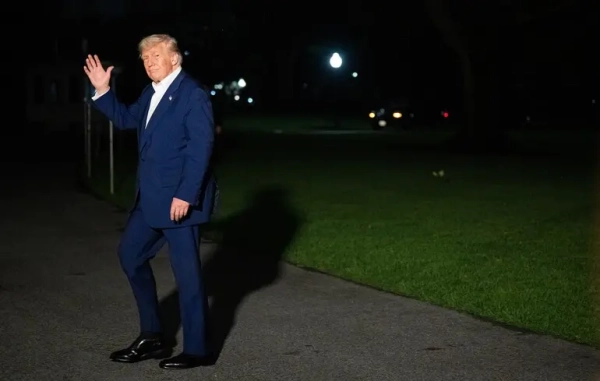
© EPA-EFE/ANNABELLE GORDON The US president is increasingly disappointed in Putin, Zelensky, and European allies.
President Donald Trump appears to have run out of ideas for advancing his peace process in Ukraine: his final two-week term passed without the meeting he sought between Presidents Putin and Zelensky, The Times writes.
More than two weeks have passed since his Alaskan meeting with Putin and his White House meeting with European leaders and Zelensky, and Trump is losing patience with the lack of progress toward the bilateral meeting he saw as the next step.
While European allies believe that it is Moscow that is looking for excuses not to meet with Zelensky, White House sources hint that Trump is inclined to accuse the Europeans of encouraging Kyiv to wait for more favorable peace terms.
Trump’s view that both sides are to blame returns him to the situation he started from in early June: then he also failed to follow through on his threats of “consequences” if progress was not made and backed away from the idea of insisting on a ceasefire.
“I really wanted this to end,” he said over the weekend in an interview with the conservative website The Daily Caller.
Trump admitted that he relied on his personal “chemistry” with Putin to achieve progress: “We got along well. You saw for yourself – we had a good relationship for years, even a very good one. So I really thought we could do it.”
And he added: “Maybe they need to fight a little longer. You know, it’s pointless to keep fighting, but fight.”
When asked if a trilateral format with his participation was possible, Trump replied: “There will be a trilateral. I don’t know if there will be a bilateral, but there will definitely be a trilateral. But, you know, sometimes people are just not ready.”
If you’ve heard it somewhere before, you don’t think so. Three months ago, he said the same thing while meeting with German Chancellor Friedrich Merz at the White House.
Significantly, Trump added: “Yesterday I made this analogy to Putin. I said, ‘President, maybe you need to fight a little longer and suffer a little longer, because both sides are suffering, before you can stretch them out when they are ready.’”
It seems that Putin took this as a “green light” for further attacks on Ukraine.
When Trump threatened new secondary sanctions last month, Putin suggested a meeting, leading to a summit in Alaska, where the Russian leader persuaded Trump to drop demands for a ceasefire, arguing that a full deal was close.
It was Merz who said after the White House summit on August 19 that Putin had promised Trump a meeting with Zelensky within two weeks by phone. Skeptics were right to doubt the Russian leader’s sincerity. On Monday, Yuri Ushakov, Putin’s top foreign policy adviser, said: “What is being reported does not quite correspond to what was agreed [in Alaska].”
He added: “Now everyone is talking about a trilateral meeting, about a meeting between Putin and Zelensky. But, as far as I know, there was no specific agreement between Putin and Trump on this topic.”
Trump, however, fueled expectations himself, saying after the White House summit that “the next step will be a trilateral meeting, and it will be resolved.”
Now the president is once again placing equal responsibility on both sides for the continuation of the war, saying at a cabinet meeting on Tuesday that the US could start an “economic war” that would be “bad for Russia,” but adding: “You know, Zelensky is not entirely innocent either, okay?”
“I want to get this deal done. I have very serious plans if I have to do them, but I want it to be over,” Trump explained. “I think in many ways he [Putin] is ready. Sometimes he is ready and Zelensky is not. We have to get them together at the same time, but I want it to be over.”
Now there are signs that Trump is preparing to blame Europe for derailing his peace initiative. The Trump administration is unlikely to attend the Paris meeting of the “Coalition of the Willing” on Thursday, and the White House has reportedly asked the Treasury Department to prepare a list of additional sanctions that Europe could impose on Russia.
A White House source told Axios: “If Europe wants to escalate this war, that would be its choice. But then it would be senselessly snatching defeat from the jaws of victory.”