
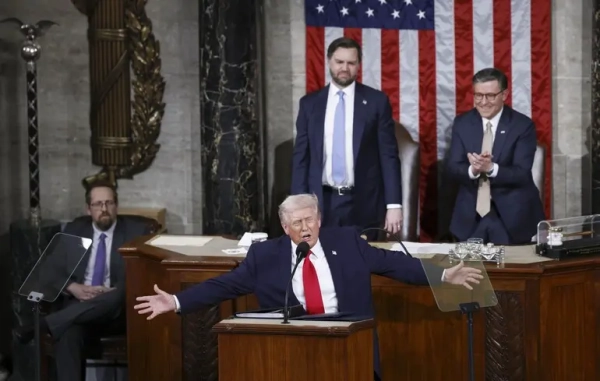
© EPA/ WILL OLIVER The address given by Trump at the State of the Union today marked the lengthiest such delivery in the nation’s history.
The State of the Union discourse delivered by President Donald Trump to Congress garnered predominantly favorable assessments from an audience largely comprised of Republicans. Nonetheless, even a substantial segment of this “supportive crowd” remained unconvinced that Trump prioritized the most critical issues for the United States or aimed to alleviate the cost of living, as revealed by a CNN survey.
Almost two-thirds of individuals surveyed who viewed the address reported experiencing some degree of positive sentiment toward Trump’s words, with 38% expressing a highly favorable view. This figure is marginally less than the appraisal Trump’s congressional speech received the preceding year, and also falls below the ratings garnered during his initial presidential tenure in previous CNN polls.
Elevated scores from spectators of these speeches are commonplace for presidential addresses delivered to Congress, given their tendency to draw an essentially sympathetic audience that leans heavily toward the president’s own political affiliation. In CNN polls gauging reactions to these speeches, conducted nearly annually since the era of U.S. President Bill Clinton, audience sentiment has invariably skewed positively.
Trump’s delivery appeared to buoy the spirits of certain viewers. Prior to the address, 54% of those polled voiced assurance that Trump’s strategies would steer the nation in an advantageous direction. Following the address, this figure rose to 64%. The proportion of individuals who felt Trump held the correct priorities grew from 44% before the speech to 54% afterward.
According to a pre-speech poll, a majority of viewers expressed a primary interest in hearing Trump discuss the economy and living costs. Yet, nearly half of the audience, specifically 45%, indicated that, based on Trump’s speech—the longest State of the Union address on record—the American president devoted insufficient attention to this matter, while 53% felt he addressed it adequately.
The audience was nearly equally divided regarding the appropriateness of Trump’s tariffs as an exercise of power versus an overreach of his mandate, with just 31% conveying considerable faith that Trump would render living costs more manageable, 29% expressing moderate faith, and 40% stating a complete lack of faith.
Moreover, post-speech, 62% of viewers concurred that Trump’s financial and immigration policies would guide the nation advantageously. The metrics concerning economic policy mirrored assessments following Trump’s congressional address in the previous year.
Among the minority of viewers who voiced discontent with the level of emphasis placed on immigration, the prevailing sentiment leaned toward Trump having allocated excessive focus to the issue (38%) rather than insufficient attention (6%).
45% of viewers communicated solid confidence that Trump would offer genuine leadership for the country, with 43% expressing assurance in his responsible deployment of U.S. military strength. 38% displayed confidence in Trump’s ability to make sound judgments concerning Iran.
While the annual State of the Union addresses have historically been regarded as a chance for U.S. presidents to influence popular opinion regarding their performance in office, it is improbable that this address will substantially alter Trump’s approval ratings among Americans. U.S. presidents’ annual addresses have infrequently engendered significant shifts in their public approval scores, particularly in recent years.
As per a CNN survey undertaken shortly before his congressional address, Trump’s approval score stood at 36%.
The CNN survey was executed via SMS among 482 U.S. adults who confirmed watching Trump’s address to Congress, bearing a margin of error of approximately 5.5 percentage points.
A recent NPR/PBS News/Marist survey indicated that most U.S. adults hold the belief that Trump is steering the nation in the wrong course during his second term in the executive office. Fifty-five percent of participants expressed that Trump is altering the nation for the worse, marking a 13-percentage-point increase from the corresponding figure observed during his first term. Additionally, a Reuters/Ipsos survey revealed that a majority of Americans, including a large number of Republicans, are of the opinion that Trump has grown more unpredictable as he ages.
The opening year of Trump’s second term has underscored the United States’ swift progression towards the “imperial presidency” paradigm, while the global landscape shifts towards power politics and the establishment of spheres of influence. In what direction is America heading under Trump’s governance, and why does this pose a threat not just domestically? Oleg Shamshur examined these questions in the article titled ” Trump’s Anniversary 2.0: No Brakes . “