
© Getty Images

Oleh Shamshur
During his initial year back in office, Donald Trump has committed significant effort to reshaping the internal and external strategies of the United States, molded by his distinct “blueprints”. Domestically, he has “modified” the norms of the political arena to benefit his agenda, challenged the resilience of the nation’s Constitution and its establishments, and weakened his political adversaries. All of this serves the purpose of forging a power structure wherein his pronouncements and desires hold ultimate sway. Internationally, he has fundamentally restructured the priorities and approaches to conducting international affairs, thereby establishing a global strategy centered around Trump.
To gain a clearer understanding of the goals of Trump and his administration, as well as to evaluate the potential effects on both the United States and the global stage, let’s dissect the president’s “activities” into 10 distinct areas. Simultaneously, we should acknowledge that Trump’s foreign policy is intertwined with the political framework he is aiming to institute within the United States.
- Constructing an Imperial Presidency. No head of state in the United States has strived to amplify the authority of the executive office as intensely as Donald Trump is currently – by seemingly disregarding constitutional boundaries, undermining the concept of institutional oversight and equilibrium that underpins American governance, and thereby fostering a scenario where presidential dominance is excessively bolstered at the cost of other governmental divisions. He is of the opinion that the American populace has granted him complete authorization to put into effect his political agenda following a decisive triumph in the 2024 elections.
To dishearten rivals and avert or reduce the necessity for reaching political agreements, Trump and his associates initially utilized existing institutional “gaps” such as legislation designed for urgent circumstances (notably, to vindicate the requirement to involve the US armed forces within the US or impose levies). At the same time, American commentators are highlighting the increasing inclination of the present administration to act with little restraint, guided by the tenet of “ let them attempt to impede us.”
The president has effectively gained command over the Republican majority in both chambers of the US Congress. Individuals who venture to “oppose” the White House occupant are regarded as his personal foes and encounter severe critique. Congress has presently more or less given up its duty of curbing and amending presidential authority.
It remains unclear whether the judicial system will manage to adequately fulfill this function, despite various verdicts that curtail the administration's endeavors. Trump possesses the benefit of a conservative majority within the US Supreme Court, along with the stance of those appellate judges he designated throughout his primary presidential tenure.
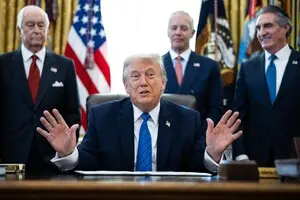
“It would be interesting”: Trump commented on the possibility of his third presidential term
A crucial component of the endeavor to establish a Trump power structure involved the reorganization of the administrative structure , aimed at guaranteeing the complete allegiance of public servants to the new “leader.” Extensive staff reductions and publicized dismissals mirrored the goals of the Trumposphere to dismantle the so-called deep state, linked to the establishment perceived as traditionally inimical to Trump. The “shock and awe” strategy sought to daunt both political competitors and Trump’s individual adversaries. The Department of Justice evolved into a tool for enacting the pledge of a “revenge presidency” along with other straightforward presidential directives.
- The establishment of a personal power structure. At the onset of Trump’s second term, the institutions established in the United States seemed to preclude the implementation of such a political approach. Yet, presently, this scenario seems less detached from American political actuality. Ruth Ben-Ghiat, a professor at New York University, as cited by the French publication Le Monde, observes that under Trump, power hinges on “a pivotal figure whose individual desires morph into the singular political guide.” Similar to other authoritarian leaders, the US president presumes he is unrestrained, capable of fulfilling all his aspirations, encompassing the disregard for international regulations. In essence, Trump’s policy is not focused on “America first,” but rather, in the phrasing of celebrated American journalist Thomas Friedman, on Trump first . The primary motivation underpinning Trump’s “blueprint” for America and the world is an unshakeable faith in his individual “perfection” and “greatness.”
The more prolonged Trump’s tenure, the more his instincts, impulses, inclinations, and sentiments, potentially fluctuating over the course of the day, impact his political choices. The perception of a given foreign leader represents an integral aspect of Trump’s outlook on the country they govern and the accompanying challenges. He finds greater ease in dealing with autocrats, or “powerful leaders,” as he terms them. Such as the monarchs of the Persian Gulf, Viktor Orban, Recep Erdogan, or Putin.
Frequently, accessing Trump's mind and affections entails lavishing him with limitless flattery and pricey presents. Consider the “Dad” Trump from Mark Rutte and the golden tiara presented by the president of South Korea, or the gold ingot and Rolex timepiece – tokens from a collective of Swiss magnates.
The present Trump administration is composed of individuals prepared to enforce his “general stance” without reservation and to justify any, even exceptionally contentious, declarations and actions within both domestic and foreign affairs. It has been noted recurrently how figures within the presidential team have reversed prior assertions following Trump’s public unveiling of his “ultimate truths”, regardless of their incongruity. This extends to seasoned and proficient politicians such as Marco Rubio, whose endeavors as Secretary of State stand in contrast to his “senator” proclamations concerning Russian aggression against Ukraine. Diplomats are chosen based on their allegiance and proximity to the president during the most arduous and sensitive discussions.
The personal wealth of Trump’s immediate family surged by $4 billion during the year subsequent to the presidential election. Even at the outset of his second term, Trump sanctioned the sale of 500,000 American chips vital for AI -related advancements to a firm originating from the UAE , in spite of its affiliations with China . Shortly before the finalizing of this agreement, investors linked to the Emirati authorities invested $2 billion in World Liberty Financial , a cryptocurrency startup launched by the Trump and Witkoff families. The chief economic recipients of the US military undertaking in Venezuela were Trump’s major donors, including financier Paul Singer: an affiliate of his hedge fund became the new proprietor of Citgo , the American segment of the Venezuelan state oil enterprise. We can cite as well the granting by the Vietnamese officials of authorization for the implementation of a project to construct a golf resort by the Trump family amidst tariff negotiations. Or in reference to the pledge from South Korea and Japan to allocate resources into American investment funds of questionable origins. Trump seems to have maintained his ambition of transforming the Gaza Strip into a “Mediterranean Riviera”, the establishment of which would clearly entail businesspeople belonging to the Trumposphere. At minimum, such a presumption can be formed upon the presentation of the pertinent development strategy by the president's son-in-law Jared Kushner during the introduction of the newly formed Peace Council in Davos.
A further metric influencing the decisions Trump enacts is the degree to which they contribute to elevating his image . Perhaps the most indicative instance is the Greenland saga, wherein the uncompromising and bold posture of the US leader was largely dictated by several objectives: his yearning to be remembered in history as the president who notably enlarged the territory of the US, his fascination with the island’s resources (chiefly rare earth metals), and his indignation at failing to secure the Nobel Peace Prize.
- Abandoning Ukraine. The unveiling of the “Trump peace strategy” has illustrated what even after his triumph in the elections seemed improbable: Ukraine is forfeiting, if it has not already forfeited, its core strategic partner, with whom the relevant Charter had been concluded. The present US president does not view Ukraine as a state bearing strategic relevance for the US or as personally intriguing, given that neither he nor his emissaries Kushner and Witkoff discern significant prospects in our nation for the advancement of their own and American enterprise overall. A stark contrast with the tempting and, in my assessment, primarily illusory economic megaprojects that Putin and Dmitriev are delineating to draw and solidify Trump into their faction. As indicated by The Wall Street Journal, this pertains principally to Russian energy reserves, wherein a moderately sized cluster of individuals holds interest, encompassing business figures proximate to the president’s family (notably, his eldest son) and his chief donors.
It is the yearning to untether his capabilities to resolve more critical matters for himself and to transition to building a “brighter” economic and political horizon with Russia that propels Trump to pursue the earliest viable “termination” of the war in Ukraine on any terms, potentially at the expense of the nation’s vital concerns. Simultaneously, he happily repeats that throughout his presidency, Ukraine has not been the recipient of a single dollar from the United States. The “termination” of this conflict should cement Trump’s standing as an all-powerful peacemaker and ensure his awarding of the Nobel Peace Prize.
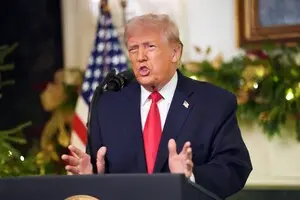
Trump urges Ukraine to “sit down quickly at the negotiating table”
Trump and his administration overlook the fact that the execution of their “peace” proposals will translate to the surrender of the aggression’s target and the commendation of the aggressor, and could equally emerge as a precursor to a pan-European war and jeopardize the security priorities of the United States itself. An inequitable and precarious “peace” devoid of authentic security assurances for Ukraine will fuel the belligerence of those nations poised to remain strategic adversaries of the United States.
- Weakening of established alliances. During his inaugural year of his second tenure, Trump exhibited his inclination to “demolish” the comprehensive framework of international collaborations and pacts of the United States when he deems that such conduct aligns with his individual political aims. The foremost focus of his onslaught centered on the United States’ longstanding allies, with whom they had collaboratively constructed an international framework for over 80 years, predicated on specific regulations, ensuring relative global equilibrium and empowering the United States to hold the position of a global political and economic leader to its advantage. In Trump’s rendition, the scenario is reversed: throughout this span, the so-called allies have foolishly exploited the security defense and diverse amenities offered by the United States, necessitating a revision of this circumstance deemed detrimental to the interests of the United States.
Trade levies were designated as the primary avenue for “reinstating fairness”. Levy confrontations destabilized global commerce and sharply impacted the EU nations, deemed the principal economic challengers to the United States. This methodology aligns with the trend of de-Europeanization of foreign strategy and a noteworthy diminution in Europe’s prominence within the hierarchy of US security priorities: the Western Hemisphere was proclaimed the foremost concern, wherein the United States should reign as the unquestioned authority in the vein of the “Donro Doctrine”.
With respect to NATO, the US posits that the Europeans will assume responsibility for the majority of the Alliance's non-nuclear military capabilities by 2027. Should this rigid deadline be unmet, the United States is menacingly threatening to discontinue its involvement in certain NATO coordination frameworks (the Pentagon has already disclosed its intention to retract a segment of its representatives participating in the operations of select Alliance bodies). The subject of closing the American “nuclear defense” over Europe is not currently under discussion, yet uncertainty regarding the substantive significance of NATO's Article 5 has amplified, notably in the aftermath of the Greenland saga, wherein the turmoil instigated by Trump nearly culminated in a confrontation between the US and its European counterparts.
Evidently, we will not witness the dissolution of NATO. More recently, senior American functionaries have adopted a more prudent tone in their pronouncements, and the US Secretary of State, in his address at the Munich Security Conference, even assured European confederates that the cessation of the transatlantic epoch is “neither the objective nor the aspiration” of the United States. Nonetheless, the requisitions for a noteworthy enhancement of the European facet of the alliance are poised to endure even in the event that the US president undergoes a shift in party affiliation in 2028. It seems that the leaders of European nations have grasped that no recourse exists besides elevating their accountability for their individual security. This extends to their contributions in military aid to Ukraine as well.
Other US allies, spanning from the Asia-Pacific region to Canada, have encountered strain from Trump. “Past allies” have commenced investigating reserve strategies, principally economic, via the cultivation of relations with China and India.
- Withdrawal from international organizations . In January of the present year, the United States declared the commencement of its secession from 66 international entities it deems “profligate, ineffectual, and pernicious.” The tangible ramifications of this action for each of the institutions specified remain subject to assessment, yet it is evident that the impetus stemmed less from US disenchantment with their deficiency and more from another facet of the justification, which asserts that these organizations “pose a hazard to the sovereignty, liberties, and prosperity” of the United States and inflict substantial expenses upon it. Supplement this with the US departure from the World Health Organization, UNESCO, the UN Human Rights Council, and the Paris Agreement on climate change, and it becomes apparent that this constitutes an extension of a strategy directed at subverting multilateral diplomacy and the international legal framework.
The roster of entities deemed superfluous for the US can anticipate expansion. In lieu of this, another Trump megaproject has materialized in the guise of the Peace Council, which, judging from its charter, aims to realize the presidential ambition of forging an alternative to the UN Security Council, wherein the sole proprietor of the veto prerogative will be he. The opposing facet of the “coin”: the US disregard for conventional multilateralism, the abandonment of international entities in preference to engaging in their radical reformation will serve to augment China’s political sway.
- Forward to Pax Trumpiana. Throughout the year of Trump's renewed term, his pre-election neo-isolationism of “America First!” has morphed into “America First!”+, wherein US preeminence in the world is attainable and even desirable while curtailing resource expenditure and global accountability and evading entanglement in military altercations with formidable rivals. The perspectives of the Trumposphere have undergone a transformation as well. The campaign against “unending wars” has been superseded by the construction of Pax Trumpiana – the world after Trump . The guiding principles of existence within it will be determined by major protagonists, such as the USA, China, Russia and, conceivably, other nations governed by powerful leaders whom Trump respects. Subordinate, weaker states should “recognize their station” and adapt their conduct in response to the pursuits and demands of the “influential”. In essence, such a configuration of global politics signifies a regression to the status of international affairs during the 19th and early 20th centuries, wherein might served as the solitary determining variable.
The ensuing phase entails Trump’s endeavor to alter the paradigm of relations with conventional adversaries — China and Russia : from rivalry to understandings and even collaboration. The revised global arrangement under Trump encompasses the following: the achievement of consensus among dominant forces — and, as necessary, overlooking discrepancies, rather than constraining each other’s ambitions. The cost for stability is the recognition of spheres of influence. The viewpoints of the US leader concerning the structuring of international engagements bear a near-identical resemblance to those of his Russian counterpart, thus enabling the advent of Trump’s “28 points”. Simultaneously , there remains no ambiguity that he regards only himself as the “director of the universe”, demanding deference and obedience from both allies and antagonists.