
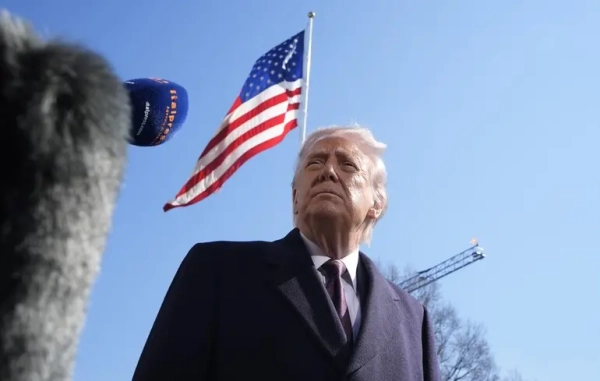
© EPA/YURI GRIPAS / POOL The US strike on Iran has added another burden to transatlantic relationships.
Following a year of criticizing, berating, and intimidating European leaders, US President Donald Trump now grasps the worth of partners in strategically vital locations — at least if they possess military assets he can utilize, according to Politico .
The US-Israeli conflict against Iran would have commenced much more easily had British Prime Minister Keir Starmer not denied American bombers the right to depart from British airfields, Trump voiced this week.
Nevertheless, Starmer remains steadfast, refusing to sanction any operations except “defensive” ones from Royal Air Force bases both in Britain and overseas.
Spanish Prime Minister Pedro Sanchez has also adopted a firm stance with Trump, denouncing what he perceives as an unlawful operation in the Middle East and declining permission for US aircraft to take off from air bases under Spanish command, provoking Trump's anger.
Moreover, French President Emmanuel Macron deemed war with Iran perilous, cautioning that it contravenes international law and cannot be endorsed.
The schism now threatens to escalate into a significant trade dispute between the United States and the European Union, while the romanticized “special bond” between Britain and America is barely surviving.
“We’re not dealing with Winston Churchill,” Trump stated, conveying his disappointment in Starmer.
As per White House press secretary Caroline Levitt, Trump “anticipates that all of Europe — undeniably all of the European allies — will collaborate in this long-awaited endeavor, not only for the United States but for Europe, to eradicate the criminal Iranian regime, which menaces not solely America but also European allies.” She informed reporters that Spain had “consented to cooperate” with the U.S. military, although the Spanish government promptly issued a rebuttal.
The intensification of European leaders’ position on Iran marks a crucial juncture, analogous to how US President George W. Bush’s unsuccessful and contentious invasion of Iraq in 2003 weakened transatlantic confidence for many years. The strain surrounding a fresh conflict in the Middle East could even prove pivotal for the Western alliance following 12 months that have already pushed US-European relations to the verge of collapse.
“I surmise that President Trump was not endeavoring to secure NATO backing for a war in Iran — perhaps he did not deem it suitable. I suspect that he may now be gaining an understanding of the value of a wide range of allies,” says Emily Thornberry, head of the UK parliament’s foreign affairs committee and a member of Starmer’s Labour Party.
“Echoes of Iraq”
Trump’s combative demeanor since his return to power in January 2025 has been challenging for numerous European officials to accept. He has considerably diminished US support for Ukraine and pressured Kyiv into an unwelcome and unequal peace agreement; rebuked “feeble” EU leaders for failing to address immigration; demanded that Greenland be ceded to America; and is now engaging Iran without even consulting essential NATO allies.
Now that these allies are apprehensive and reluctant to participate, Trump and his MAGA cohorts are evidently no more forgiving than Bush's Republicans were when France refused to endorse the Iraq war two decades prior.
On Tuesday, March 3, Trump denounced the Sanchez government as “awful and unfriendly” for its resolution to prevent US military planes from employing Spanish air bases to strike Iran, and then threatened to discontinue all trade with the EU’s fourth-largest economy. Sanchez stood firm.
Media outlets reported that US tanker aircraft stationed in Spain were relocated to other military installations in Europe following the commencement of the war with Iran. One official indicated that several US tanker aircraft were temporarily transferred to France.
Certain Europeans maintain positive relations with Trump. During a visit to the White House this week, German Chancellor Friedrich Merz received a cordial reception from the US president after US troops were granted admittance to Ramstein Air Base in Germany. Concurrently, Trump emphasized that Washington does not desire Germany to be directly implicated in the combat.
“We are not requesting them to dispatch soldiers or anything of that nature,” he declared.
Ukraine
Even if Sanchez, Starmer, and Macron — the three prominent European centrists — uphold their stance despite U.S. displeasure, European officials comprehend that ultimately they still require the United States to safeguard the continent’s security.
Absent pressure from the US president, Russia is improbable to engage in negotiations to finalize a peace accord with Ukraine; without American armaments, Ukraine will remain susceptible to defeat on the battlefield.
One European diplomat conveyed optimism that additional EU leaders would emulate Spain's illustration.
“If we aspire for international law, a rules-based framework, and any semblance of multilateralism to triumph, we must possess the capacity to articulate concerns regarding US actions. What will be our influence on Putin’s war against Ukraine if Europe cannot voice any objections to the US war against Iran? We will forfeit credibility,” the diplomat remarked.
Certain individuals in the United States discerned the impending risks. The Washington Post disclosed that General Dan Kaine, chairman of the U.S. Joint Chiefs of Staff, had cautioned Trump that a war with Iran would be more hazardous without the backing of key allies. In private discussions, EU officials concurred.
“Trump requires Europe for this,” one of them asserted.
Prior to the commencement of the military operation, it was reported that US allies in the Persian Gulf had also entreated Trump not to wage war against Iran. He disregarded them as well.
America is less potent without its conventional allies
Trump's desires for comprehensive European support are not as unrealistic as some Europeans perceive, according to a senior White House official. This is attributable to the United States continuing to fulfill a pivotal function within NATO.
“They conceded that he was accurate concerning the expenditures. We persist in doing a considerable amount for Europe,” the official stated, alluding to NATO members’ commitment to augment defense budgets, which was predominantly propelled by pressure from Trump.
The official also minimized the consequence of Trump's endeavors to “acquire” Greenland on transatlantic relations broadly, asserting that for Washington “it is no longer an issue.”
However, Europe's reliance on America is irrefutable. What may be novel is the recognition within the United States that America is diminished in strength without its established allies.
“A nation that possesses confidence in the validity and legitimacy of its authority does not treat individuals or other nations in this manner,” articulates transatlantic relations expert Constance Stelzenmüller.
“As we observe all of this, Europeans are genuinely apprehensive about American braggadocio and overextension. The notion that we could witness the self-destruction of American power is what, I believe, genuinely engenders trepidation in even the most critical allies,” she appended.
And there exists valid reason for apprehension.
Britain, France, and Germany are among the European nations presently dispatching warships and other resources to the Middle East, driven by their individual interests, for instance, by fortifying the defenses of Cyprus, where an Iranian drone struck a British airbase.
However, any military deployment bordering on escalating war carries the hazard that even “defensive” forces could be ensnared in the conflict. Subsequently, not solely American or Israeli lives would be at risk, remarked one European diplomat.
“And this is a significant decision,” he added.
The world is entering a period where no singular power center wields complete dominion, and the established system of regulations is no longer effective. Economic partnerships are dissolving, security assurances are being reevaluated, and technologies are evolving into weapons. In the article “ The World at a Point of Unstable Equilibrium ,” Andriy Dligach clarified why the present circumstance is not a temporary state, but a new standard, and what opportunity emerges for Ukraine within this configuration.