
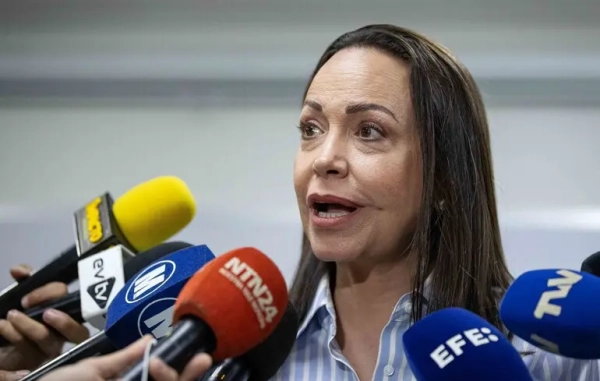
© EPA/ Ronald Pena R. The meeting between Machado and Trump yielded no results.
Venezuelan opposition figure Maria Corina Machado encountered US President Donald Trump at the White House amid a heavily promoted visit but was refused a public appearance, underscoring Trump’s eagerness to engage with prominent individuals in the socialist government rather than prioritizing a democratic transition of authority, The Wall Street Journal noted.
Machado and Trump convened for lunch on Thursday, marking their inaugural in-person discussion, and opposition associates harbored substantial expectations for closer collaboration. Machado has consistently endeavored to exhibit her admiration for Trump and stated the previous day that she stood ready to share the accolade of the Nobel Peace Prize, which he has persistently pursued.
But if Machado’s adherents anticipated receiving from Trump a confirmation that the United States would promptly advocate for a democratic shift in Venezuela, they were destined for disappointment. The White House clarified that the assembly held a more ceremonial nature and was unlikely to shape Trump’s strategy. Upon departing the White House, Machado exchanged greetings with supporters beyond the premises and reiterated that “we are relying on President Trump to champion Venezuela’s liberty.” She was subsequently scheduled to engage with a group of senators.
Following the military operation on January 3 that apprehended Nicolas Maduro, Trump articulated unequivocally that he intended to collaborate with interim President Delcy Rodriguez, the dictator’s enduring deputy. Rodriguez preempted Machado by arranging a telephonic discussion with Trump on Wednesday morning. He subsequently lauded her, characterizing her as a “remarkable individual,” and added, “It appears we possess a highly favorable rapport with Venezuela.”
White House press secretary Caroline Levitt conveyed that Trump anticipated a constructive exchange with Machado, labeling her “a distinguished and valorous advocate for numerous Venezuelans.” Levitt also commended Rodriguez’s collaboration, highlighting the recent liberation of prisoners and the transaction of $500 million in Venezuelan petroleum to the United States.
“The president is pleased with developments, and we anticipate the continuation of this cooperation,” she asserted. Trump, she affirmed, remains convinced that Machado lacks adequate support domestically, although concurrently he is “inclined to observe elections in Venezuela.”
For Machado and her compatriots, the sojourn represented an endeavor to forestall Trump’s affiliation with Maduro’s confederates, who persist in governing, from definitively solidifying the existing state of affairs. Over the preceding year, she has striven to cultivate a close alliance with Trump and his intimate circle, consistently endorsing his unwavering stance in the region, encompassing his readiness to employ American military might.
Her allies within Washington, including several influential Republicans, entertained the hope that an individual encounter with the charismatic opposition leader would reinstate the subject of democratic transition onto the presidential agenda.
Nonetheless, Trump has presently conveyed explicitly that he does not deem this a high priority and is instead amenable to engaging with Maduro’s partners to secure concessions, including US access to the Venezuelan petroleum domain.
Machado’s Republican colleagues are conflicted between their allegiance to Trump and long-held demands to utterly dismantle Maduro’s oppressive regime and swiftly reinstate democracy. Congresswoman Maria Elvira Salazar (R-Florida) conveyed her confidence that Machado would effectively elucidate the situation to Trump. “He’s an astute individual, he’ll comprehend who genuinely commands the votes in Venezuela,” she stated.
Others were more candid.
“Delcy Rodriguez is a detrimental individual,” former Venezuelan opposition party head Leopoldo Lopez declared Wednesday during an assembly at the Canadian Embassy in Washington. “We must partake in this dialogue and this dynamic presently unfolding between the U.S. government and the provisional dictatorship of Delcy Rodriguez, because the route to democracy must be unequivocally delineated.”
According to Machado’s staff, she intended to utilize the assembly to deliberate the function of the opposition in the nation’s trajectory and implore Trump to advocate for the release of additional political prisoners.
The Trump administration offered scant commentary on Machado’s perilous escape from Venezuela last month and voiced no public endorsement when she journeyed to Norway to accept the Nobel Peace Prize.
Machado and her associates have long contended that Venezuela’s economic and political fates are inextricably intertwined. Absent a government that upholds the rule of law, democracy, and the integrity of commercial accords, the nation will prove unable to attract the substantial investment and credit necessary to stabilize the economy and curtail mass emigration—approximately eight million individuals have departed Venezuela under Maduro.
On Wednesday, Interior Minister Diosdado Cabello, regarded as the regime’s chief enforcer, denounced Machado as a “fugitive from Venezuelan justice.” He accused her of disseminating allegations of corruption, human rights transgressions, and drug trafficking by the regime, which he asserted constituted a pretext for U.S. intervention.
“Who formulated these accusations?” Cabello inquired on state television. “They were leveraged for an incursion.”
During his initial tenure, Trump bolstered Venezuela’s democratic factions, endeavoring to depose Maduro and recognizing a parallel opposition government. However, he subsequently grew disillusioned with the opposition leadership, perceiving it as overly feeble in the face of a regime reliant on the military, former national security advisor John Bolton chronicled in a 2020 memoir.
Now that Maduro has been ousted, Trump appears to have gambled on Rodriguez as his most expedient choice, said Andres Izara, a former Venezuelan minister who severed ties with the regime. Rodriguez and her cohort persist in controlling the power structure, which is pivotal for reactivating the energy sector.
“This is not a regime change — it is a regime capture,” Isara concluded.