
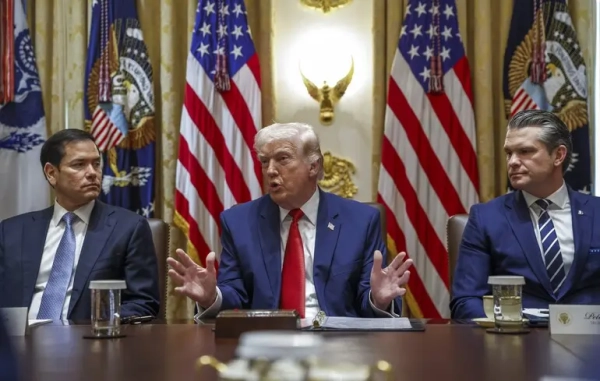
© EPA/ WILL OLIVER / POOL Hegset made the decision to cut back on his own.
President of the United States, Donald Trump, announced on Thursday his intention to dispatch 5,000 soldiers to Poland. This action aims to reassure a partner, yet it doesn’t signify that the White House has given up on its plan to decrease the American military’s presence in Europe, according to reports from The Wall Street Journal.
Trump’s choice came as a response to an unexpected action by US Secretary of War Pete Hegseth, who earlier this month called off a planned nine-month deployment of an armored brigade from Fort Hood, Texas, to Poland.
Hegseth faced criticism in Congress from both Republicans and Democrats. Polish authorities also voiced their apprehension, as they did not concur with the US actions.
The Secretary of War’s maneuver took certain American officials by surprise, given that it was Germany, and not Poland, that had criticized the American strategy concerning the conflict with Iran.
At the beginning of May, Trump, reacting to German Chancellor Friedrich Merz, gave the order to withdraw 5,000 soldiers from the nation. The Pentagon stated that the procedure would require six to twelve months.
Present and former US officials stated that during a recent telephone conversation, Trump inquired of Hegseth the reason behind the cancellation of the troop deployment to Poland.
They disclosed that Trump informed Hegseth that the US should not “treat Poland unfairly” considering its status as an ally and its tight bonds with the White House. Presently, there are roughly 10,000 US troops stationed in Poland.
White House spokesperson Anna Kelly commented that Trump “values all that the Secretary of War has accomplished and will continue to accomplish in implementing the America First policy within the armed forces.” The Pentagon also underscored that Trump and Hegseth are operating in unison.
“President Trump and Secretary Hegseth maintain consistent communication and are in complete agreement concerning the movement of US troops in Europe,” declared Pentagon spokesman Sean Parnell.
The Wall Street Journal reported back in April that Trump was contemplating the option of “penalizing” nations that did not back the conflict with Iran by withdrawing American troops.
In his statement, Trump did not clarify which units would be sent to Poland, whether they would arrive from other European nations, or whether he intended to reinstate the canceled deployment.
Earlier in the month, the US president mentioned that certain troops could potentially be transferred to Poland from Germany. One possibility under discussion at the Pentagon is transferring the 2nd Cavalry Regiment from Vilseck, Germany, to Poland. Such an action would enable Trump to exert pressure on Germany while simultaneously maintaining close ties with Warsaw.
The brigade slated to be sent to Poland for nine months — the 2nd Armored Brigade Combat Team of the 1st Cavalry Division — is composed of over 4,000 soldiers.
Hegseth's choice to halt this deployment was among the simplest approaches to curtailing the American military presence in Europe.
Nonetheless, it received approval with such haste that US Army Secretary Dan Driscoll and Acting Army Chief of Staff General Christopher LaNeuve confessed during congressional hearings that they only received notification of the deployment’s cancellation a few days prior to the formal announcement.
Polish Deputy Defense Minister Pawel Zalewski, who engaged with American officials at the Pentagon on Thursday, conveyed that the United States would present Warsaw with options in the coming weeks on how to “avoid diminishing American involvement in Poland.”
According to Zalewski, the Polish government stands ready to construct infrastructure for new American military personnel and their families, enabling a portion of the contingent to be stationed in the country on a lasting basis.
“We have proposed to the Pentagon to station American troops on a permanent footing and we comprehend the implications of this. It signifies the need to construct a small city for this unit, and we are prepared to undertake this. We will bear the expenses,” he stated.
Although Trump’s decision should alleviate apprehensions in Warsaw, the US remains engaged in preparing additional alterations to its policy concerning NATO.
The American side is diminishing the quantity of forces it stands ready to dispatch to Europe in the event of war, in accordance with the NATO force model, which dictates the resources and units a country should supply during a crisis.
As per US officials, the action is necessitated to redirect more forces to the Pacific region and the Western Hemisphere, aligning with the Trump administration’s novel defense strategy.
Simultaneously, there is escalating unease in Congress regarding the Trump administration’s practice of bypassing lawmakers on matters of war with Iran and reducing the military presence in Europe.
Congressmen and their assistants are endeavoring to fully comprehend the Pentagon’s blueprint for troop reductions.
The initial briefings for Congressional staff occurred just this week, and they were led by career officials, rather than the Pentagon’s political leadership.
Republicans have already cautioned that they may pursue legislative measures to impede further troop reductions in Europe — for instance, through provisions in the military budget and the Defense Appropriations Act.
The existing Defense Appropriations Act stipulates that the quantity of US troops in Europe cannot be reduced below 76,000 without executing a comprehensive assessment of the ramifications for US security and submitting it to Congress.