
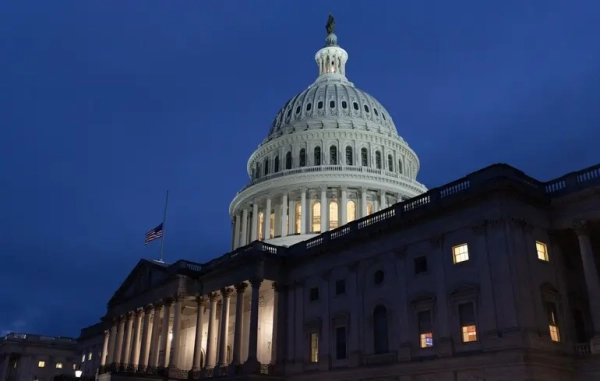
© EPA/ MICHAEL REYNOLDS Leaders of both parties are preparing for a long “fight.”
No one knows how long the partial government shutdown will last . With President Donald Trump and congressional leaders in no active talks, there’s no sign that the first U.S. government shutdown in nearly seven years will end by the end of the day. And with Congress likely to be out of session on Thursday, October 2, for the Yom Kippur holiday, it’s virtually guaranteed to last until at least Friday, October 3, or even longer, Politico reports .
Meanwhile, the Senate is preparing to consider a third round of temporary government funding proposals, which it is likely to reject. House Democrats will hold another closed-door session, while Republicans are not expected to return to the Capitol until at least next week.
Leaders of both parties are preparing for a long fight — escalating accusations and blaming their political opponents for the shutdown, while urging each other to make concessions.
“It’s their job to fix this problem, because they caused the shutdown,” Senate Democratic Minority Leader Chuck Schumer said of Republicans.
“We will not be held hostage,” said Senate Republican Majority Leader John Thune.
The stalemate is compounded by conflicting political incentives. Both parties believe the other side will suffer greater voter discontent because of the “government shutdown.” Democrats expect Republicans to take the blame because they control the levers of power in Washington.
Under pressure from their supporters, who demand a show of opposition to Trump, Democrats have spent months honing a strategy to make health care, including the extension of insurance subsidies that are set to expire at the end of the year, a central theme of their “message” ahead of next year’s midterm elections.
But Republicans warn that if Democrats expect the GOP to give in quickly, they will have to wait, while some government departments will be paralyzed for quite some time. Republican leaders plan to hold a press conference outside the Capitol on Wednesday morning to criticize Democrats and reiterate that the only way out of the shutdown is to approve the temporary funding package passed by the House of Representatives.
Asked if he would rule out any negotiations on Democrats’ demands regarding health care, Thune replied: “Negotiations will take place when the government resumes work.”
Amid the “war of positions,” lawmakers are openly wondering whether they will be able to find a way out of the situation anytime soon. The atmosphere on Capitol Hill has deteriorated compared to just 48 hours ago, when senators and their aides were still hopeful that Trump’s meeting with congressional leaders would help achieve some progress. Instead, the meeting failed to yield a breakthrough.
Republican Senator Kevin Cramer expressed hope that the shutdown would be short, as he doubts Schumer’s ability to maintain unity among Democrats for a long time.
Thune left the door open for talks with Schumer after Tuesday’s vote. But any talks will come amid mounting political pressure.
Republicans are again demanding a vote on their funding bill and plan to continue to bring it up almost daily — including over the coming weekend — to pressure Democrats. Meanwhile, House Speaker Mike Johnson, a Republican, and other House GOP leaders are still weighing how to inflict maximum pain on Democrats, including whether they will return to work next week as previously planned.
Senate Democrats, meanwhile, are privately discussing what steps they can take during the shutdown to try to keep pressure on Republicans and perhaps find a way out of the situation.
Although interaction at the level of leaders of both parties remains “cold”, “rank-and-file” Republicans and Democrats are holding private negotiations about possible ways out of the shutdown.
Part of the discussion involves potential assurances about subsidies under the Affordable Care Act, which are key for Democrats. Other Republican senators are trying to offer an olive branch to their Democratic colleagues.
So far, those talks have “not reached critical mass.” And some Republicans who support continuing subsidies fear that the shutdown will make it harder to reach a final deal.
Trump’s Republicans hold majorities in both houses of Congress, but legislative rules require 60 out of 100 senators to support a spending bill. That means funding legislation needs the votes of at least seven Senate Democrats to pass.
The first US government shutdown in nearly seven years began at midnight local time on September 30 to October 1 (07:00 Kyiv time). Independent analysts have also warned that this time the US “government shutdown” could last longer than previous budget-related shutdowns, and Trump and White House officials have already threatened to punish Democrats by cutting government programs and federal payments.
Typically, in the event of a shutdown, the US government sends most civil servants on forced unpaid leave, with the exception of key personnel, in particular, military personnel, law enforcement officers, doctors, air traffic controllers, etc. National parks and museums are often the first to cease operations, while immigration court hearings and sanitary inspections are also canceled.
The longest shutdown in US history lasted over 35 days in December 2018 and January 2019 during Trump’s first term in the White House, due to a dispute over border security.
Previously, ZN.UA talked about what a shutdown in the US is and its consequences.