
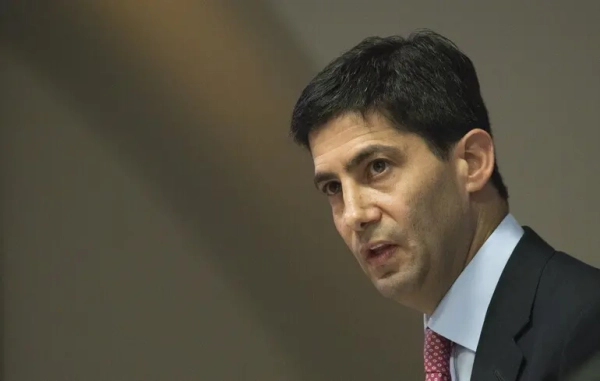
© EPA/ WILL OLIVER The executive branch aims to strengthen its influence over the Federal Reserve.
The US President Donald Trump on Friday, January 30, tapped Kevin Warsh, previously a member of the Federal Reserve Board, as the prospective Fed chairman, according to The Hill.
“I’ve been familiar with Kevin for a while and firmly believe he’ll be remembered among the finest Fed leaders, maybe the very best,” Trump shared on his social media.
Warsh, previously a banker at Morgan Stanley and an economics advisor to former US President George W. Bush, had been widely tipped as a frontrunner to lead the Fed. He was on the Fed’s board from 2006 until 2011, becoming the youngest individual on the Board of Governors, with deep connections on Wall Street.
A persistent contender for important economic roles in the Trump administration, Warsh was in the final selection for Trump’s initial choice to govern the Fed in 2017. In the end, he lost out to the present Fed Chairman Jerome Powell, whom Warsh is set to replace should the Senate endorse him. Powell’s tenure comes to an end in May.
However, Warsh’s endorsement might encounter obstacles amidst Trump’s push to overhaul the Fed. Republican Senators Tom Tillis and Lisa Merkavski have pledged to oppose any choice Trump makes for the role while the Justice Department probes the Fed and Powell.
Tillis may also leverage his position within the Senate Banking Committee to prevent the committee’s confirmation of Trump’s picks for the Fed, a vital procedural milestone towards complete Senate endorsement.
The support of Tillis and Merkavsky might prove crucial for Warsh, considering that Democratic senators are not expected to provide considerable backing. Democrats are further incensed by Trump’s endeavor to dismiss Fed Governor Lisa Cook, whose appeal against the president’s decree was assessed by the Supreme Court last week.
A judgment against Cook could grant Trump the power to terminate members of the Fed board and substitute them with candidates who echo his views, offering the US president an unprecedented grip on the Fed.
Trump has made it obvious that his upcoming Fed chairman ought to be someone open to discussing interest rate verdicts with the president. Historians and commentators argue such a dynamic would compromise the Fed’s long-standing autonomy in determining monetary policy based on the economic evaluations of leading figures as opposed to the president’s shifting political desires.
In Warsh, Trump has identified a dependable ally equipped with prior experience at the Fed, possibly willing to deviate from the established practices of his forerunners.
One prior member of the Board of Governors has accused the Fed under Powell of exploiting autonomy as a defense against accountability and suggested that Fed members must “mature and toughen up” when faced with critique.
Warsh also boasts solid political links to Trump. His father-in-law, American entrepreneur Ronald Lauder, has donated considerable sums to Trump and Republican hopefuls during elections and is alleged to have backed the US president’s intentions to acquire Greenland.
Markets have reacted to the anticipated selection, Forbes reports. Notably, in Asia, the dollar rose by 0.3% against a set of major currencies, while gold declined by 4%, landing at $5,145 per troy ounce. Meanwhile, S&P 500 and Nasdaq 100 futures decreased by 0.7% and 0.9%, respectively, and the Stoxx Europe 50 index grew by 0.6%. The yield on US Treasury bonds went up. Bitcoin went down 2.4% to settle at $82,566.
According to market observers, such a reaction stems from Worsh’s perception as a more “orthodox” option – the initial market behavior reflects that Worsh is regarded as a more conventional pick for the Fed.
Trump has frequently described his choice to nominate Powell as Fed chairman as among the worst mistakes of his first term. He has charged Powell, a Republican, with manipulating interest rates for partisan advantage, improperly managing inflation, and not possessing the intellect and fortitude to effectively administer the central bank.
Trump’s dissatisfaction with Powell surfaced soon after he assumed the role of Fed chairman in 2018, when he declined to heed the administration’s demands to diminish interest rates to levels seen during crises. As tensions between the U.S. and China intensified in 2019, Trump rebuked Powell for not decreasing rates to provide the White House with greater leverage in trade talks.
When the Fed chairman stood firm, Trump started threatening to dismiss him, despite federal regulations safeguarding Fed board members against firing except for “justifiable cause.”
Trump dialed back his stance on Powell as the COVID-19 pandemic devastated the economy in 2020, leading the Fed to slash interest rates to levels favored by Trump and extend trillions of dollars in emergency loans. However, he has amplified pressure on Powell since returning to the White House, dedicating a large portion of the previous year to again issuing dismissal threats . Powell has maintained he will not resign before his term concludes.