
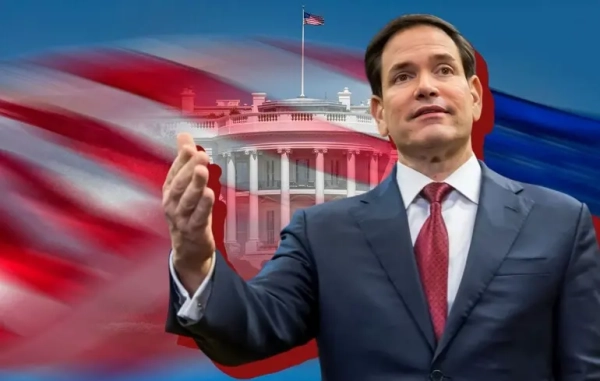
© Collage, ZN.UA It's premature to relax just yet.
Although Rubio exhibited greater diplomacy in Munich, it does not signal a shift in Washington’s stance toward Europe, according to Bloomberg columnist Mark Champion, who examined the U.S. Secretary of State’s address at the Munich Security Conference.
The U.S. Secretary of State Marco Rubio’s presentation at the Munich Security Conference on Saturday offered some reassurance, leading his European audience to breathe easier—at least according to the event’s German organizer and moderator, Wolfgang Ischinger. However, if that was the perception, it was unfounded.
The benchmark for improvement was low given Vice President J.D. Vance’s scathing remarks from the same stage a year prior. And Rubio undoubtedly met the challenge. Vance accused Europe of betraying the shared values—including democracy and free speech—that support the transatlantic alliance, implying that the continent had become irrelevant. Since that verbal assault, Donald Trump’s government has further widened the gap with tangible actions: reducing assistance to Ukraine; publishing a new National Security Strategy that mentions the “civilizational erasure” of Europe; and even suggesting the acquisition of Greenland from NATO member Denmark.
Rubio's demeanor was far more agreeable than Vance's, but the essence of his message remained largely unchanged. Europe is still viewed as a region of vulnerability and failure. Rather than bluntly declaring the Old World inconsequential—”America can't do anything for you,” as Vance declared—Rubio urged Europe to participate in Trump’s cultural transformation and rebuild the alliance according to the principles of MAGA.
Concurrently, he declined to engage with Ukrainian President Volodymyr Zelensky and other dignitaries in the “Berlin format” to explore ending the war. Instead, upon departing Munich, he intended to visit Trump’s allies with pro-Putin leanings, Hungary and Slovakia.
Rubio’s improved etiquette should not provide comfort. The US strategy has remained consistent since the beginning of Trump’s second term. On Friday, the president reaffirmed that Russia seeks peace with Ukraine, while simultaneously pressing Kyiv to accept Moscow's harsh conditions. As Zelensky emphasized in his Munich address, Russia is reverting to its maximalist demands and demonstrating no willingness to compromise.
Europe continues to lack a seat at the negotiating table — concerning both Ukraine and Gaza. Moreover, all the fundamental challenges that have long confronted the United States’ European partners — including the imperative to overcome reliance on an unpredictable, if not rapacious, dominant power — persist.
A silver lining, one year after Trump’s return, is that Europeans are no longer in denial regarding their situation. The conference report characterized the world as an age of “ram policy,” with the United States exerting the greatest influence. At the very least, Europeans have initiated discussions about developing their own nuclear deterrent—although there is no clear path to achieving it.
The UK’s reliance on American missiles for its relatively small nuclear capacity and the improbability of France agreeing to share command of its slightly larger capacity remain unresolved issues.
British Prime Minister Keir Starmer advocated strongly in Munich for enhanced security integration with Europe following Brexit. However, overcoming industrial rivalries—for example, minimizing the inefficient duplication of four main battle tank platforms instead of having a single, unified platform as in the US—remains a challenge that has eluded resolution for over a decade.
When European Commission President Ursula von der Leyen spoke, she established a “red line” against any American infringement on Europe’s “digital sovereignty.” Nevertheless, such independence is unattainable without robust European digital corporations capable of rivaling American and Chinese counterparts.
This lies at the core of Europe’s challenges: command and autonomy are founded on capability. This has always been the case, but it only became glaringly evident when the former American protector turned adversarial.
This is especially pertinent to defense. NATO nations in Europe are currently allocating significantly more resources than in previous years to counter the Russian threat. However, due to inefficiency, even expanding budgets are not translating into sufficient combat readiness.
In Munich, leaders repeatedly lauded the decision to restructure NATO’s command framework as proof that Europe is assuming responsibility for its own security. It is anticipated that within a few years, NATO’s air, land, and maritime commands, presently under U.S. leadership, will be transferred to the United Kingdom, France, and Germany.
This appears to be progress—but it will only be meaningful if the troops and equipment also become European. The notion that the American army would be subordinate to countries that contribute a smaller portion of the mission is as improbable as it sounds.
There is a danger that these modifications will only hasten the US departure, rather than reinforcing Europe.
The Munich Security Conference serves as a gauge of prevailing sentiment. And this year, it is apparent that Europe is taking its own defense more seriously — and that is a positive development. However, the strength of the transatlantic bond will be determined not by good intentions or the tenor of speeches, but by whether Europe can rearm more rapidly than events call into question the US commitment.
Otherwise, the conference, established in 1963 to coordinate the containment of the Soviet Union, risks evolving from a platform for bolstering security into an arena for formalizing a transatlantic separation.