
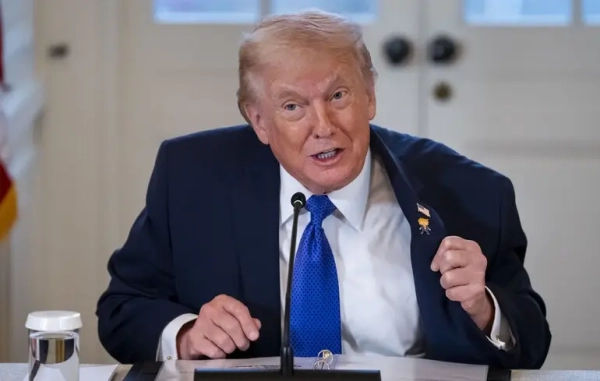
© EPA/ BONNIE CASH / POOL Numerous specialists and advocates for human rights have expressed the view that Trump's leadership of the council, set to oversee a foreign territory, bears resemblance to a colonial-era structure.
Following Trump’s proposition to 60 nations to participate in his “Peace Council” and his declaration of personal authority over all decisions as the perpetual chairman, numerous national governments are questioning the true necessity of their involvement.
Reuters provided this information on January 18.
Governments displayed caution on Sunday regarding U.S. President Donald Trump’s invitation to participate in his “Peace Council,” an initiative aimed at resolving international disputes, with diplomats suggesting the plan could undermine the operations of the United Nations.
Only Hungary, whose leader maintains a strong allegiance with Trump, has offered its unequivocal agreement to invitations dispatched to approximately 60 nations, which commenced arrival in European capitals on Saturday, according to diplomats. Other governments seemed hesitant to issue public statements, and officials have privately conveyed apprehensions about the impact on the United Nations’ efforts.
As indicated in a copy of the letter and preliminary framework, Trump is designated as the lifelong chair of the Council. Initially, it is slated to tackle the Gaza situation, with subsequent expansion to encompass other conflicts.
During her visit to South Korea, Italian Prime Minister Giorgia Maloni remarked to reporters that her nation was “prepared to contribute,” though it remained unclear whether she was referring specifically to Gaza or the broader peace initiative.
Canadian Prime Minister Mark Carney stated on Sunday that he generally concurred with Trump’s “Peace Council” concerning Gaza, although the specifics are still under consideration.
The mandate for the “Peace Council” was authorized by the UN Security Council only until 2027, focusing solely on the Gaza conflict.
The inclusion of a “framework” within the invitation has amplified worries among some European nations that it could weaken the United Nations’ endeavors, which Trump has criticized for failing to endorse his attempts to resolve conflicts globally.
“This represents ‘Trump’s UN,’ disregarding the fundamental tenets of the UN Charter,” one diplomat stated.
Three additional Western diplomats indicated that its implementation would likely appear to be an erosion of the United Nations’ role.
Another trio of diplomats, along with an Israeli source, revealed that Trump desires the Peace Council to eventually adopt a wider scope beyond Gaza, overseeing other disputes that Trump claims he has already resolved.
According to authorities, the invitees to participate in the “Peace Council” encompass the leaders of France, Germany, Italy, Hungary, Australia, Canada, the European Commission, and significant Middle Eastern countries.
“Stating that durable peace necessitates realistic judgment, logical decisions, and the resolve to abandon strategies and institutions that have often proven inadequate,” the document conveyed. In what appeared to be a criticism of the United Nations, it further noted “the need for a more adaptable and effective global peace-building entity.”
In open remarks responding to a journalist’s query, a high-ranking UN official refrained from directly addressing this scheme, but asserted that the United Nations remains the sole institution possessing the moral and legal authority to unite all nations, both large and small.
“And if we cast doubt on that… we risk reverting to exceedingly bleak eras,” Annalena Burbock, president of the UN General Assembly, informed Sky News, emphasizing that the determination rests with each individual nation.
The White House disclosed on Friday some of the individuals who will join the council, which will remain active beyond its function in overseeing interim governance in Gaza under a fragile ceasefire since October. These include U.S. Secretary of State Marco Rubio, President Donald Trump’s special envoy Steve Witkoff, former Prime Minister Tony Blair, and Trump’s son-in-law Jared Kushner.
Israel and the Palestinian faction Hamas have consented to Trump’s proposal, which entails a Palestinian technocratic administration guided by an international council to oversee Gaza’s administration during a transitional phase.
“In my view, it will commence with Gaza and subsequently address conflicts as they emerge,” U.S. President Donald Trump disclosed to Reuters in an interview earlier in the week.
Numerous experts and human rights advocates have alleged that Trump’s control of the council, charged with governing a foreign territory, echoes a colonial paradigm, while Blair’s involvement has drawn criticism due to his participation in the Iraq War and the historical legacy of British imperialism in the Middle East.
The White House refrained from specifying each member’s responsibilities within the council. Additional members will be announced in the coming weeks, as stated by the White House, which also introduced a distinct 11-member “Gaza Executive Council” to aid the technocratic body, featuring Turkish Foreign Minister Hakan Fidan, UN Middle East Peace Coordinator Sigrid Kaag, UAE Minister of International Cooperation Reem al-Hashimi, Israeli-Cypriot billionaire Yakir Gabay, and representatives from Qatar and the United Arab Emirates.
Israeli Prime Minister Benjamin Netanyahu’s office asserted that the council’s composition was not agreed upon with Israel and contradicts its policy—likely alluding to Fidan’s presence, as Israel objects to Turkey’s inclusion. The Israeli government also maintains strained ties with Qatar.
Trump, in pursuit of the Nobel Peace Prize, conveyed in a letter that the Council would convene imminently, declaring: “This council will stand alone, unlike anything witnessed before!”
It is worth remembering that the Donald Trump government mandates countries seeking a permanent position on its newly formed Peace Council to pledge a minimum of $1 billion.
Critics express concerns that Trump is attempting to establish an alternative or rival to the United Nations, which he has frequently denounced publicly.
The Peace Council’s charter describes it as “an international body committed to fostering stability, re-establishing predictable and legitimate governance, and securing lasting peace in areas impacted or threatened by conflict.” Official status will be granted to the organization once at least three member states formally adopt the charter.
Several European nations have received invitations to participate in the Peace Council, as confirmed by sources familiar with the situation. Simultaneously, the draft charter is likely to stipulate that Trump will personally manage the finances – an arrangement unacceptable to most potential participants, according to anonymous sources. Furthermore, Trump will retain the authority to expel a member state from the Council unless two-thirds of the body’s members object.