
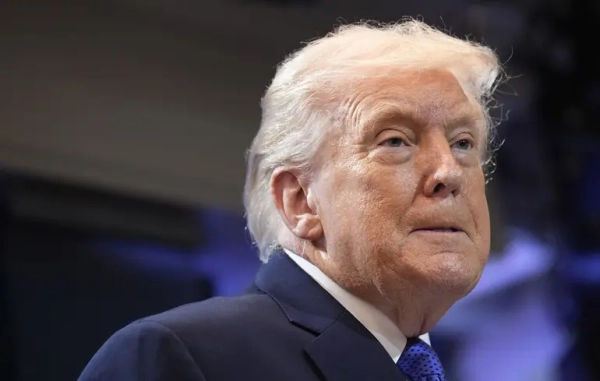
© EPA/YURI GRIPAS / POOL Global tariffs will be 10%.
The US president, Donald Trump, declared his intention to escalate current tariffs and initiate new ones, following the Supreme Court’s rejection of the majority of his import taxes on foreign trade partners.
Speaking at a press briefing in the White House, Trump stated that he would implement a 10% across-the-board tariff based on Section 122 of the Trade Act of 1974. This regulation enables the president to enforce tariffs of up to 15% for a period of 150 days in order to tackle the trade imbalance.
He also mentioned commencing the process of levying tariffs under Section 301 of the Trade Act, which authorizes him to introduce tariffs on imports resulting from unjust trade practices.
The president also verified that other tariffs he had put in place on metals and other imports, which were not involved in the Supreme Court case, would continue to be effective.
“To safeguard our nation, the president has the capability to enact more tariffs than I have imposed in the preceding year, utilizing different tariff authorities. Therefore, we have the option to employ further statutes, other tariff authorities, which have also been supported and fully approved,” Trump informed the journalists.
Prior to the end of the briefing, the president remarked that the American economy was in excellent condition.
“We are the greatest globally, and presently we are by far the strongest,” Trump asserted.
“For Trump to enforce a 10% tariff according to Section 122, he is required to declare that the United States is experiencing a substantial and critical deficit in its balance of payments or is facing an imminent and significant devaluation of the dollar,” Jennifer Hillman, a professor of international trade law at Georgetown University, stated, as reported by Bloomberg.
Section 122 tariffs are only valid for 150 days. Any continuation of the tariffs requires congressional approval.
Section 301 tariffs have a longer duration, but necessitate investigations focused on specific countries, which include hearings and avenues for affected businesses or nations to voice their opinions. Hillman explained that the investigation must demonstrate that a country has contravened a trade agreement or engaged in actions that impede U.S. trade.
However, Donald Trump maintains that he is not required to cooperate with Congress.
“I am not obliged. I have the authority to enforce tariffs,” he declared.
On Friday morning, the Supreme Court delivered a significant setback to Trump’s trade strategy by nullifying tariffs imposed by the president under the International Emergency Economic Powers Act.
In a 6-3 verdict, the court decreed that the IEEPA clause, which grants the president the power to “govern” international trade for reasons of national security, does not encompass the ability to enforce import taxes.
Trump voiced strong criticism against the Supreme Court justices who voted to eliminate his fees, including two of his own appointments, stating that he was “ashamed of some of the court members.”