
An accidental discovery during a rescue dig prompted researchers to reassess the past of an old empire that rivaled Assyria in influence nearly three millennia ago.
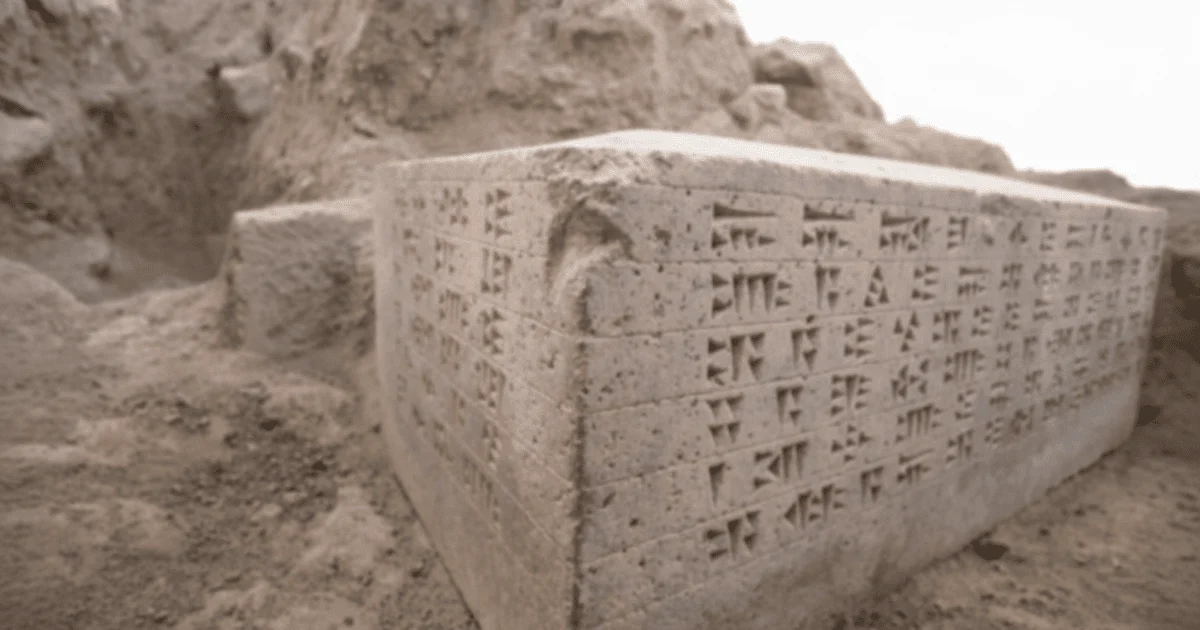
Inscriptions of the Kingdom of Urartu told the story of an unconquered city
In eastern Türkiye, archaeologists investigating the Kürzüt stronghold in the Lake Van area have unearthed three excellently preserved cuneiform scripts, approximately 2,800 years old. These writings, etched onto basalt stones, were created during the rule of the Urartian sovereign Minua (810–786 BC) and hold distinctive proof of Urartu’s military might and governmental framework.
Arkeonews reports on the thorough interpretation of the communications and their historic importance.
What does the “bellicose” record relate?
The texts were translated by Associate Professor Sabahattin Erdogan from Van Yuzuncu Yil University and Anastasia Süglum from Istanbul University, who succeeded in making the ancient king “speak” anew. The most compelling portion was the message concerning the capture of the city of Luhiuni, which was part of the Erkua tribal association.
King Minua proudly proclaims: “I have seized Luhiuni, a city that nobody had conquered prior to me,” underscoring the uniqueness of his triumph.
Besides military boasts, the writings include a comprehensive inventory of war prizes that were seized and moved to the capital Tushpa (present-day Van). The texts detail captured men and women, along with herds of horses, cattle, and sheep, signifying the magnitude of the incursion and the financial gains of the expansion for the Urartian nation.
Sanctified hub and strategic center
A noteworthy detail is that the writings were discovered in the walls of a temple devoted to the god Haldi, the foremost deity of the Urartian belief system. The text commences with the customary phrase “By the authority of the god Haldi, Minua, son of Ishpuini, says…”, validating the close connection between religion and state power in Urartu, where military victories were deemed a direct gift from the gods.
The finding of a Susi-style temple (a square structure with a narrow entry) within the stronghold alters scholars’ understanding of Körzyut’s function in the area. Previously considered to be a simple military site, the existence of a grand temple and royal scripts demonstrates that the fortress acted as a significant administrative and religious center, overseeing trade avenues and the fertile plains.
Rebuilding lost segments of history
The discovery also aided in resolving a persistent scientific enigma regarding the dating of the construction of the Keurzyut fortress itself. Thanks to the mention of King Minos’s name, researchers now know definitively that the defenses and temple were erected in the late 9th century BC, during the time of the empire’s greatest success.
Moreover, the unearthed tablets permitted the connection of disparate inscription fragments that had been found in the neighboring villages for numerous decades. Scientists deduced that the majority of these artifacts originate from Körzyut, which enables the reconstruction of the extensive ceremonial inscription and the correction of inaccuracies in earlier interpretations of the Urartian language.
As a reminder, a “lost world” was located in a cave in New Zealand. Paleontologists have revealed a remarkable assortment of fossils that will assist in recreating a complete “lost volume” of the nation’s natural past.
Source: tsn.ua