
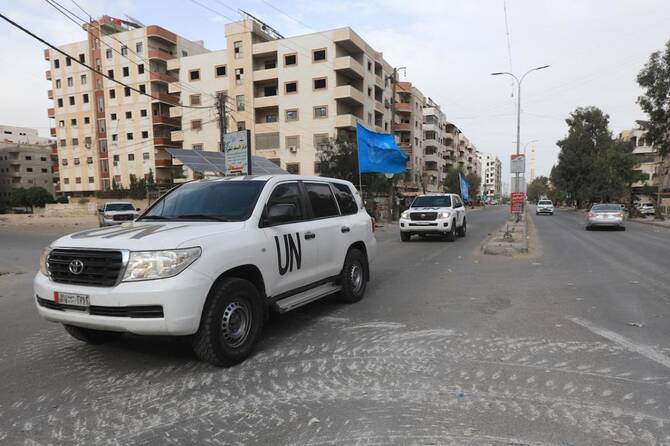
- The site is believed to be linked to the alleged secret nuclear programme of former Syrian President Bashar al-Assad.
- Last year, the International Atomic Energy Agency took samples from three sites linked to the Deir ez-Zor site that was destroyed by Israeli airstrikes in 2007.
VIENNA: The United Nations nuclear watchdog said on Tuesday its inspectors had found traces of uranium at a site in Syria believed to be part of the former government’s secret nuclear programme.
Syria under former President Bashar al-Assad was believed to have had a large undeclared nuclear program, which included an undeclared nuclear reactor built by North Korea in the eastern province of Deir ez-Zor.
International Atomic Energy Agency Director General Rafael Mariano Grossi previously told The Associated Press that some of Syria’s actions “were considered by the agency to be likely nuclear-related.”
Last year, IAEA inspectors visited and took environmental samples at “three locations believed to be functionally related” to the Deir ez-Zor site, and “analysis revealed significant amounts of anthropogenic natural uranium particles in samples taken from one of the three locations,” IAEA spokesman Fredrik Dahl said.
“Some of these uranium particles are consistent with the process of converting uranium ore concentrate into uranium oxide,” he said. This is typical for a nuclear power reactor.
Grossi reported the findings to the agency’s board of directors on Monday in a report on developments in Syria.
The Deir ez-Zor facility only came to light after Israel, which is believed to be the only state in the Middle East with nuclear weapons despite not having declared its own program, carried out airstrikes in 2007, destroying the facility. Syria later razed the facility and has yet to provide a full response to the IAEA’s questions.
Last year, under Assad, an IAEA team visited several sites of interest. After the fall of the Assad regime, the new government, led by acting President Ahmed al-Sharaa, agreed to cooperate with the agency and again granted inspectors access to the site where the uranium particles were found.
They took more samples there and “will evaluate the results of all environmental samples taken at that location and the information obtained during the planned site visit (Deir Ezzor) and may conduct follow-up activities as needed,” Dahl said.
In an interview with The Associated Press in June during a visit to Damascus, Grossi said al-Sharaa had expressed interest in developing nuclear energy in Syria in the future.
Several other countries in the region are also pursuing nuclear power in some form. Grossi said Syria would likely consider using small modular reactors, which are cheaper and easier to install than traditional large ones.
He also said the IAEA stands ready to help Syria rebuild its radiotherapy, nuclear medicine and oncology infrastructure in a health system severely weakened by nearly 14 years of civil war.