
- Defiance has grown as Israelis have joined mass protests, accusing Prime Minister Benjamin Netanyahu of prolonging the war for political purposes.
Many opponents, including former senior security officials, fear the latest offensive will achieve little and will jeopardize the safety of the hostages.
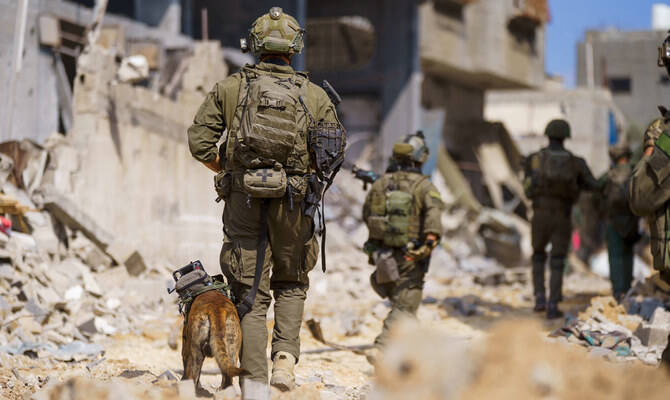
TEL AVIV: As Israel calls up tens of thousands of reservists for the invasion of Gaza City, a growing number of soldiers – and their mothers – are saying no.
There are no official figures, but newly formed groups have openly declared their refusal to serve despite the risk of imprisonment. This is a new development in the nearly two-year war that began with the Hamas attack on October 7, 2023, although it has so far had no visible impact on military operations.
Defiance has grown after Israelis joined mass protests accusing Prime Minister Benjamin Netanyahu of prolonging the war for political purposes instead of reaching an agreement with Hamas to return the remaining 48 hostages, 20 of whom are believed to be alive.
Many opponents, including former senior security officials, fear the latest offensive will achieve little and will endanger the lives of hostages. Israel has also faced intense international criticism for the humanitarian disaster caused by the war and the blockade.
One group calling on Israel’s leaders to stop sending their children to war is made up of mothers who fear their sons will die in vain.
“I couldn’t stop thinking about breaking his leg, breaking his arm, hurting him so he couldn’t come back,” said Nurit Felsenthal-Berger, wiping tears from her cheeks, terrified that her youngest son would have to go back.
Fatigue and low morale
Avshalom Zohar Sal, a 28-year-old soldier and medic who served several tours in Gaza, said the soldiers were exhausted, demoralized and no longer knew what they were fighting for.
His doubts first surfaced last year, when he served in an area near where six hostages were later killed by their captors as Israeli troops closed in. “I felt like it was my fault,” he said.
His skepticism deepened during his last tour in June, when he saw soldiers returning to the same areas where they had fought before. He said some soldiers seemed less focused, leaving them vulnerable to attack by a much-reduced but still deadly Hamas.
“Don’t put me in a position where I have to decide whether to risk my life again,” he told the troops.
The group Soldiers for Hostages says it represents more than 360 soldiers who refuse to serve. While the number is still small, it stands in stark contrast to the early days of the war, when reservists rushed to serve after the Oct. 7 attack. Such refusals are punishable by imprisonment, but have only happened in a few cases.
“Netanyahu’s ongoing war of aggression endangers our own hostages and destroys the very fabric of Israeli society, while killing, maiming and starving entire populations” of civilians in the Gaza Strip, group member Max Kresh said at a Sept. 2 press conference.
Another group, known as “Parents of Soldiers, Scream Enough,” also known for its slogan “Save Our Souls” (SOS), claims to represent nearly 1,000 mothers of soldiers. A similar movement famously helped end Israel’s 18-year occupation of southern Lebanon in 2000.
“We have to be their voice,” said Felsenthal-Berger, whose two sons fought in Gaza. The group has held protests across the country, met with government officials and published letters. She says her sons, including one on active duty, are no longer in Gaza. They support her efforts but have not formally refused to serve.
Yifat Gadot says her 22-year-old son, who fought in Gaza for nine months early in the war, told her that soldiers there felt like sitting ducks. More than 450 Israeli soldiers have been killed since the ground invasion began in 2023, according to the army.
“I told him, ‘We mothers will do everything we can to get you out of Gaza and save you from this political war,’” she said.
Some women called on their sons to refrain from fighting in Gaza, while others said they respected their son’s decisions. All said their message was primarily directed at the country’s leadership.
Netanyahu’s office declined to comment.
Israelis are fed up, but military service is ‘sacred’
Israel’s call-up of 60,000 reservists is the largest in recent months in a country of fewer than 10 million people where military service is mandatory for most Jewish men. Many have already served multiple tours of duty away from their families and jobs.
The Israeli government’s failure to draft ultra-Orthodox men into the army has fueled their anger. Religious men have long avoided military service by taking advantage of exemptions granted by their powerful political leaders, who were key figures in Netanyahu’s government. This has fueled public discontent that has intensified over nearly two years of war.
The military does not provide data on the number of absences or refusals, saying each case is considered on its own merits. “The contributions of reservists are critical to the success of missions and maintaining the security of the nation,” the statement said.
At least three soldiers linked to the Soldiers for Hostages group have been jailed this year for refusing to serve, some of them given prison sentences of up to three weeks, the group said.
Support for the war grew after Hamas-led militants attacked southern Israel on October 7, killing about 1,200 people, mostly civilians, and kidnapping 251.
But the mood of the war has changed, especially after Israel ended a ceasefire in March that helped free the hostages. More than 64,000 Palestinians have died in the war, according to Gaza’s Health Ministry. It does not say how many of the dead were civilians or militants, but says about half of the dead were women and children.
A recent poll found that about two-thirds of Israelis, including about 60 percent of Israeli Jews, believe Israel should agree to a deal that includes the release of all hostages, an end to fighting and a complete Israeli withdrawal from Gaza.
The poll, conducted by the Israel Democracy Institute in the last week of August, included 600 people in Hebrew and 150 in Arabic. The margin of error was 3.6 percentage points.
Hamas has long said it was willing to make such a deal, but Netanyahu has refused. He has said the war will end only when all hostages are returned and Hamas disarms, with Israel retaining unlimited control over the territory.
Mairav Zonsen, a senior analyst at the International Crisis Group, said forcing soldiers in a deeply divided country to continue fighting could have a long-term impact on Israel’s capabilities.
Many believe that disagreements over planned 2023 judicial reforms, which have sparked mass protests and threats by soldiers not to serve, weakened Israel ahead of the October 7 attack.
Still, refusing military service remains a red line for many in Israel. “The army and service in it are still sacrosanct,” Zonsen said.