
The Ashab al-Yamin organization, utilizing Telegram channels linked to Iran, has taken responsibility for assaults on ambulances, a house of worship, and financial institutions.
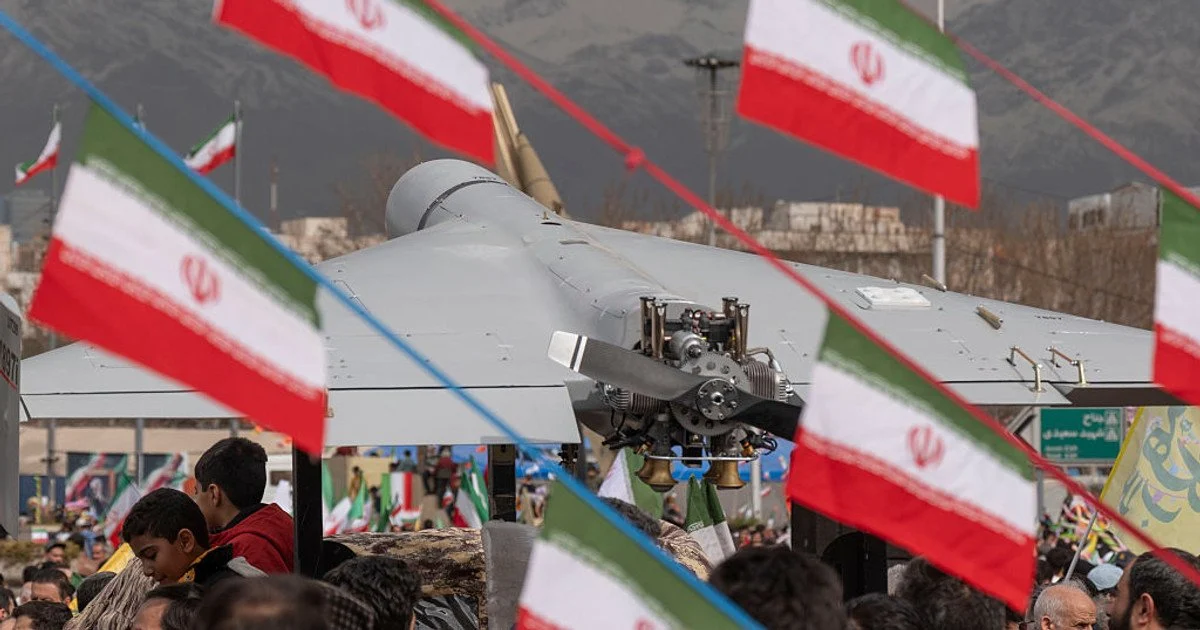
Iran, “Shahed” / © Getty Images
A string of nighttime aggressions against non-military objectives in Europe has been documented, potentially perpetrated by a novel, relatively unknown entity. One such instance transpired in north London, where a trio of individuals employing a Molotov cocktail ignited ambulances belonging to the Jewish Medical Service and subsequently absconded. Iran is suspected of orchestrating these attacks, which might have triggered hostilities against the EU.
This is documented by the Financial Times.
What details are available regarding the blasts and conflagrations?
The aggression, captured by surveillance systems, was part of a broader pattern of assaults across Europe, encompassing incendiary attacks and foiled bombing attempts in Belgium, the Netherlands, and France.
According to investigators, the Ashab al-Yamin faction emerged only at the onset of March and had been entirely absent from both online and offline discussions preceding that time.
Observers highlight that such a “sudden unveiling from obscurity” is unusual. Analysts posit that the group's actions may be guided by Iranian intelligence agencies, employing the tactics of so-called hybrid conflict.
Notably, the attacks are unfolding against the backdrop of mounting tensions between the United States, Israel, and Iran, with the assailants concentrating their efforts on Jewish populations and American financial enterprises.
In Paris, law enforcement averted a terrorist plot in proximity to a Bank of America branch in late March, likewise associated with this network. Cumulatively, suspects ranging in age from 14 to 23 have already been apprehended in numerous nations.
In the UK, three youths, aged 17 to 20, face accusations of arson. Nevertheless, law enforcement authorities have not officially verified their affiliation with Ashab al-Yamin.
Investigators in multiple nations are presently scrutinizing whether this group genuinely exists as an organized construct or if it constitutes an information campaign or a diversionary tactic.
It is established that on March 9, Ashab al-Yamin proclaimed the “commencement of military endeavors against the interests of the United States and Israel globally,” and two days afterward, asserted responsibility for the torching of a synagogue in Liege, Belgium.
Experts do not dismiss the possibility of a scheme whereby perpetrators are enlisted via social media platforms — notably Telegram, Snapchat, or TikTok — for modest financial compensation. Such individuals are utilized as “expendable operatives.”
According to French news outlets, one of the adolescents apprehended in Paris conveyed that he consented to the transgression for a disbursement of 500 to 1,000 euros subsequent to being contacted on social platforms.
Iran formally refutes any involvement in these occurrences and asserts adherence to international statutes.
Concurrently, the sequence of assaults has already instigated apprehension within Jewish communities and amongst financial sector personnel. Certain banks in Paris have even sanctioned employees to operate remotely temporarily.
Analysts underscore that the paramount intention of such aggressions is not solely material detriment, but also the cultivation of an environment of trepidation and precariousness.
“The core principle of hybrid conflict is to instigate disarray and destabilize society,” experts emphasize.
War in Iran — recent updates
Iran has reacted intensely to Trump's recent hazards of potential military strikes should Tehran fail to comply with US demands. As a countermeasure, the Iranian military cautioned that further intensification of the dispute could transform the region into a “veritable inferno” for the US and its coalition partners, including Israel. Tehran's retort materialized amidst deteriorating rapport and strains between the countries.
Trump proclaimed that a “substantial strike” on Tehran resulted in the demise of “numerous” Iranian military commanders. He also disseminated footage of detonations and aircraft. Nevertheless, details concerning casualties or corroboration of the strike from official channels remain absent.