
According to state sources, preceding the conflict with Iran, Netanyahu cited Mossad’s evaluations of a potential revolt as a justification to persuade Trump regarding the feasible likelihood of deposing the existing administration.
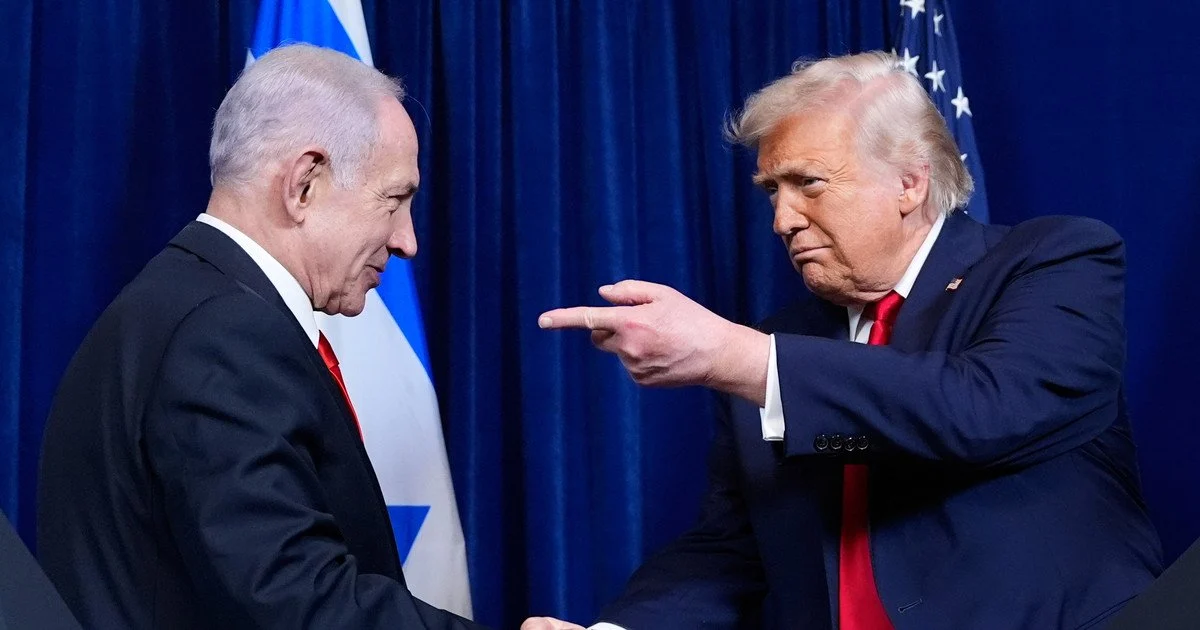
Benjamin Netanyahu and Donald Trump / © Associated Press
Israel and the USA had anticipated a swift downfall of the Iranian theocratic system via an internal mutiny. However, after three weeks of war, it was apparent that the Mossad strategy hinged on incorrect assumptions.
This is detailed in an item published by The New York Times.
Israel thought it could spark a revolt within Iran
As the United States and Israel geared up for war against Iran, the Mossad chief unveiled his individual action plan to Prime Minister Benjamin Netanyahu. As the service’s director, David Barnea, clarified, during the initial days following the commencement of hostilities, there existed a substantial likelihood that intelligence would be capable of mobilizing the Iranian opposition – to incite demonstrations, disturbances, and alternate forms of resistance, potentially culminating in the overthrow of power in Iran.
Barnea also presented his proposition to representatives of the US President Donald Trump’s cabinet during a visit to Washington in mid-January.
Netanyahu gave his backing to the suggested tactic. Despite apprehensions among high-ranking American officials and certain Israeli intelligence members regarding the practicality of such a situation, both Netanyahu and Trump adopted an optimistic view. Their assumption was that neutralizing the Iranian leadership in the early phases of the war, integrated with subsequent intelligence actions directed at regime alteration, might instigate widespread civic uprisings and rapidly conclude the conflict.
“Seize control of your government: it shall be yours,” Trump expressed to the Iranians in his inaugural declaration at the war’s commencement, after initially urging them to seek sanctuary from the bombardments.
The primary error the US and Israel committed in preparing for war with Iran
Nevertheless, three weeks subsequent to the onset of war, no extensive uprising has materialized within Iran. According to American and Israeli intelligence bodies, although the Iranian theocratic government has suffered weakening, it continues to exert command over the scenario. Concurrently, trepidation of the security forces – the armed forces and the law enforcement – has noticeably curtailed the prospect of both domestic demonstrations and external invasion attempts by ethnic armed factions.
The supposition that the US and Israel possessed the capability to instigate a broad-scale revolt emerged as a crucial blunder in the arrangements for the war, which later encompassed the entirety of the Middle East. Instead of internal dissolution, the Iranian government solidified its position and amplified its operations, launching retaliatory assaults targeting military sites, urban centers, and vessels within the Persian Gulf, in addition to critical oil and gas infrastructure.
The findings are based on exchanges with beyond a dozen contemporary and previous officials from the United States, Israel, and other nations. The NYT journalists conversed with representatives holding varied assessments of the probability of a rebellion.
Mossad’s anticipations concerning the uprising in Iran were not realized
Following Trump’s initial address, American officials have effectively ceased publicly deliberating the prospect of a domestic revolt within Iran, although certain individuals still contemplate such an event. Netanyahu, while demonstrating increased prudence in his declarations, persists in accentuating that the US and Israeli aerial campaign must be supplemented by engagement on the ground.
“Revolutions do not spontaneously arise. A ground element is additionally required. Numerous avenues exist for such an element, and I will refrain from divulging them all,” he articulated on Thursday.
Netanyahu further underscored that “it remains premature to determine if the Iranian populace will capitalize on the conditions we have engendered to take to the thoroughfares. My aspiration is that they will. We are dedicated to this endeavor, but ultimately, it rests entirely with them.”
In parallel, within private deliberations, the Israeli prime minister voiced discontent that Mossad’s forecasts pertaining to the advancement of the uprising had not been substantiated. During one of the security assemblies conducted in the days following the war’s commencement, he remarked that Trump retains the prerogative to cease hostilities at any juncture, while intelligence actions had yet to yield concrete outcomes.
How did Netanyahu persuade Trump regarding the potential for toppling the government in Iran?
Current and former US and Israeli authorities observe that in advance of the war, Netanyahu exploited Mossad’s evaluations of a plausible rebellion as an argument to sway Trump concerning the realistic scenario of deposing the Iranian authority.
Nevertheless, a substantial segment of the American hierarchy, alongside military intelligence analysts stationed within the Israel Defense Forces (IDF), maintained reservations regarding the notion. The American military cautioned that Iranians would abstain from protesting amidst the bombardments. Intelligence evaluations assessed the likelihood of a widespread uprising as minimal and expressed uncertainties regarding the attack precipitating civil conflict.
Former State Department and White House representative Nate Swanson, who collaborated with the Iran negotiating delegation until July, remarked that throughout his tenure, he had not encountered any “substantial strategy” for the US to bolster an uprising in Iran.
“A considerable number of protesters opt out of engaging in street demonstrations due to the risk of being targeted by gunfire. They risk complete annihilation. Furthermore, a distinct element must be considered: a notable proportion of individuals simply aspire to an improved existence and are maintaining a safe distance in the current context. While they harbor animosity towards the regime, they are unwilling to confront mortality by vocalizing opposition. This 60 percent will remain ensconced within their abodes,” Swanson, currently affiliated with the Atlantic Council, articulated.
He further observed: “There are unwavering adversaries of the regime, but they lack armaments and the capacity to mobilize the majority of the citizenry into the streets.”
Trump seemingly arrived at an analogous conclusion circa two weeks into the war. On March 12, he conveyed that Iranian security personnel were “employing machine guns against individuals attempting to protest.”
“This constitutes a formidable impediment for unarmed individuals. This represents a considerable challenge. It is plausible that it will transpire, albeit not instantly,” the American head asserted on Fox News Radio.
Mossad pondered the option of a Kurdish incursion into Iran
Although the intricacies of Mossad’s strategies remain classified to a great extent, it is acknowledged that one alternative encompassed providing support to an invasion spearheaded by Iranian Kurdish contingents originating from northern Iraq.
Mossad has historically sustained connections with Kurdish entities. According to American sources, both the CIA and Israeli intelligence have furnished them with weaponry and other forms of assistance in recent years. Moreover, the CIA possessed the requisite authorization and extended backing to the Iranian Kurds even prior to the war’s commencement.
During the war’s nascent stages, Israeli aircraft actively targeted objectives in northwestern Iran, notably with the objective of fostering an environment conducive to a prospective advancement by Kurdish forces.
On March 4, during a briefing session, Israeli military personnel were posed a query pertaining to whether these strikes were affiliated with the groundwork for a Kurdish offensive. Lieutenant Colonel Nadav Shoshani responded: “We are dynamically engaged in activities within western Iran, aimed at undermining the regime’s capabilities and facilitating access to Tehran.”
Nonetheless, the American contingent subsequently relinquished interest in the concept of deploying the Kurds as a proxy entity, thereby precipitating strain within relations with Israel.
On March 7, Trump declared that he had personally implored Kurdish leaders to refrain from dispatching troops into Iran: “I do not wish for the Kurds to initiate an incursion.”
The head of the Kurdish political faction, Bafel Talabani, remarked that such designs were nonexistent and issued a warning that such a maneuver could potentially consolidate Iranian society in the face of an external menace.
Turkey additionally cautioned the US against endorsing any actions undertaken by Kurdish forces.
The Iranian uprising that never materialized
American intelligence projections preceding the war’s inception indicated a low probability of the Iranian government collapsing entirely. Even amidst the widespread demonstrations in January, during which thousands perished, the authorities successfully quelled the protests with relative expediency.
Analysts acknowledged the potential for internal conflicts amidst the elites but posited that they would be unlikely to culminate in the emergence of a democratic movement. The predominant likelihood remained the perpetuation of control by inflexible elements within the current regime.
Israeli intelligence organizations have persistently deliberated the option of orchestrating an uprising in Iran, but until recently, they deemed it impractical. The former director of the Iranian division within Israeli military intelligence, Shahar Koifman, posits that these concepts were destined for failure from their inception.
The preceding head of Mossad, Yossi Cohen, similarly concluded that such endeavors were bereft of promise and notably curtailed the resources allocated to this sphere.
“Our conclusion was that we could not attain this objective,” he stated.
Instead, during that period, Mossad channeled its attention toward a strategy centered on incrementally debilitating Iran — via the imposition of sanctions pressure, the elimination of scientists, and acts of sabotage.
However, Barnea has lately revisited his methodology and once more leaned toward the scenario of ousting the government in Tehran.
Despite the preliminary strikes and liquidations transpiring at the war’s inception, the anticipated rebellion has not materialized. Nevertheless, the Israeli side has not yet abandoned this notion.
“We require entities on the ground — but they must be Iranians. And my expectation is that they will present themselves,” asserted Israeli Ambassador to the United States Yechiel Leiter.
Why does Iran refuse to surrender?
It is noteworthy that Iran is declining diplomatic avenues, irrespective of substantial losses and strikes conducted by the US and Israel, counting on economic coercion via the Strait of Hormuz. Tehran has instituted partial restrictions on maritime transit (through which 20% of the world’s fuel is transported), anticipating a collapse of global markets at a swifter pace than the Trump administration’s capacity to neutralize the nation militarily. Despite the Pentagon’s augmenting its presence within the region and Trump’s issuing a 48-hour ultimatum, threatening the annihilation of Iran’s energy infrastructure, the authorities in Tehran do not perceive duress to engage in negotiations.