
Explorers have detected a submerged urban center belonging to a forgotten ancient society.

Ocean (illustrative photo) / © Associated Press
Initially identified over twenty years prior, an undersea formation situated off India's western shoreline continues to incite considerable scholarly debate. Should the object’s man-made origin be substantiated, it might entirely revise our comprehension of humanity's progress and its timeline.
This information comes via Daily Galaxy.
Unintentional Finding and Dimensions of the Structure
Back in December of 2000, Indian marine scientists inadvertently came across this structure at a depth of 36 meters. While examining the floor of the Arabian Sea, instruments indicated massive constructions exhibiting uniform shapes – 8 km in length and 3 km in width.
Sonar readings revealed a grid-like arrangement and sizable rectangular forms that seemingly mirror urban districts. Among the items located at the site, investigators emphasize:
-
remnants of pottery and carvings;
-
ornaments and fragments of walls;
-
mortal remains.
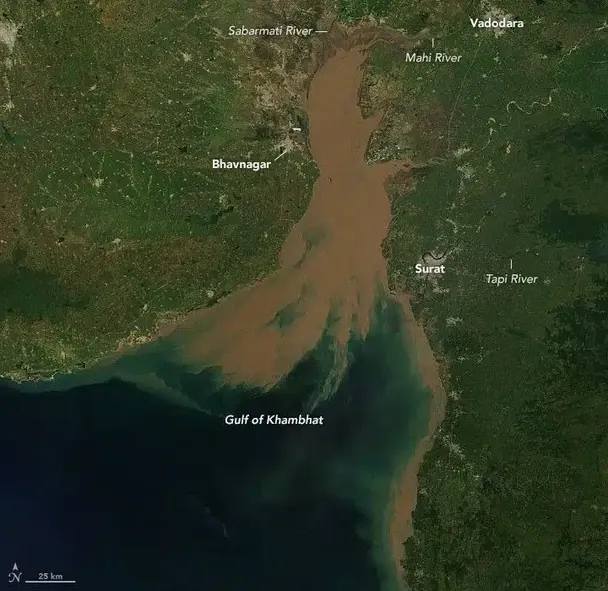
Satellite image of the Gulf of Khambhat in India. / © NASA
Artifact Dating Back 9,500 Years
A pivotal argument leveraged by adherents of the “vanished civilization” hypothesis was the discovered piece of timber. Radiocarbon assessment determined that the specimen is approximately 9,500 years old. This substantially precedes the Harappan civilization (Indus Valley), considered the region’s most ancient, which originated around 3000 BC.
Geologist Badrinarayan, a part of the NIOT team, posits this to be an advanced society from the conclusion of the last glacial period. According to this interpretation, the city was submerged due to a worldwide rise in oceanic levels.
Notwithstanding the compelling discoveries, numerous researchers maintain skepticism. The primary issue involves the complexity of interpreting data in a marine setting, where inherent geological activities may construct misleadingly consistent configurations.
Based on the conventional historical framework, by 2500 BC, only modest rural communities existed in this area of the world, rather than grand-scale urban centers.
Governmental Involvement
It is documented that the question surrounding the object’s origin remains unresolved, yet Indian governing bodies emphasize the significance of continued explorations.
“We need to ascertain what transpired at that time… where and how this civilization disappeared,” expressed Murli Manohar Joshi, who, during the intensive phase of research, was in charge of the Ministry of Human Resources and Ocean Development of India.
It’s worth mentioning that in the Bay of Gibraltar, archaeologists unearthed over a hundred sunken vessels from diverse periods — spanning from the 5th century BC to the time of the Second World War.