
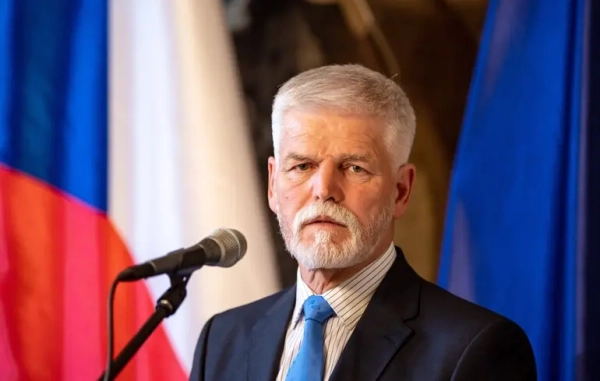
© EPA-EFE/MARTIN DIVISEK Pavel called Trump's harsh statements against the Alliance “unfair.”
The President of the Czech Republic, Petr Pavel, expressed that recent rebukes of NATO by the US President Donald Trump have impacted the Alliance’s reputation more severely than the actions of the Russian leader, Vladimir Putin, over several years, The Guardian indicates.
Pavel, a former general within NATO, also observed that Trump’s censure of the Alliance concerning the conflict involving Iran was “unjust, to say the least.”
During a speech at an event hosted by the Czech media outlet Seznam Zprávy in Prague, Pavel highlighted that NATO is grounded in the tenets of deterrence and shared defense.
“The instant we start to doubt the Alliance as a unified and coherent entity, prepared to act collectively and with resolve, then, undoubtedly, it loses its purpose,” the Czech President cautioned.
“It must be recognized that Donald Trump has undermined the credibility of the Alliance more in recent weeks than Vladimir Putin has in numerous years. This is assuredly not positive news,” he added.
Pavel remarked that Trump’s disparagement appears to disregard that NATO functions as a defensive Alliance, “not an Alliance that will inherently offer aid in battles waged beyond its domain.”
The Czech President underlined that European partners “were not briefed on the objectives and actions initially, and, indeed, no one even sought their collaboration.”
“Only as the conflict began to unfold, perhaps in an unforeseen manner, did Donald Trump proclaim that European allies should ensure the security of shipping in the Strait of Hormuz, and when he did not get an affirmative response, he viewed it as a disappointment for the entirety of NATO,” Pavel conveyed, describing it as “unjust.”
Reports indicate that Trump is already deliberating on the concept of penalizing specific NATO nations that, according to him, did not back the US and Israel during the engagement with Iran. The prospective scheme encompasses removing American forces from those countries and relocating them to the territory of allies displaying greater assistance. The NYT suggested that Trump’s return to the Oval Office is favorable for Putin, given that the current US president represents Russia’s primary asset today.
In this evolving landscape, allies are hesitant to promptly respond to Washington’s signal. What has disrupted the system that has guaranteed US influence for decades? Oleksiy Izhak in the piece “ What's Left of the 'Collective West': Why Allies Are No Longer in a Hurry to Help the US ” elucidated how the rationale behind alliances is shifting.