
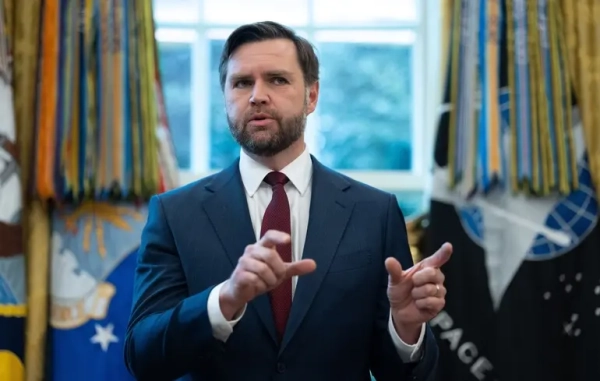
© EPA/ AARON SCHWARTZ / POOL The Vice President offered his thoughts on the suspension of the troop transfer to Poland.
US Vice President J.D. Vance stated that the choice to halt the positioning of 4,000 American soldiers in Poland represents a “routine postponement” and ought to motivate European nations to proactively manage their own protection, Bloomberg reports.
Addressing journalists on Tuesday, Vance minimized the importance of the determination, asserting that the US was “rearranging certain assets in a manner that optimizes American security.”
He further highlighted that Poland possesses the ability to defend itself with backing from the United States.
“I don’t view it as detrimental to Europe. It inspires Europe to assume increased accountability,” Vance remarked.
The US verdict caught Poland off guard, whose president is seen as a steadfast ally of Donald Trump.
In the past week, news emerged that the US Armed Forces had called off the emplacement of the 2nd Armored Brigade Combat Team of the 1st Cavalry Division — encompassing over 4,000 soldiers alongside equipment — to Poland.
Warsaw has consistently garnered commendation from Washington as a leading contributor to NATO’s defense spending relative to its economic size.
As per sources knowledgeable about the circumstance, the European command had yet to ascertain the precise location for the military deployment, but a substantial portion of the contingent was slated to be dispatched to Poland.
Trump previously indicated his intention to pull back a minimum of 5,000 US soldiers from Germany and alluded to a more extensive decrease in the US military presence in Europe, where approximately 85,000 US personnel are currently based.
This unfolded in the wake of a public disagreement with German Chancellor Friedrich Merz, who expressed last month that Iranian negotiators were “demeaning” the United States.
Vance underscored that a definitive resolution is pending regarding the subsequent deployment of these soldiers.
“These soldiers could be relocated to another site within Europe. We might opt to send them elsewhere. We haven’t definitively decided yet on their ultimate destination,” the US vice president conveyed.