
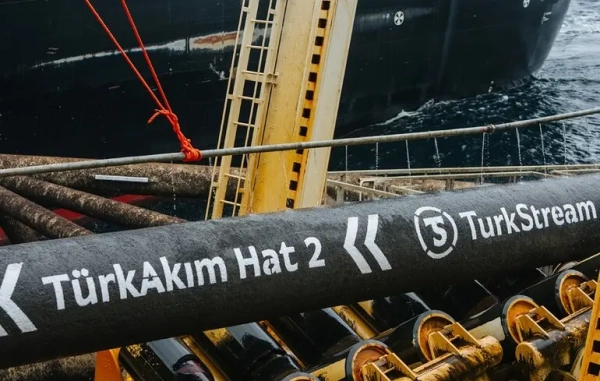
© TurkStream However, despite this, gas continues to flow to Europe in significant volumes.
Russian pipeline gas deliveries to Europe in 2025 are projected to decline to their lowest point since the mid-1970s, resulting from the closure of the Ukrainian transit route and the European Union’s progressive reduction of imports from Russia. Nevertheless, despite a 44% reduction in imports, Russian gas still reaches Europe in notable quantities, and in certain instances, supplies have even grown.
Reuters reports on this matter on Tuesday, January 30.
As previously stated, the EU has declared its intention to cease importing Russian gas by the conclusion of 2027 as part of a strategy to overcome reliance on Russian energy and deny funds potentially utilized to finance Russia’s conflict against Ukraine.
Europe once constituted the primary source of Russian governmental revenue from oil and gas sales via pipelines constructed from the Soviet Union to Western Europe during the 1960s and 1970s.
Russian pipeline gas exports to Europe reached their apex at over 175-180 billion cubic meters annually in 2018-19 – generating tens of billions for Gazprom. However, this year, Gazprom’s deliveries amounted to a mere 18 billion cubic meters, transported through the TurkStream undersea pipeline, according to Reuters’ calculations based on data from European gas transport group Entsog.
This signifies the lowest level witnessed since the early 1970s.
TurkStream remains the sole remaining Russian gas transit route to Europe after Ukraine chose not to prolong a five-year transit accord with Moscow, which lapsed on January 1. Countries receiving gas via the TurkStream pipeline encompass Turkey itself, along with Serbia, Hungary, and Slovakia.
Russia exports gas to Europe in a liquefied state via tankers and stands as the EU’s second-largest provider, following the United States.
In December alone, shipments via TurkStream to Europe surged by 12.9% compared to the prior month, reaching approximately 56 million cubic meters daily. The information also indicates that exports via TurkStream to Europe have risen by around 7% this year from 16.8 billion cubic meters in 2024.
Gazprom’s exports to Turkey approximate 20 billion cubic meters each year.
As a reminder, subsequent to the Russian Federation’s initiation of a full-scale invasion of Ukraine, the European Union endorsed the REPowerEU plan in the spring of 2022 and embarked on a course to renounce Russian energy resources. And the primary beneficiary of this action was the United States of America, as detailed in the article “Peace as a Business: How Much Does the US Earn from the War in Europe” by Mykhailo Honchar, Oksana Ishchuk, and Oleksandr Hara.