
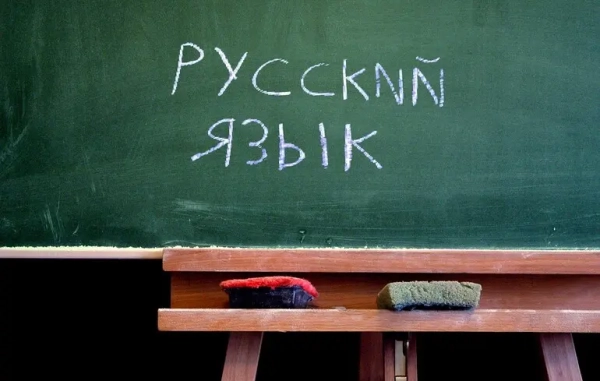
© Ukraine.ru In France, the appeal of studying Russian has waned considerably over the last several decades.
France is commencing a shift away from instructing Russian as a secondary language. For the first time in half a century, there will be no employment opportunities for instructors of Russian in French secondary schools this year, Euronews reported on January 31.
The government opted to omit this discipline from all competitive examinations, encompassing both CAPES (the national examination for recruiting educators for secondary schools) and the more selective agrégation, irrespective of whether they are for public or private educational institutions. Previously, Russian was taught in France from middle school (pupils aged 11 and above) through the university level.
However, interest in learning Russian has been diminishing for several decades. While the peak popularity of Russian language programs in secondary schools was observed in the 1970s, the subject has seen a reduction in prominence since the dissolution of the USSR.
Nevertheless, Russian still holds the distinction of being the most commonly spoken non-EU language within the domain of general secondary education in the European Union: in 2023, approximately 2.7% of students were engaged in its study as a foreign tongue, exceeding the figures for Chinese, Japanese, and Arabic. Yet, this notable presence is attributed to marked geographical variances: the eastern region of the EU exhibits a higher number of learners and instructional hours dedicated to the language.
Conversely, France accounts for a modest fraction within this statistical data: at the commencement of the 2024 academic year, a mere 10,000 students were pursuing Russian studies in secondary education – encompassing middle schools, high schools, and preparatory divisions of higher learning institutions, including both publicly funded and privately operated ones.
As per the latest figures, the tally of new teaching posts, which oscillated between 7 and 9 during the initial years of the full-scale war in Ukraine, is projected to dwindle from 2 to 0 between 2025 and 2026.
The French Association of Russianists, a significant portion of whose membership originates from Ukraine, also perceives its role as a platform for demonstrating solidarity with the nation that has endured an attack from Russia. In one of its official statements, the association articulated its intention to “affirm its condemnation of this unwarranted, dishonorable, and unacceptable conflict waged by the armed forces of the Russian Federation.”
The petition will not impact the government’s stance. The Ministry of Education has corroborated that it “will no longer proceed with organizing competitive examinations for the hiring of teachers” specializing in the Russian language. It rationalizes this determination by citing “the recent drop in the appeal of this subject,” asserting that in preceding years “the number of qualified individuals surpassed the available positions.”
According to the ministry’s data, the count of applicants vying for the position of Russian language instructor has been on a “consistent downward trajectory” over the past three years: registering 71 candidates in 2023, 64 in 2024, and 52 in 2025.
Educators who have devoted their entire careers to the subject must now leverage the limited resources at their disposal to imbue renewed relevance into the study of a language that continues to be linked with classical literature, Soviet historical narratives, and, currently, the aggressive war against Ukraine, which will mark its fifth year in a few weeks.
However, there exists a nation that has instituted compulsory Russian language education starting from the fourth grade. That nation is North Korea.
According to Russian Minister of Natural Resources and Ecology Alexander Kozlov, who also serves as co-chair of the intergovernmental commission connecting Russia and the DPRK, roughly 600 North Koreans are presently engaged in the study of Russian, positioning it among the top three most favored languages in the country.
Last year witnessed the acceptance of 96 North Korean nationals into Russian universities, including the prestigious Moscow State Institute of International Relations. Furthermore, an additional 29 students enrolled in geology courses within Russia this year.