
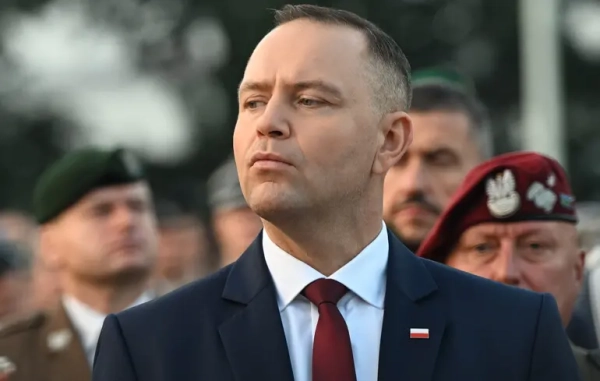
© Getty Images The head of state's action has already been deemed an act of betrayal.
The Polish President, Karol Nawrocki, declared on Thursday evening his intention to reject a governmental proposition that outlines the method for utilizing the nation’s share of 43.7 billion euros from the European Union’s SAFE (Security Action for Europe) initiative, a mechanism designed for weaponry procurement through loans, as reported by Politico.
The administration of Prime Minister Donald Tusk lacks the necessary parliamentary support to overturn a presidential veto. This confrontation is almost certain to intensify the existing political discord between Tusk and the President regarding Poland’s international relations.
Poland stands alone as the sole nation where the SAFE initiative has evolved into a contentious political subject. Ursula von der Leyen, the President of the European Commission, previously stated in December that EU member states had effectively committed the complete €150 billion SAFE allocation and are requesting supplementary funds.
“The president forfeited an opportunity to behave patriotically. A disgrace!” Tusk posted on the X platform soon after Navrotsky’s pronouncement.
The premier further indicated that an extraordinary governmental assembly would be convened on Friday to formulate a response.
The government labels it “national betrayal”
The SAFE program offers extended, reduced-interest loans featuring a decade-long deferment period before principal repayment commences.
The funds are sourced by the European Commission through financial institutions and possess significantly more favorable terms compared to domestic borrowing. This holds particular relevance for Poland, which intends to dedicate 4.8% of its GDP to defense expenditure this year.
Following Nawrocki’s resolution, Poland’s allocation from SAFE will remain guaranteed, although the stipulations governing its implementation are likely to be less adaptable than originally outlined in the rejected legislation.
The government had intended to designate the funds towards:
- increased financial resources for the Border Protection Service and the police force,
- infrastructure enhancements.
Before the decision was reached, Radosław Sikorski, the Polish Foreign Minister, cautioned:
“If the president vetoes SAFE, yet we proceed with its implementation, I will advocate for the placement of a label on every rifle, tank, cannon, drone, and anti-drone system, stating: ‘Esteemed soldier of the Polish Army, President Nawrocki opposed granting you this.’”
In the wake of the president’s determination, prominent individuals within Tusk’s cabinet expressed vehement condemnation through media outlets and social networking sites, characterizing it as “national betrayal.”
The veto similarly runs counter to the military’s stance. Wiesław Kukula, the Chief of the General Staff of Poland, had referred to the SAFE program as “a pivotal moment for the army” back in February.
During his address, the president reiterated viewpoints he has voiced in recent weeks. He contended that SAFE loans could saddle Poland with enduring debt commitments and exposure to currency fluctuations.
“The SAFE mechanism represents a substantial foreign loan spanning 45 years denominated in a foreign currency, with potential interest obligations reaching 180 billion zlotys (roughly 42 billion euros). This signifies that Poland would effectively reimburse an amount equivalent to the initial loan, solely in interest payments,” Nawrocki elucidated.
He further asserted that the mechanism could empower Brussels to impose political mandates on Poland’s defense expenditures and primarily advantage international arms manufacturers.
“SAFE constitutes a mechanism wherein Brussels retains the prerogative to suspend funding arbitrarily, while Poland remains obligated to service the debt. Security contingent upon conditions is not genuine security. I have resolved that I shall not endorse legislation that would permit Poland to acquire a SAFE loan. I shall never assent to legislation that undermines our sovereignty, autonomy, and economic and military safeguards,” the president declared.
Nawrocki suggested an alternative methodology for financing armament acquisitions — independent of loans and interest, leveraging the gold reserves held by the National Bank of Poland.
Presently, 550 tons of gold are secured in vaults within Poland and internationally, thereby positioning the Polish central bank among the foremost gold custodians in Europe.
Adam Hlapinski, the Governor of the National Bank, indicated last week that the bank possesses approximately PLN 197 billion in unrealized gains derived from the elevated valuation of gold reserves.
A fraction of these assets is being considered as a viable source of funding for defense allocations.
The proposed scheme entails allocating the National Bank’s profits to a dedicated Polish Defense Investment Fund. Hlapinski further remarked that these profits could be realized through actions aimed at reducing the proportion of gold within the bank’s asset portfolio.
Political Strife on the Verge of Elections
Tusk’s administration has delivered sharp criticism of the notion of employing gold reserves, deeming it a high-risk approach that contradicts the central bank’s function as a guardian of financial soundness.
The Council of Ministers also underscored that the vast majority of SAFE allocations were earmarked for Polish manufacturers, which would generate new employment opportunities and spur economic activity.
The disagreement concerning SAFE surfaces as Poland gears up for parliamentary elections in 2027. The opposition Law and Justice (PiS) party aspires to unseat Tusk’s pro-European coalition.
Surveys of public sentiment suggest that Tusk’s Civic Coalition party could emerge in the lead, but might lack sufficient electoral backing to establish a majority government.
Concurrently, PiS could potentially secure a majority contingent upon establishing an alliance with the far-right Confederation party and the even more extremist Confederation of the Polish Crown, which frequently faces accusations of anti-Semitic rhetoric.