
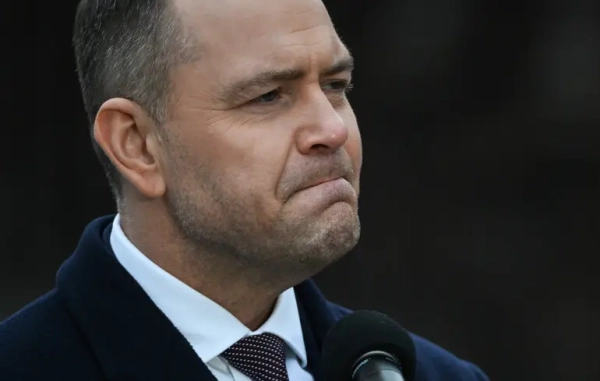
© Getty Images

Oleksandr Shevchenko,
Karol Nawrocki is still reshaping the political scene in Poland. Throughout his seven months in power, the Polish president has grown accustomed to a consistent, sharp confrontation with the government, and to the reality that the right of veto in his hands has evolved from an uncommon tool to a more regular occurrence. In this aspect, he has already surpassed all prior accomplishments, as he rejected 31 draft laws between August and May (in contrast, his forerunner Andrzej Duda utilized the veto option 19 times during his 10 years in authority. And the individual with the most uses before Nawrocki, Aleksander Kwasniewski, employed this right 35 times across 10 years). However, the president's aspirations for transformation did not end there, and on Constitution Day, celebrated on May 3, Nawrocki revealed the initial measures to update Poland's existing Constitution.
Presidential initiative
Karol Nawrocki alluded to the necessity of constitutional alterations in late April, when he expressed support for a presidential system of governance during an interview with Kanał Zero. This declaration arose during a discussion about the influence wielded by the Polish president, after Nawrocki declined to swear in certain judges of the Constitutional Court who had been nominated by the Sejm. “During electoral campaigns, citizens vest their expectations in their president. Consequently, either Poles should forfeit the right to elect a president, acknowledging a chancellor-led structure, or we ought to establish a presidential system (…) I advocate for a presidential system, though I am not insistent; perhaps opting for a chancellor system would be wise,” Nawrocki shared with journalists, contemplating his authority. These remarks generated considerable attention within Polish media and were widely disseminated.
On May 1, Rafal Leszkiewicz, the Polish President's spokesperson, disclosed that the inauguration of the Council of the New Constitution would be announced during the Constitution Day observances. Indeed, Karol Nawrocki proclaimed during a ceremonious address on Castle Square in Warsaw on May 3: “We are living in a period where political strife has escalated excessively, shattering unity, families, and exceeding every conceivable boundary. It is compromising the political framework and the very principles of the Polish nation. State institutions are duty-bound to be robust and influential, tasked with fostering the nation and ensuring its continuity (…) Today, Poland finds itself at a constitutional juncture. The 1997 Constitution — I hold its creators in respect and gratitude. It was essential and indispensable. I am and shall remain its guarantor until the very end — either mine or its. However, we now require a new generation Constitution for 2030 (…) We must conclusively determine whether we desire the country to be governed by those democratically chosen by the will of the sovereign or permit the government to rule through party alliances (…) I shall not address today what the system should be – prime ministerial or presidential . Yet, this situation cannot persist. It is untenable for power in Poland to be divided between two factions.”
On that same day, Nawrocki formed a novel advisory organization — the Council for the New Constitution operating under the President of Poland. It comprised 10 individuals — renowned legal experts and former politicians (notably including former Marshals of the Sejm Józef Zych and Marek Jurek, as well as the longstanding mayor of Krakow (2002–2024) Jacek Majchrowski), most of whom had some association with Law and Justice. Nevertheless, according to Nawrocki, this constitutes only the initial phase in constructing the Council's framework. Professionals from diverse societal domains will be invited subsequently, and invitations will also be extended to parliamentary bodies. Evidently, the president intends to position the Council, and more broadly the entire endeavor to modernize the Constitution, as a bipartisan matter intended to unite all responsible political entities in Poland. However, given the prevailing circumstances, collaborative efforts towards a new Constitution involving all political factions within parliament appear unattainable. And Prime Minister Tusk's prompt and critical response to the presidential initiative substantiates this.
Donald Tusk was quick to address Nawrocki's ambitious project. And, as predicted, this response proved to be sharply satirical. Back on May 1, following the preliminary announcement of the Council of the New Constitution's establishment, the Prime Minister commented on the X platform: “I suggest commencing by showing respect for the existing one.” Nonetheless, on May 3, during a press conference preceding a work-related journey to Armenia, the Polish Prime Minister articulated his viewpoint more comprehensively: “Today, I would urge the president and the opposition to cultivate respect for the current Constitution before initiating work on a fresh one. (…) There is no flawless Constitution, nor are there perfect political structures. (…) Currently, we require not only cohesiveness within NATO and the European Union but also unity concerning the institutions of the Polish state. This unity, this uniformity, is achievable solely when individuals are bonded by fundamental solidarity, and the government by law and the Constitution. “Often, the president hails from one political group, and the prime minister from another; hence, reliance must be placed on upholding the law. Life remains viable even amidst ongoing political disagreements, provided the Constitution and other legal provisions are adhered to. The president is acutely aware that there will be no constitutional majority to endorse his concepts presently, in the near future, or thereafter , rendering this endeavor predominantly a political maneuver.”
Tusk's pronouncements and the overarching reaction of representatives from the governing coalition to Navrotsky's undertaking suggest that their participation in crafting a revised version of the Constitution is virtually nonexistent. Consequently, any efforts by the President's Office to portray this as a national and non-partisan procedure are destined for failure.
Furthermore, modifying the Constitution necessitates the backing of two-thirds of the Sejm, specifically 307 deputies (for context, the incumbent government coalition, encompassing the Civic Coalition, the Third Way, and the Left, possesses 248 deputies). Throughout Poland's history, no political assembly has commanded such a majority, and there are no indications that the forthcoming parliamentary elections could grant anyone such a majority, even within a coalition. Why, then, did Nawrocki propose this endeavor at all, given its minimal prospects of materializing in the approaching years?
How Navrotsky imposes his own rules of the game on his opponents
The past election cycle and the initial seven months of Karol Nawrocki's tenure reveal him as a politician who opts not to operate according to established norms, traditions, or conventions, but instead prefers to dictate his own principles and compel his rivals to adhere to them. This strategy was evident during the election campaign, where his forceful stance on Ukrainian migrants and refugees pressured even the liberal Rafal Trzaskowski to address the issue and propose ending the 800+ program for unemployed Ukrainian citizens in Poland. Since becoming the president of Poland, Nawrocki has remained committed to this approach. Unlike his predecessor Andrzej Duda, he avoids assuming the role of a generally impartial arbiter who remains detached from the political fray. Nawrocki readily engages in the political process and serves as a constant participant. He achieves this by leveraging all available presidential instruments. He utilizes powers traditionally regarded as ceremonial to engage politically with his adversaries. These include the right of veto, the refusal to administer oaths to newly designated judges of the Constitutional Court (which is, in reality, the president's duty, but Nawrocki cites procedural irregularities in appointing judges), and the prolonged neglect to endorse ambassadorial appointments, resulting in Poland lacking ambassadors in numerous countries worldwide (including Ukraine, where Piotr Lukasiewicz has functioned as the chargé d'affaires ad interim for Poland for over a year and a half). Therefore, the Polish president does not conform to the regulations of the government or the governing coalition but obliges them to function according to his imposed rationale.
On May 3, Nawrocki introduced a fresh, enduring topic into the Polish political discourse (he underscores that it should be the Constitution of 2030 for good reason), which may well evolve into a new point of contention among Polish political entities. The decision by left-liberal political groups to abstain from involvement in the Presidential Council of the New Constitution will be exploited by PiS to accuse opponents of irresponsibility. Concurrently, both “Confederations” will now be hindered from capitalizing on the subject of constitutional amendments without damaging their standing as anti-establishment forces. Crucially, the discussion surrounding the new Constitution has already been integrated into the public arena and political sphere, rendering it unlikely to be ignored now. Consequently, Polish political factions will inevitably define their stance on it, willingly or unwillingly. And thus, they will engage according to the revised parameters of the political landscape — the parameters established by Nawrocki.