
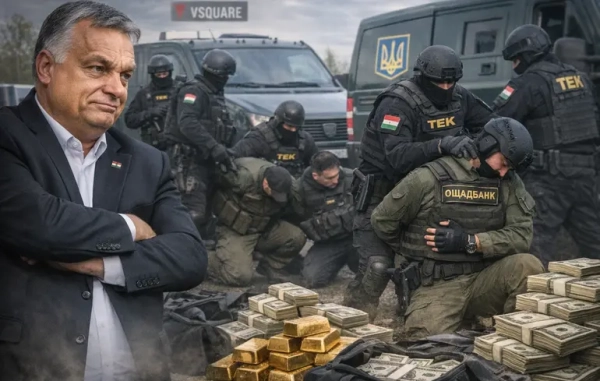
© Image generated by AI at the request of ZN.UA This is how Orban gains favor politically amidst the electoral process.
The action taken against Oschadbank’s cash couriers appears to be a politically charged undertaking by Hungarian intelligence, designed to instigate discord with Ukraine and leverage it leading up to the April 12 election. The Hungarian news outlet hu24 reports this, referencing investigative findings by journalist Szabolcs Panyi from VSquare.
The vilification of the Ukrainian government and backing from the West constitutes a key aspect of the Fidesz party’s messaging. Several VSquare sources suggest that this could be a meticulously orchestrated intelligence scheme for political advantage. The operation was purportedly overseen by Orsz Farkas, the state secretary in charge of civilian intelligence.
On March 5, a specialized team from the Hungarian Counter-Terrorism Centre (TEK) apprehended a pair of fortified Oschadbank collection vehicles, owned by the Ukrainian state, as they transited Hungary en route from Vienna to Kyiv.
The operation led to the detention of seven bank personnel and the confiscation of $82 million in currency and gold. State-affiliated media outlets quickly disseminated claims that the shipment was illicit, linking it to a “military syndicate” and Western funding for the Ukrainian war effort. However, according to VSquare, the incident was, in fact, an intelligence maneuver with ramifications for the election.
According to accounts, the endeavor was managed by Orsz Farkas, the state secretary responsible for overseeing civil intelligence and a vital associate of Minister Antal Rogan, who is in charge of intelligence agencies and governmental communications.
The formal legal rationale — which sources indicate served primarily as a superficial pretext — pertained to a counterintelligence inquiry regarding a former SBU officer who previously directed Oschadbank’s security division.
According to the details of the journalistic probe, Hungarian intelligence had been tracking the movements of cash couriers between Austria and Ukraine since at least January 2026. A portion of the surveillance took place internationally: operatives ascertained the hotels in Vienna where Ukrainian security personnel lodged, along with the routes they frequented.
Once their patterns became evident, the initial strategy was to intercept them while they were transporting weaponry, allowing for the construction of a narrative involving terrorism or illegal weapons proliferation. This is why TEK was involved in the operation, with Farkas personally supervising from the operations hub, attended by representatives from civilian intelligence bodies.
However, the scheme deviated from the intended course. In the aftermath of the raid, it emerged that every aspect — the documentation, financial exchanges, and the transport procedure itself — was entirely compliant with the law, and the drivers and guards were unarmed.
As per numerous sources, it became apparent that neither the action, the imprisonment, the interrogations lacking legal counsel, nor the subsequent expulsion held any legal grounding. Subsequently, a “plan B” was rapidly formulated: the tax authority (NAV) was compelled to initiate a probe into money laundering to retrospectively legitimize the occurrences.
This sparked indignation even within NAV itself, as initially, even the service’s anti-money laundering division was not involved.
The politically driven and impromptu character of the operation is substantiated by another piece of information: despite allegations of a “military syndicate,” military intelligence was not informed, and the Ministry of Defense only became aware of the operation when TEK determined it lacked the means to move the seized vehicles and goods, necessitating recourse to the military for assistance.
According to Szabolcs Panya, the planners of the undertaking boasted in confidential circles about its “most noteworthy outcome.” They maintain that information about the operation promptly reached Ukrainian President Volodymyr Zelensky, who delivered an impassioned response during a press briefing that same day – March 5.
Specifically, he asserted that he could furnish his military with the coordinates of an individual obstructing EU financial assistance to Ukraine. This declaration was interpreted by many as a direct threat to Viktor Orbán.
Panyi states that he could not independently verify that Zelensky’s remarks were indeed a reaction to this precise operation. Concurrently, Orbán’s inner circle is characterizing the events as confirmation that the provocation was successful and elicited a response that can be exploited in the election campaign.
The Prime Minister’s Office, which exercises control over intelligence organizations, and the tax agency NAV did not offer replies to requests for comments. In the meantime, a legal representative for Oschadbank has submitted a grievance to the Hungarian prosecutor’s office, alleging that the officials misused their authority and raising suspicions of a terrorist act.
A celebration that culminated in sorrow
According to Szabolcs Panyi, on March 5 — concurrent with the operation on the Ukrainian couriers — one of the key NAV figures, Lieutenant General D. T., hosted a significant festivity to mark his advancement at a farm situated in the Somogy region. More than a hundred attendees were present, comprising high-ranking NAV officials, government representatives, and politicians, including Orsz Farkas and the government commissioner from the Ministry of Foreign Affairs and Foreign Trade, Gyula Budai.
However, the occasion was marred by a tragic development: one of the invitees, a NAV general, was discovered deceased in a pond in proximity to the farm on the subsequent day. The incident was internally regarded as an accident, but neither law enforcement nor NAV provided a formal explanation.
Sources claim that the details might have been suppressed given the delicate nature of the situation — considering the timing, the array of attendees, and the concurrence with a politically sensitive undertaking against Ukrainian debt collectors. Farkas and Budai later stated that they were invited to the event but did not attend.
Previously, VSquare, citing sources within European security agencies, divulged that Russian President Vladimir Putin had dispatched a cohort of political technologists and information warfare experts to meddle in Hungary’s electoral cycle. Their mandate was to sway the information ecosystem and bolster the ruling Fidesz party’s prospects of maintaining its grip on power.