
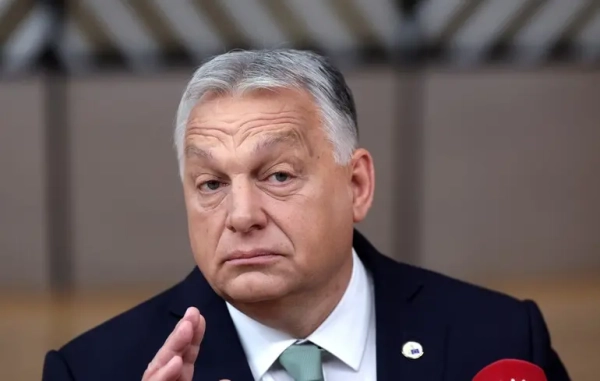
© EPA/OLIVIER MATTHYS The politician is constructing a campaign by standing against Brussels.
The Prime Minister of Hungary, Viktor Orban, dramatically intensified his language towards Ukraine and the European Union, while speaking at an “anti-war” demonstration in Szombathely. He essentially portrayed Ukraine as an external foe of Hungary, and Brussels as the key political adversary, against whom the upcoming electoral campaign is being structured, reports Index.
Orban asserted that Ukraine is allegedly insisting that Brussels disconnect Hungary from inexpensive Russian gas, which, according to him, endangers the system of decreased utility charges for Hungarian households.
“Anyone who demands this is an enemy of Hungary. And therefore, Ukraine constitutes our enemy,” declared the Hungarian Prime Minister.
He contends that without the government's “tariff safeguard” policy, the expenses of Hungarian families for utilities would rise by 800,000-1 million forints annually.
Ukraine, conflict, and the “menace from the EU”
Throughout his address, Orban frequently circled back to the subject of Russia's war in Ukraine.
As per his statement, the European Union is purportedly executing a scheme to gear up for war by 2030, and he referred to the period of 2026–2030 as “the most perilous in the lifespan of the present generation.” Therefore, as clarified by Orban, he views the ongoing parliamentary elections as “the last before war.”
The Prime Minister posited that Hungary ought not to endorse Ukraine's entry into the EU, nor relinquish any military or economic collaboration with it, as this, he stated, would “pull the nation into war,” resulting in Hungarian soldiers perishing on the battle lines.
Orban devoted a distinct segment of his address to the European Union, urging young individuals to “revolt not against the Hungarian government, but in opposition to Brussels.”
“It's not hard to rebel against the Hungarian government. Rebel against Brussels – that's where the threat to us originates,” he conveyed.
Orban affirmed that Brussels is attempting to deprive Hungary of financial resources, redirecting them to Ukraine, and is additionally applying pressure to compel all EU member countries into engaging in the war.
He also blamed European political powers for endeavoring to unseat him, arguing that “they were unable to persuade us.”
“They attempted to convince us previously. It proved unsuccessful – now they seek to replace us,” voiced Orban.
Hungary is currently one of the most heavily subsidized nations within the European Union: it is a recipient, as opposed to a contributor, within the EU. For each 1 euro paid into the EU budget, Hungary gains roughly 3–4 euros in return. Simultaneously, the European Union has put a hold on a portion of the Recovery Fund designated for Hungary, citing substantial deficiencies concerning the rule of law within the country.
The Hungarian Prime Minister further disclosed that he will journey to Washington in a fortnight for the inaugural gathering of the so-called Peace Council. As he stated, it is a matter of national safety for Hungary to retain dominance over power, the financial industry, and to maintain equilibrated ties with Russia, Ukraine, and the EU.
Hungary's elections are penciled in for April 12, and Orban is facing a challenge to his authority for the first time since 2010. The opposition is headed by the leader of the Tisza party, Peter Magyar, a former government official, who pledges to combat corruption, release billions of euros in suspended EU funds, and firmly plant the country within the European Union.
Public opinion surveys indicate that Viktor Orban's pro-government party, Fidesz, is currently trailing its competitor by 8 points.