
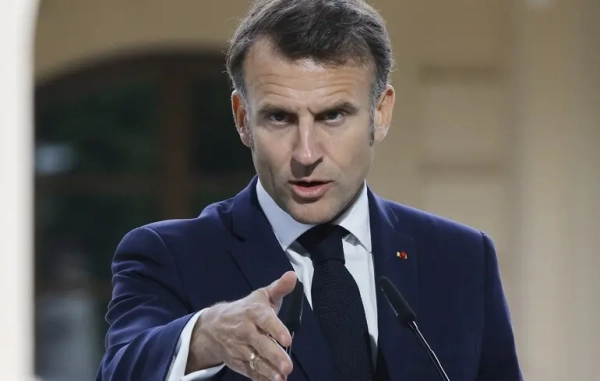
© EPA-EFE/SERGEY DOLZHENKO Europe is showing growing skepticism about the US’s trustworthiness.
French President Emmanuel Macron is scheduled to present an updated version of his nation’s nuclear doctrine on Monday, March 2, detailing what Paris can provide to allies who have worries concerning the dependability of the American nuclear safeguard under President Donald Trump, Reuters reports.
Even though both France and the UK possess nuclear capabilities, most nations in Europe mainly depend on the US to discourage potential enemies—a security arrangement that has spanned decades across the Atlantic.
However, Trump’s course of action concerning Russia, along with his stricter attitude toward established allies, including threats regarding the acquisition of Greenland, a self-governing area belonging to Denmark, a NATO ally, has made European governments uneasy.
Earlier in the month in Munich, German Chancellor Friedrich Merz stated that Berlin had initiated talks with France regarding a possible European nuclear deterrent, which Macron suggested should be a “holistic approach to defense and security.” Other nations, even typically pro-American Nordic countries, have indicated a level of careful interest.
The issue of France's capabilities
European officials have privately cast doubt on the degree to which France’s nuclear power can safeguard the continent. These worries include the division of expenses, determining who has the authority over launch rulings, and whether a focus on nuclear capabilities might overshadow vital investments into standard forces.
France allocates around 5.6 billion euros ($6.04 billion) yearly to sustain its set of 290 nuclear warheads — the fourth-largest worldwide.
“If Europe truly aspires to operate independently, it needs to build its own nuclear ability. This will demand billions of euros… It would also result in the loss of the ultimate assurance of our freedom, namely the US nuclear safeguard,” NATO Secretary General Mark Rutte said this past January during a speech at the European Parliament.
Specialists approximate that the United States has positioned a total of approximately one hundred nuclear bombs across Belgium, Germany, Italy, the Netherlands, and Turkey as a component of NATO’s nuclear discouragement. If a war were to occur, the air forces of these nations lacking nuclear arms would deploy the American bombs consistent with the “nuclear sharing” policy.
This month, US Deputy Secretary of Defense Elbridge Colby informed allies while in Brussels that Washington would proceed to extend its nuclear deterrent to Europe, even as it dedicates over a trillion dollars to updating its personal stockpile.
French authorities assert that Paris does not intend to substitute for American defense or challenge NATO. They clarify that Paris seeks to improve European understanding of what France’s approach can and cannot furnish. However, Paris firmly maintains that funding deterrence remains France’s individual duty, ensuring national oversight.
A critical aspect of France’s stance involves “strategic ambiguity,” specifically relating to the circumstances under which nuclear arms could be utilized and clarifying the convergence of Paris’s interests with the broader European defense objectives.
Some partners view this ambiguity as failing to bolster trust.
“First, we wish to ascertain what France can contribute… It’s not merely about possessing deterrents, but about the extent of their reliability,” declared a senior diplomat representing Eastern Europe.
Any escalation of France’s function would also compel Europe to create long-range missiles exceeding 2,000 km, a capability currently absent. Furthermore, the creation of tactical nuclear arms tailored for use on the battlefield, as opposed to strategic arms intended for distant launches, is deemed even less plausible.
Authorities indicate this situation would elicit worries about the nuclear non-proliferation treaty, which European governments have historically backed.
“We grasp the origin of these conversations. They arise from the reality that our transatlantic partnership has declined from its former stature. My personal view is that the proliferation of nuclear weapons globally does not foster a more secure environment for us all,” the EU’s principal diplomat, Kaia Kallas, communicated to journalists in Brussels earlier in the month.
Macron's nuclear doctrine
While at France’s nuclear submarine base positioned in Brittany, Macron plans to present a speech centered on nuclear doctrine, a habitual practice for each presidential term. According to this doctrine, France’s policy involves upholding a small yet dependable inventory capable of inflicting severe losses to dissuade any preliminary strike.
“The mere dialogue surrounding alternatives serves as a signal for Moscow,” one senior European official pointed out.
French officials refrained from furnishing details leading up to Macron’s speech, yet emphasized that the strategic landscape had drastically changed since his previous address in 2020, referencing Russia’s growing stockpile and heightened nuclear discussions in the wake of its full-scale incursion into Ukraine in 2022.
France has continuously stated that its crucial interests span a European dimension. Going back to 2020, Macron extended invitations to associates for strategic talks, a proposal that did not generate much enthusiasm at the time.
Officials clarify that a fundamental principle of the doctrine remains unchanged: a nuclear strike can only be ordered by the French president.
“That was the case, and that shall remain the case,” said the advisor to the French president.
Europe seeks a strategy for enduring security. However, is it capable of guaranteeing its own security without complete dependence on Washington and its nuclear safeguard, coupled with readiness for widespread mobilization in response to Russian aggression? In the article “ France and Britain instead of the USA? Five scenarios of nuclear autonomy for Europe, ” Oleksiy Izhak performed an extensive study of the existing nuclear deterrence setup, explaining why trust in American guarantees has waned from its unconditional stature and outlining the feasible options available to European capitals.