
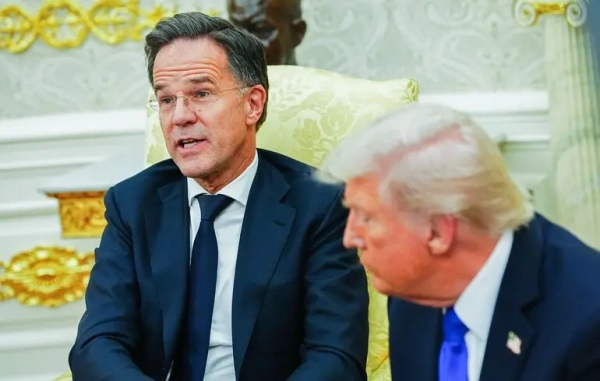
© EPA/ AARON SCHWARTZ / POOL The dangers of the Alliance's breakdown are too significant to overlook.
The deadly attribute of a commander, as considered by the 19th-century Prussian general Carl von Clausewitz, is obstinacy—or “resistance to one’s own good judgement.”
A contemporary instance of such conduct, according to The Economist, is NATO Secretary General Mark Rutte.
In recent times, Rutte has declined to recognize that the transatlantic alliance — the cornerstone of European security for over seventy years — is nearing collapse.
And to achieve this, the journal observes, one must intentionally turn a blind eye to reality.
Rutte disregards repeated pronouncements by US President Donald Trump, who questions America's readiness to adhere to NATO's Article 5 – the clause stipulating that an assault on one ally constitutes an assault on all.
Trump also mentions a potential decrease in the American military footprint in Europe.
Despite this, Rutte, the prior prime minister of the Netherlands, continues to assert that the US is “absolutely committed to NATO and absolutely committed to Article 5.” He also contends that the Alliance does not require a “Plan B” in the event of a sudden US departure from NATO.
Furthermore, at NATO headquarters, he has essentially forbidden any conversations concerning such a scenario.
According to The Economist, Rutte is mistaken on all these counts. Nonetheless, in his justification, the authors indicate that the NATO Secretary General is acting as a diplomat.
In an attempt to retain the US within the Alliance, Rutte praises Trump, endures his volatile outbursts, and has even referred to him as “daddy.”
He is concerned that Europe's endeavors to progressively forgo American security assurances might further irritate the unpredictable US president and merely accelerate the separation that the remainder of NATO seeks to prevent.
Other European leaders are similarly resorting to praise and attempting to appeal to Trump's commercial mindset, investing billions in American weaponry, much of which is subsequently transferred to Ukraine.
In certain instances, Europe simply lacks a different avenue. For instance, the EU possesses practically no substitute for the American Patriot air defense systems.
Even the mere prospect of a “plan B” is already sparking alarm among the generals.
A substantial part of NATO's deterrence is predicated on the capability to integrate the armies of numerous nations into a unified system under the joint command of an American general.
Without the US maintaining this structure intact, the remnants of the Alliance could become entangled in disputes over who should be in command, along with uncertainties about whether European commanders would possess genuine authority in the event of war.
However, notwithstanding all the hazards of Europe openly preparing for a possible “divorce” with the United States, it is left with no alternative. Rutte's optimism no longer aligns with reality.
Trump's threats in January to seize Greenland from NATO member Denmark have already compelled several European countries to discreetly commence planning war scenarios without US involvement.
Since that time, Trump has further weakened assurances from his own officials that the diminution of the American role in Europe would be gradual and regulated.
He also unexpectedly declared a reduction in the number of American troops in Europe and revoked some of the scheduled force deployments.
On May 22, the US was also slated to decrease the forces it would pledge to dispatch to Europe in the event of war.
The allies can no longer be certain even of the deliveries of American arms they have acquired, as the US is postponing certain shipments due to the necessity of replenishing stockpiles depleted during the conflict with Iran.
Reestablishing the Alliance without the US will be challenging and costly — which is why, according to The Economist, we must commence immediately.
Europe could:
- “Europeanize” NATO frameworks;
- establish a new military coalition;
- or expand upon existing formats, such as the British-led Joint Expeditionary Force;
- or a “coalition of the willing” that intends to furnish security guarantees to Ukraine.
Each of these choices would be perilous. But, the journal concludes, inaction is even more hazardous.