
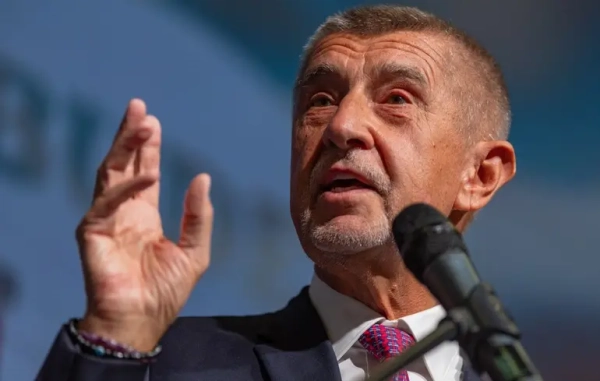
© EPA/ MARTIN DIVISEK Babis pointed out that his cabinet does not plan to elevate military expenses to 3.3% of GDP, in accordance with EU blueprints.
The Prime Minister of the Czech Republic, Andrej Babis, stated that Ukraine is not a focus for the existing administration. According to Babis, the termination of hostilities needs to be negotiated by US President Donald Trump, Ukrainian President Volodymyr Zelensky, and “European heads of state.” He conveyed this in an interview with Denik.cz on February 26.
He remarked on the discourse by Czech Foreign Minister Patr Macinka at the UN, who strongly objected to Russian Foreign Minister Sergei Lavrov and deemed the Russian strategy flawed and opposed to international law, observing that this address does not imply that anything will shift in the current administration’s stance regarding Ukraine.
“No, no, no. We triumphed in the elections with a platform of enhanced daily life for Czech inhabitants. That's what I'm pursuing, chiefly in the sphere of healthcare. I realize that the opposition, the president, and others are perpetually discussing Ukraine. Yet this is not our focus; it's incumbent upon Donald Trump and European leaders, jointly with President Zelensky, to adjudicate,” he expressed, underscoring that the principal matter for him is to construct a healthcare infrastructure in the Czech Republic.
Furthermore, Babis clarified that his government will not augment defense outlays to 3.3% of GDP, since the funds will be channelled to domestic requirements. Concurrently, the defense budget constitutes 2.1% of GDP this year.
It is worth mentioning that Prague and Bratislava are progressively leveraging domestic populism, impeding backing for Ukraine and enervating the EU's posture. In the article “Populism and 'Orbanization' Instead of Security: Why the Czech Republic and Slovakia Are Playing into the Kremlin's Hands Against Ukraine,” Yulia Nevmerzhytska, a junior expert at the Ukrainian Prism Foreign Policy Council, scrutinizes how the Czech Republic and Slovakia are gravitating towards the Orban paradigm and why this redounds to the Kremlin’s advantage.