
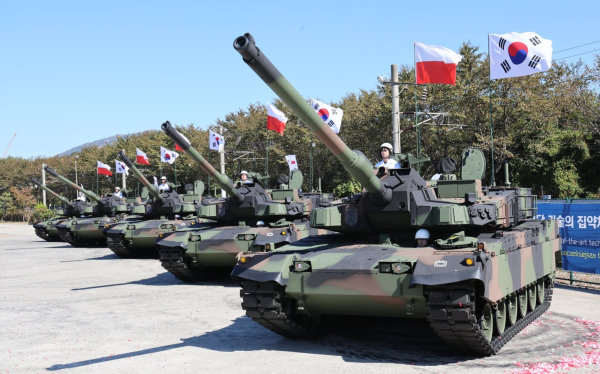
Warsaw and Seoul have consented to elevate their mutual relationships to a comprehensive strategic partnership, with a primary focus on the defense sector, collaborative manufacturing, technology exchange, and investment in a Polish production base.
South Korean President Lee Jae-myung and Polish Prime Minister Donald Tusk concurred in Seoul on April 13 to advance their diplomatic ties to a holistic strategic alliance. Leading up to discussions, both parties articulated that the nucleus of this fresh cooperative framework would be the defense industry, alongside linked domains such as energy, infrastructure, science and technology, cutting-edge manufacturing, and aerospace. Tusk characterized South Korea as “Poland’s most vital partner following the United States, particularly within the defense sphere,” and pledged to directly oversee the augmentation of bilateral collaboration.
The economic significance of this announcement resides in the fact that political convergence is predicated not solely on arms dissemination, but on enduring industrial assimilation. Lee underscored that teamwork will evolve within the context of a $44.2 billion defense arrangement formalized in 2022, extending beyond mere provision: it encompasses cooperative manufacturing, technological diffusion, and workforce instruction. The Polish armed forces presently utilize Korean K2 tanks, K9 self-propelled artillery, FA-50 light combat airplanes, and Chunmoo multiple launch rocket systems.
For Poland, this signifies more than simply acquiring hardware, but establishing a novel defense-industrial infrastructure within its borders. Earlier in 2022, Reuters communicated that the inaugural segment of the Korean-Polish package comprised 180 K2 tanks and 48 K9 howitzers, with the subsequent stage encompassing over 800 tanks and 600 howitzers, with a proportion of production being localized in Poland.
This paradigm is already manifesting into tangible capital undertakings. In July 2025, Poland finalized negotiations with Hyundai Rotem for a secondary consignment of 180 K2 tanks valued at approximately $6.5 billion; the agreement incorporates domestic assembly within Poland in conjunction with Polish defense entities. Towards the close of 2025, Poland and South Korea also transitioned to collaborative missile production for the HOMAR-K/Chunmoo platforms: as per the Polish Ministry of Defense, the contract addresses the establishment of production capabilities in Poland, and Reuters previously documented the creation of a joint enterprise involving Hanwha Aerospace and WB Electronics.
The renewed political intensification of relations also reinforces Poland's wider investment allure as a European nexus for Korean capital and technology. According to the South Korean Foreign Ministry, Poland has already evolved into Korea's fifth-largest trading collaborator within the EU, and Korea represents the foremost Asian investor in Poland as of 2024. Given this framework, the defense partnership is evolving into one of the most substantial conduits for industrial investment across Europe.
The monetary context additionally favors such consolidation. Poland continues to be NATO's principal defense allocator in relation to GDP: Reuters previously conveyed that the nation intends to allocate 4.7% of GDP towards defense in 2025 and aspires to elevate this figure to 5% in 2026. For Korean manufacturers, this signifies not merely a solitary transaction, but entry into one of Europe’s most vibrant defense capital expenditure marketplaces.
Consequently, the accord between Seoul and Warsaw transcends a mere diplomatic formality. For investors and industrial conglomerates, it serves as an indicator that the Korean-Polish coalition is progressing into an era of sustained productive investment, where arms dissemination is augmented by localization, technology transfer, the formation of joint ventures, and the expansion of affiliated sectors – spanning from infrastructure to energy distribution networks. This constitutes a deduction that directly emanates from the pronouncements of leadership and the contracts already executed.
For Ukraine, this instance is illustrative, yet it is more precise to articulate not a comprehensive deficiency of such initiatives, but that they have yet to attain the equivalent magnitude and institutional framework. Poland is affiliated with NATO and the EU, possesses anticipated multi-year defense financing, and is capable of finalizing extensive long-term contracts incorporating production localization within the country. Conversely, Ukraine operates within parameters of military vulnerability, constrained accessibility to long-term capital, and circumstances wherein its own defense sector is already ahead of the state’s capacity to procure the aggregate accessible volume of products. Hence, Kyiv inaugurated military exports in 2026 and initiated the creation of European export hubs, endeavoring to secure external demand and capital for the sector.
An additional significant factor exists: Seoul’s own apprehension pertaining to a straightforward military cooperative model with Ukraine. Reuters previously indicated that within South Korea, substantial public disapproval existed regarding direct arms provisions to Ukraine, with national authorities restricting themselves to non-lethal support and highly circumspect political signals. Under such circumstances, it is considerably simpler for Korea to construct a large-scale defense-industrial alliance with Poland, a NATO member with predictable funding, assurance mechanisms, and diminished political jeopardy for the Korean administration and enterprises.
Simultaneously, this does not imply that substantial defense investment programs with Ukraine are unfeasible. Contrarily, in recent months, Kyiv has commenced unblocking military exports, with Ukrainian entities endeavoring to monetize combat-verified technologies — from drones to air defense systems. Reuters has also reported on an endeavor to attract $760 million in capital for Fire Point from a strategic Middle Eastern investor, albeit the procedure has thus far encountered regulatory impediments. Stated differently, the issue does not reside in a scarcity of technologies or demand, but in Ukraine’s current inability to consolidate this potential into a unified interstate program of localization and technology transference on the scale of the Korean-Polish template.