
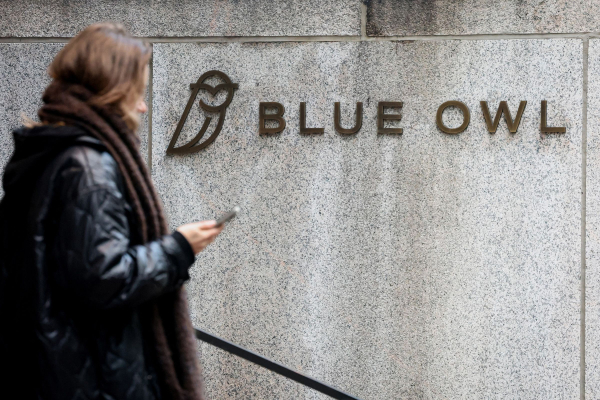
Moody’s Ratings has adjusted its projection for Blue Owl Credit Income Corp (OCIC), a leading fund under Blue Owl’s management with approximately $36 billion in assets, from “stable” to “negative.” This change was triggered by withdrawal applications during the initial quarter of 2026, which, according to the agency, were considerably elevated relative to comparable investment vehicles. Moody’s also cited as a further source of concern the fact that the bulk of these requests originated from a notably small group of shareholders, suggesting a concentrated shareholder composition.
The stress on the fund has grown following Blue Owl’s announcement last week that it would place a limit on redemptions across two of its private credit funds. Regarding OCIC, investors sought to redeem 21.9% of outstanding shares, yet the firm opted to fulfill only 5%, aligning with the quarterly threshold. Concurrently, within the technology-focused fund OTIC, withdrawal demands reached 40.7% of the shares, marking one of the highest quarterly figures witnessed in its sector.
Blue Owl, for its part, asserts that this situation does not indicate any underlying weakness in its portfolio. In a communication to investors, the fund highlighted that net redemptions in OCIC constitute less than 1% of the total assets being managed, and that roughly 90% of its investors have not filed any exit requests whatsoever. The firm also maintains that it is adequately positioned to navigate the prevailing market conditions.
Nevertheless, Moody’s anticipates that even with the imposition of a 5% redemption ceiling, liquidity constraints will not ease rapidly. The agency projects a continuing high volume of withdrawal applications in the upcoming quarters, juxtaposed with a deceleration in the rate of new capital inflows. The rating agency suggests that this could incrementally erode the fund’s presently robust capital and liquidity positions.
The Blue Owl development formed part of a more extensive evaluation of potential risks within the private credit landscape. On that very day, Moody’s also revised its outlook for the overall U.S. business development company (BDC) sector from “stable” to “negative,” citing increasing buyout pressures, elevated leverage levels, and diminished access to funding opportunities. According to Reuters, these strains have already impacted Wall Street, with numerous funds restricting distributions and leading banks tightening lending guidelines for the approximately $2 trillion private credit domain.
This represents a noteworthy signal for the investment community: the challenge lies not solely in the caliber of loan portfolios but additionally in the degree of liquidity offered by products that promised limited, yet consistent, withdrawals. Back in March, S&P Global had already taken a parallel action, altering the outlook for the major private credit fund Cliffwater to “negative” due to heightened redemption requests. This signals that rating pressure is progressively transitioning from individual instances to a more comprehensive systemic threat across the non-traded private credit landscape.