
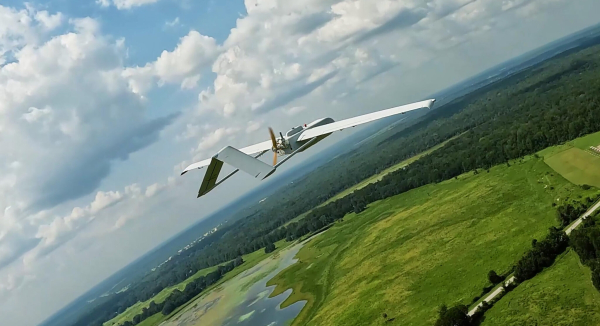
AEVEX, headquartered in Solana Beach, CA, has revealed an initial public offering price bracket of $18-21 per share, aiming for a market capitalization reaching $2.35 billion. The enterprise is supported by private equity group Madison Dearborn Partners, with Goldman Sachs, BofA Securities, and Jefferies serving as joint global coordinators and lead bookrunners.
AEVEX’s investment rationale centers on the swiftly expanding need for unmanned and self-governing systems in contemporary warfare. Within the offering document, the entity portrays itself as a purveyor of AI-driven unmanned systems for pinpoint attacks, lingering munitions, and comprehensive intelligence, surveillance, and reconnaissance, additionally noting it has already supplied over 6,200 independent systems, with an additional 3,900 secured for delivery by the close of 2026. Independently, the firm underscores the magnitude of the Phoenix Ghost and EUCOM AOR Deep Strike initiatives, which collectively comprise in excess of 9,300 systems and more than $1.2 billion in total contract worth.
From a financial standpoint, AEVEX is entering the equity market not as a nascent startup, but as an already established defense business. Per the S-1 document, the firm's earnings in 2025 grew to $432.9 million compared to $392.2 million in the prior year, while the funded order book rose to $503.1 million from $179.2 million. Concurrently, the bottom line in 2025 was in the red – the deficit totaled $16.8 million, and Adjusted EBITDA declined to $37.6 million from $77.0 million in 2024.
A noteworthy detail for the market: in the offering document, AEVEX unequivocally asserts that it will not secure funds from the fraction of shares slated for sale by current selling stakeholders as part of the IPO. In other words, the headline sum of $336 million signifies the extent of the placement, yet not all of this sum will translate into fresh capital for the business itself. A portion of the capital sourced by the company is earmarked for debt reduction and broad corporate objectives.
For stakeholders, this represents an additional sign that defense-related issuers are opening a new IPO timeframe. Reuters directly attributes interest in AEVEX to escalating military outlays, the conflict in Ukraine, and tensions in the Middle East, and analysts are presently characterizing the market setting as a defense “supercycle.” Concurrently, aerospace/defense manufacturer Arxis also commenced a roadshow in the US, suggesting a wider inclination to capitalize on the defense narrative via the public markets.
On a separate note, AEVEX effectively incorporates the Ukrainian component into its equity narrative. Inside the offering document, the corporation stresses that the hostilities in Ukraine have illustrated the pivotal function of UAS in modern warfare, and further anticipates the manufacturing of roughly 4 million unmanned aerial vehicles in Ukraine during 2025. For public investors, this renders the drone/ISR sector not a specialty story, but one of the key orientations of the novel defense epoch.
From a risk angle, AEVEX also remains a notably focused government contractor: approximately 84% of its funded commitments as of year-end 2025 were tied to the American government, and the entity itself cautions in its submission concerning vulnerability to the budgetary procedure, regulatory stipulations, and potential revisions to government agreements. In essence, the public market isn’t solely acquiring a “drone narrative,” but a defense business with a strong reliance on government commissions.