
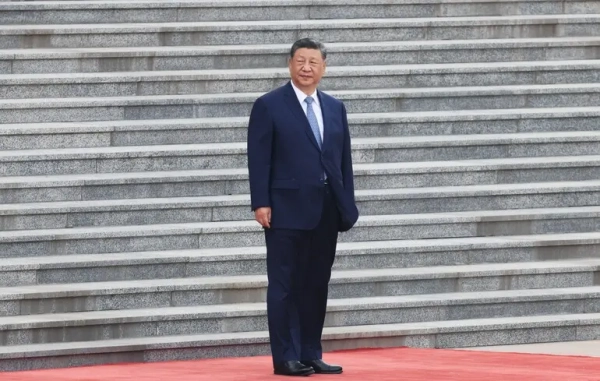
© EPA/ MAXIM SHEMETOV / POOL China endeavors to showcase itself as a dependable mainstay on the global arena, even as it implements contentious strategies.
This year, global leaders are flocking to meet a key figure: the Chinese President, Xi Jinping. According to the Financial Times’ findings, drawing on figures from China’s Ministry of Foreign Affairs and state-run media, 21 presidents or prime ministers have visited China during the initial five months of 2026.
Amongst China’s visitors are the heads of Turkmenistan, Uruguay, and Mozambique, together with the German Chancellor, Friedrich Merz, the Spanish Prime Minister, Pedro Sanchez, the Canadian Mark Carney, and the British Prime Minister, Keir Starmer. US President, Donald Trump, and Russian President, Vladimir Putin, also convened summits with Xi this month. Pakistani Prime Minister, Shehbaz Sharif, and Serbian President, Aleksandar Vucic, are currently in Beijing this week.
Commentators suggest that this procession of international figures could bolster China’s ambitions to depict itself as a steadfast anchor and proponent of multilateralism on the international stage, even while Beijing adopts a forceful trade approach, displays rising military presence in Asia, and cultivates tight alliances with Russia and North Korea.
For Xi’s domestic audience, it carries distinct undertones harking back to the pre-20th-century tributary system, where minor rulers and dignitaries undertook pilgrimages to the imperial court.
“There is a specific Chinese connotation to this, particularly in its reception by the Chinese populace, as a revival of the normal order, where others come to you,” observes historian John Delury.
Concurrently, Xi’s international travel has diminished notably relative to the early phase of his leadership. He has not ventured outside China this year, and in 2025 he undertook merely six international journeys.
During the seven years since Xi assumed leadership of the Chinese Communist Party in 2012, he has embarked on 100 overseas trips. Over the same duration, US presidents Barack Obama and subsequently Trump completed 90 journeys, as indicated by data assembled by the Asia Society.
Subsequent to the relaxation of stringent coronavirus measures, Xi undertook 26 foreign visits in 2022. The comparative figure for his American counterparts — Joe Biden and Trump — stands at 56.
Neil Thomas, a fellow at the Center for China Analysis, remarked that Xi’s international travels since the pandemic’s onset have prioritized China’s neighbors and a limited assortment of strategic partners within Central and Southeast Asia — regions frequently overlooked by the United States.
Hosting leaders at one-on-one summits, as contrasted with encountering them at international gatherings, also empowers Beijing to amplify its sway over less influential partners and steer them toward its framework for bilateral engagement.
“For China, the avenue to Europe runs via Berlin and Paris, not Brussels. A similar pattern is evident in Southeast Asia: they exhibit a reluctance to engage with ASEAN (Association of Southeast Asian Nations),” notes analyst Damien Ma.
“You are not journeying to Beijing to instruct them and enforce your rules. You are going to foster robust ties, reveal certain commercial transactions, and perhaps convey a message to a third party affirming your favorable rapport with China,” analyst Delury observes.
In accordance with this standard, the advantages for foreign leaders varied.
Carney was lauded for his January advocacy for middle-income nations to unite amidst global turmoil at Davos. He also extracted some concessions from Xi, notably the elimination of tariffs on canola seeds, a pivotal Canadian agricultural export. Carney’s critics contended that the prime minister had taken Beijing’s side despite strains between China and Canada stemming from espionage episodes and “hostage diplomacy.”
During Starmer’s visit, Beijing scaled back the customs levy on whiskey and enabled Britons to enter China without requiring a visa, while AstraZeneca declared investments totaling $15 billion in China.
According to the British opposition, the results proved ultimately more beneficial for China than for the UK, with Starmer’s detractors accusing the prime minister of “taking it easy.”
Former Canadian diplomat Michael Kovrig, who experienced detention by China for espionage, inciting a diplomatic uproar, posits that Western leaders should synchronize their China policies and communication before undertaking trips, uphold shared principles and collectively resist Chinese duress “rather than succumbing to Beijing individually,” reinforcing Xi’s depiction of “the rise of China and the decline of America.”
Contrarily, analysts claim, Trump’s two-day summit with Xi this month was abundant in pageantry but deficient in essence, with the Chinese leader offering no tangible assurances that he would aid in exerting pressure on Iran.
Putin, a foremost global collaborator of Xi, also departed Beijing sans a definitive accord concerning the Power of Siberia-2 gas pipeline venture, the realization of which has encountered extended delays.
China is now nearing its forthcoming significant domestic occurrence, a party congress in late 2027, during which Xi is anticipated to secure a fourth five-year tenure in power. In this context, analysts surmise that the Chinese leader, who recently executed a purge of high-ranking military figures, will increasingly prioritize domestic affairs to cement his upcoming term.
“We are effectively already within the election season in China. For Xi Jinping, remaining at home holds greater value than continuous international travel,” notes analyst Damien Ma.
The NYT reported that China perceives America’s decline under Trump’s presidency and is capitalizing on the moment. Beijing is progressively positioning itself not as a declining civilization striving to catch up with the West, but as a superpower poised to outstrip the “Western world.” Simultaneously, as highlighted by the FT, China has yet to undertake concrete steps to fill the leadership void resulting from Washington’s pursuit of global dominance bereft of accountability.