
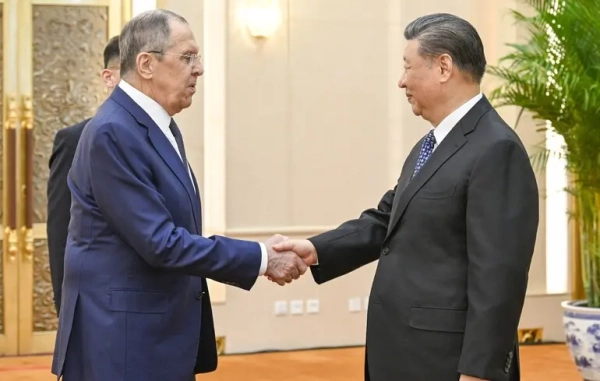
© EPA/ XINHUA / Li Xueren According to Xi, China and Russia should support and protect each other's interests.
The Chinese President Xi Jinping stated on Wednesday, April 15, that the steadiness and predictability of China-Russia ties hold unique importance amidst the turbulence and shifts in the global landscape, AP details .
During his discussion with Russian Foreign Minister Sergei Lavrov in Beijing, Xi noted that the power and significance of the amity treaty between the two nations are even more apparent in such an international setting. Lavrov arrived in China on Tuesday, April 14, for a two-day sojourn upon invitation from his Chinese counterpart, Wang Yi.
Xi also expressed that the foreign ministries of both countries should thoroughly execute the agreement established between him and Russian President Vladimir Putin, advocating for strengthened strategic dialogue and intimate diplomatic collaboration. The Chinese leader further urged the departments to advance the all-encompassing strategic alliance between Beijing and Moscow to ensure it “moves ahead with confidence.”
Xi emphasized the significance of the links between the two nations, yet he didn’t clarify exactly what he meant by upheaval and transformation in the global arena.
“Facing changes unseen in a century, China and Russia should, via intensified and robust strategic partnership, resolutely defend the legitimate interests of both nations, maintain the solidarity of the Global South, and exhibit the sense of responsibility anticipated of major powers and permanent members of the UN Security Council,” Xi conveyed to Lavrov.
Connections between China and Russia have notably strengthened in recent times, especially after the Russian Federation’s extensive intrusion into Ukraine in early 2022. China furnishes Russia with components, machinery, and raw resources vital for the functioning of the Russian military-industrial establishment, provides ports for logistics, while openly attempting to project a semblance of neutrality amidst Russia’s warfare against Ukraine.
When Putin visited China last September, Xi welcomed the Russian leader as a “longtime friend.” Putin and Xi are anticipated to conduct a summit this year to reaffirm Sino-Russian alliance and collaboration. Lavrov indicated that Putin would visit China “in the first half of 2026” and the “itinerary of the visit” was currently being finalized.
Xi articulated that China and Russia should place trust in one another, bolster collaboration, and protect their respective interests. The Chinese leader assured Moscow of friendship even as the globe’s second-largest economy develops ties with other nations.
Numerous Western leaders have journeyed to Beijing this year, encompassing the prime ministers of Spain, Britain, and Canada, aiming to reinforce connections with China. Vietnamese leader Tho Lam also paid a visit to Beijing, convening with Xi to strengthen mutual ties as both countries endeavor to resist pressure from U.S. trade duties. U.S. President Donald Trump is slated to visit China in May.
Recently, China has been endeavoring to construct what it characterizes as an equitable and well-ordered multipolar world, where every nation has a voice and major powers assume greater accountability — an alternative to what Beijing terms US dominance.
Is it viable to concurrently advocate for peace while profiting from conflict? China is demonstrating that it can be done. As the Russian Federation depletes resources and Ukraine fights for its existence, China is subtly transforming war into a source of revenue: inexpensive energy, multibillion-dollar commodity flows, control over supply chains. Beijing’s economic footprint is discernible on both sides of the battle line. Where does the demarcation lie between impartiality and gain? In the essay “ War as a Business: How China Makes Money from Russia and Ukraine, ” Serhiy Korsunsky elucidated Beijing’s rationale .