
© Collage, ZN.UA

Serhiy Korsunskyy,
Each conflict represents a commercial enterprise as well. The reallocation of assets, the boost to military production, the establishment of novel supply routes, the domestication of crucial manufacturing – these are merely the evident elements of a wartime economy. For some, it equates to earnings from defense contracts, while for others, it’s about enduring and adjusting. Those who gain profits do not perish on the front lines, thus forming the core of “conspiracy theories” asserting that economic drivers, not political ones, instigate wars. This holds true for individuals and entire nations alike.
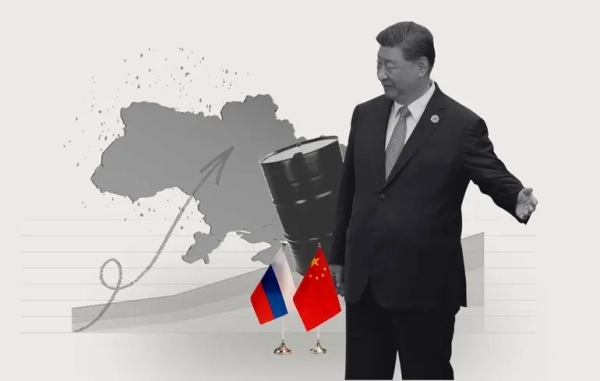
Extensive discourse has covered the geopolitical advantages China reaps from Russia’s aggression against Ukraine. Beijing addresses numerous strategic concerns by observing Russia’s actions of killing civilians, devastating Ukrainian cities and infrastructure, and the reciprocal attrition of Russian oil and gas complex infantry, armaments, machinery, and strategic installations by the Ukrainian Armed Forces. Weakening Russia economically aligns with the PRC’s goals, and exploiting Siberia’s resources has long been a Chinese ambition. It proves incredibly convenient and lucrative to maintain a pristine image, uttering hollow platitudes about promptly fostering peace, while at the same time providing both parties with all necessities for both survival and the war’s continuation.
It has been well-known for a while that China shows a willingness to back Russia’s invasion, procuring unprecedented quantities of oil and gas, and supplying essential gear vital for defense manufacturing, microelectronics, and drone components. However, this winter, it became unequivocally apparent that the Chinese are even profiting from their neighbor’s desperate attempts to subject Ukrainians to freezing conditions. EcoFlow and similar mobile energy storage units, generators, communication devices, power banks, and solar panels, which are currently the most in-demand items in the Ukrainian market, are all Chinese-made. In the past year, shipments from the PRC to Ukraine totaled $19.2 billion (a fourth of aggregate imports), doubling those from Poland and tripling those from Germany, who stand as the second- and third-largest providers to our nation. Chinese business owners openly express their satisfaction with their companies’ success, with several even setting up offices in Ukraine, undeterred by the threat posed by Russian missiles and drones assembled using Chinese components.
Actually, this custom of gaining from both sides embroiled in a dispute isn’t groundbreaking, even in recent annals. Instances akin to this were quite widespread during both global conflicts. However, they involved “non-aligned countries.” The distinction now is that China overtly bolsters Russia in its “campaign” targeting the West, and without being a combatant, practically establishes the political foundation for a revised global arrangement favorable to China, even earns tens of billions of dollars from it.
How Russia and Ukraine raced for Chinese drone components — FT
Figures present unwavering evidence. Even by fairly restrained estimates, since 2022, China has saved as much as $20 billion on Russian oil purchases. In 2025, Russia dispensed oil to China at an 8.3% markdown, and over the conflict years, the markdown averaged up to $10 per barrel. Russia ranks as China’s foremost oil supplier – accounting for 20% of China's total oil imports, amounting to roughly 2 million barrels each day. Russia achieved unparalleled oil deliveries to China by June 2022, coinciding with the enactment of initial penalties against the aggressor. The previous year showed about a 7% dip in supply volume, yet in financial terms, factoring in discounts, Russia's profits slid by 20%.
The same is true for natural gas. A portion conveyed via the Power of Siberia-1 pipeline trades to China at a discount reaching 30%, resulting in annual losses for Gazprom totaling around $3 billion (based on prior year’s figures and current predictions). As reported by Reuters, Beijing procures liquefied gas, furnished in violation of sanctions, at a 40% price reduction. These procurements are not diminishing but escalating, approximating $5 billion annually, especially considering the turmoil in the Persian Gulf. According to commerce statistics, China also leads as the primary buyer of Russian coal (accounting for 44% of Russian exports in 2022–2025, with roughly $900 million spent each month last year). Despite a slight decline in supply, coal still reaches China at appreciable markdowns. China’s gains from the coal segment of energy commerce are pegged at $2–4 billion, varying based on market price oscillations.
One of the most critical Chinese commodities, essential in contemporary warfare, encompasses drones and their constituent parts. In 2023, Denys Shmyhal, then Ukraine’s Prime Minister, declared that Ukraine procures 60% of global drone production from the Chinese enterprise DJI, renowned for its “mavics”. He noted that UAH 40 billion was earmarked for drone acquisitions that year (possibly including non-Chinese makes). Data indicates that Ukraine acquired Chinese drones valued at $725 million in the initial semester of 2025, although President Zelensky communicated in May that DJI ceased supplying Ukraine and transitioned solely to Russia.
According to The Japan Times, Thailand has evolved into a pivotal intermediary in supplying drones to Russia, evading sanctions. Last year, Russia secured more than $125 million worth of “Thai” drones from China (an eightfold surge compared to 2024). Comparatively, it’s significant that Thailand exported drones valued at $1 million in 2022, with none directed to the Russian Federation. Along this route, drone parts (engines, cameras, fiber optics) worth $63 million were dispatched to Russia during 2023–2024. Alternative sources indicate that Chinese drone engines (notably the Harpy-A1) are routed to Russian military factories disguised as “industrial refrigeration equipment” to bypass restrictions. Approximately 6 thousand such drones were manufactured at the Russian Kupol plant in 2025. Of course, the Chinese government refutes these shipments, although Chinese commerce statistics attest to these estimations. The overall volume of drone and component supplies is gauged at about $2 billion yearly.
The Russian defense sector largely relies on receiving Chinese machinery and tools, without which missile, drone, and artillery shell output would cease. These are imported via various sanction-dodging tactics, notably re-export through Central and Southeast Asian nations. American specialists evaluate such supplies: directly and via intermediaries during 2023–2024 – totaling up to $3 billion. The concealed nature of these provisions, frequently involving transit across multiple countries, hinders precise volume assessment. Secondary metrics encompass the surge in commerce between the Russian Federation and intermediary nations since the aggression’s start, challenging to explain through alternative determinants. Hence, the year’s formal trade volume decrease between the Russian Federation and the PRC doesn’t mirror shifts in trade strategies or lessened bilateral partnership. Indeed, this occasionally arose from imposed sanctions, at times from market “downturns,” yet primarily, it involves rerouting commodity streams via third and fourth nations.
Diplomat explains how protests in Iran could affect China's policy towards Russia
Sanctions imposed on the Russian Federation due to the conflict against Ukraine have resulted in China’s dominance in the Russian microelectronics, complex machinery, household appliance, and automotive markets. Goods in this category are supplied only partially under transparent contracts, as Chinese state-run corporations and financial institutions avoid sanction-related operations, which could jeopardize more significant ventures. Japanese experts suggest a large part of these goods are thus vended under “gray” arrangements, influenced by both export controls and settlement mechanisms, as settlement occurs in yuans and rubles, while Russia needs dollars. Data from financial intelligence agencies across various nations reveals intricate chains of non-convertible currency transformations into convertible ones via banks in European, Asian, and Arab territories, obscuring actual supply volumes and contents. Certainly, price levels sometimes hinge on pure market dynamics, yet these are considered, despite substantial influence from political expedience.
The transformation of the Russian economy into a comprehensive consumer of Chinese goods, encompassing household appliances or defense products, reinforces the PRC’s leading role in the “tango” with Russia. Simultaneously, whereas the PRC market (along with India) stands as an absolute priority for the Russian Federation, Russia merely comprises one of China’s trade partners, as the EU and US markets remain notably more important. As experts correctly underscore , China not only profits from Russia’s conflict against Ukraine but forfeits some opportunities due to sanctions that state-run Chinese companies and financial institutions endeavor to bypass.
During the Russian Federation’s years of all-out aggression against Ukraine, China procured an additional $40 to $50 billion, likely an underestimation owing to excluded “earnings” from gray supply routes involving numerous intermediaries to skirt sanctions. Even the collective gains from Russia’s assault on Ukraine aren’t definitive, except as a component of strategic equilibrium through access to inexpensive natural resources and energy sources, boosting China’s maneuvering space in a novel, Trump-esque global landscape.