
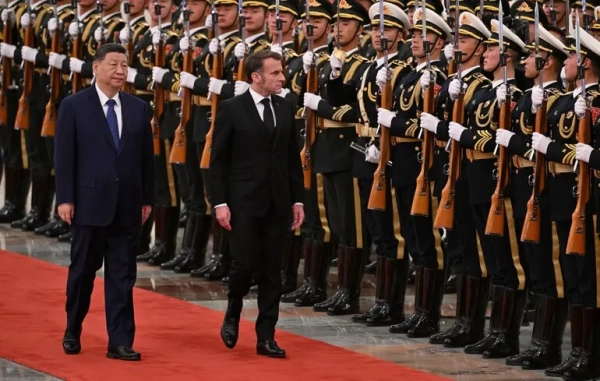
French President Emmanuel Macron and Chinese President Xi Jinping inspect the guard of honor during a meeting in Beijing, China / December 4, 2025 © EPA/ADEK BERRY China has been patiently anticipating the moment America would begin nudging its allies closer.
Pivotal U.S. allies, including France, Canada, the UK, Germany, Finland, and South Korea, are boosting their diplomatic interactions with China, dispatching their leaders to Beijing for dialogues with President Xi Jinping. This influx of visits underscores a desire to lessen reliance on Washington given the mounting unpredictability of American foreign policy under President Donald Trump.
This is what The Economist reports on the matter.
“All-Consuming” China
From the start of December, French President Emmanuel Macron, Canadian Prime Minister Mark Carney, British Prime Minister Keir Starmer, and a minimum of five other global figures have journeyed to Beijing. German Chancellor Friedrich Merz is slated to participate in February.
“China, considered “all-consuming” in its diplomatic approach, extends a warm reception to the leader of any nation, irrespective of its stature or affluence. However, six of the recent visitors share a significant trait: they all preside over nations that are recognized allies of America,” the publication points out.
In a global landscape unsettled by Donald Trump, US partners are endeavoring to cultivate connections with Washington’s chief competitor. Experts suggest this resembles a logical diversification strategy for Western leaders and a substantial triumph for Beijing. For much of the preceding decade, deliberations from Seoul to Ottawa have centered on distancing from, or at least diminishing ties with, China. Now, with that drive diminishing, Chinese officials are “elated.”
Simultaneously, the leaders encountered critique upon their return from Beijing, with concerns raised that their visits yielded minimal benefit and only amplified dependence on China. Nevertheless, notwithstanding the various accusations of succumbing to China, the concrete outcomes of the bilateral discussions were limited.
Specifically, the Canada-China trade agreement, which Trump asserts will devastate the US’s neighbor, incorporates a noteworthy reduction in tariffs on Chinese electric vehicles. Yet, the allocated quota will severely restrict the quantity of cars subject to the reduced rate.
A profound “bow” from the UK entailed China’s authorization to erect an immense new embassy. However, British intelligence agencies remain unconcerned about this perceived threat. Concerning the European nations, they are largely maintaining their stance. China has proposed the notion of renewing negotiations regarding a trade arrangement. Conversely, as an Eastern advisor remarked, Beijing is not accomplishing substantial progress in discussions with the European Commission, and only marginally better with individual national governments.
It is equally notable how promptly goodwill in Beijing can transform into criticism, The Economist notes. Merely days after his return, Macron cautioned that if China fails to curb its considerable trade surplus, the European Union may enforce new tariffs. Discord has also arisen between London and Beijing. Scarcely a week after Starmer’s visit, China condemned British-Hong Kong business magnate Jimmy Lai to 20 years of imprisonment for his pro-democracy endeavors. For its part, the UK has relaxed visa protocols for numerous Hong Kong inhabitants, an action Chinese officials have characterized as “revolting.”
In the interim, diplomats who partook in the leaders’ gatherings in Beijing recount that China is spotlighting Japan’s revival to “the pernicious route of militarism.” However, this message is not resonating effectively — not solely in Western capitals, but also in Asian countries that suffered under Japan’s control during World War II. Subsequent to his journey to Beijing, South Korean President Lee Jae-myung engaged in drumming alongside the figure who is presently China’s foremost adversary: Japanese Prime Minister Takaichi Sanae.
Next move
Analysts are curious as to why, given China’s current robust geopolitical standing, it isn’t demanding greater concessions from visiting leaders. A partial explanation lies in the sufficiency of symbolic gestures. Bilateral visits transmit a compelling message both domestically and globally regarding China’s stature as a major power and the waning dependability of the US. Stabilizing relationships with capitals that previously aspired to exclude Chinese products from their supply chains also signifies a notable advancement. This affords China the latitude and duration necessary to cultivate its technological prowess, which will augment its influence in the future. Simultaneously, China’s prominent green technology firms aspire to establish factories in the West as a safeguard against tariff conflicts. Numerous specialists in China harbor the conviction that Beijing will ultimately demonstrate to the world that it provides greater steadfastness and prosperity compared to the US.
Chinese officials are now keenly aware of their extensive economic sway, particularly noting how they compelled Trump to retreat from his most extreme trade warfare strategies, and they also comprehend how to complicate matters for smaller nations that “misbehave.”
Some commentators are advocating that China adopt a more forceful stance in pursuing its objectives. A recent editorial penned by the Chinese ambassador to Australia has garnered attention from diplomats in Beijing. He cautioned that it is “unacceptable” to solicit advantages from Beijing while disregarding its fundamental interests. If interpreted literally, this resembles a novel form of threat, urging foreign leaders to endorse China’s stance on reunification with Taiwan or encounter economic repercussions, experts contend.
“In essence, one could envision a more resolute shift in the manner China leverages its trade influence. To date, the government in Beijing has primarily penalized countries that have slighted it. Moving forward, it may endeavor to alter their policies. This would constitute a hazardous maneuver for China, as overt coercion could backfire, uniting the targeted states more closely. For the moment, fortunately, China is content with the “captivating impression of momentum” engendered by the influx of visitors to Beijing,” The Economist concluded.
Why did Emmanuel Macron’s subsequent visit to China devolve into mere courteous exchanges devoid of progress on Ukraine? Despite an hour-long private discussion, Xi Jinping conveyed unequivocally: Beijing has no intention of diminishing its backing of the Kremlin.
Can Europe persist in relying on China to deter Russian aggression, or has this long represented a perilous fallacy?
The answer resides within the article “Macron seeks influence on Xi. And found only a Chinese wall of support for Putin” authored by the former ambassador of Ukraine to France, Oleh Shamshur.