
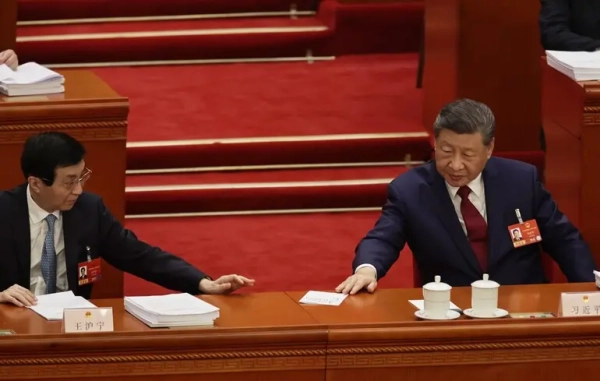
© EPA/ ANDRES MARTINEZ CASARES This could point to a “cleansing” that is substantially larger than presently recognized.
The count of attendees at a gathering of the National People's Congress of China in Beijing has diminished to its nadir since Xi Jinping, the Chinese leader, ascended to power in 2012, underscoring the volatility within the nation’s foremost legislative body amidst an ousting of functionaries, Bloomberg indicates .
According to Zhao Leji, the chairman of the Standing Committee of the National People’s Congress, the inaugural ceremony at the Great Hall of the People in Beijing on Thursday, March 5, was attended by 2,765 delegates. Nonetheless, 113 delegates—close to 4% of the entire participant count in the congress—were absent.
This marks the most elevated rate of non-attendance during Xi’s administration, excluding 2022, when 161 delegates were absent from the opening session owing to stringent protocols enacted to impede the propagation of the coronavirus. Various factors, including illness, can lead to delegates’ absence from the yearly legislative assemblies.
Zhao provided no further clarification on the grounds for the absence of the 113 delegates.
The delegates’ non-attendance occurs concurrently with Xi’s stern action against disloyalty and corruption within the Communist Party and prompts inquiries into whether the absence of certain delegates stems from ongoing investigations, potentially signaling a more extensive purge than previously understood.
The count of 113 missing individuals excludes delegates already formally removed from the legislative body. The current National People’s Congress has experienced a loss of 99 delegates since 2023, representing the steepest decrease across Xi’s three terms in office. Numerous individuals were ousted amidst the comprehensive purges. Some stepped down, while others passed away.
One particularly noticeable absentee at this year’s session is Politburo figure Ma Xingrui, formerly a party leader in Xinjiang. Since last November, Ma has been absent from several significant gatherings and was not included, as per official lists, in this year’s presidium of the National People’s Congress.
Ma was relieved of his position as party secretary for the western Xinjiang region in July and has not been publicly assigned a new role. Furthermore, he is no longer a member of the Xinjiang delegation to the National People’s Congress, according to an official statement issued in December.
Xi has executed the most substantial restructuring of China’s armed forces in a half-century, leaving merely one general in its paramount leadership, thereby elevating the stakes as the country’s legislative body gears up for this year’s session, seeking indications of additional removals or other noteworthy absences among the thousands of delegates, encompassing provincial governors, military officers, and business executives.
The scale of the cleansing within the Chinese military was unprecedented, even considering Xi’s standards—the cleansing extended to encompass his inner circle and the leadership of pivotal branches of the armed forces. Viktor Konstantinov scrutinized the Chinese leader’s motives and ramifications of the personnel reshuffle in the article “ Purges before the strike: why is Xi changing generals on the eve of a possible war for Taiwan, ”.