
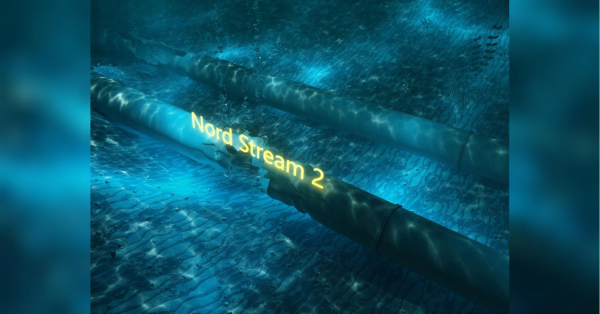
The Nord Stream pipes have been lying dormant on the bottom of the Baltic Sea since September 2022. Technically, the pipeline is seriously damaged, but politically it is by no means dead. While Berlin and Brussels publicly insist that their dependence on Russian pipeline gas has been overcome, numerous signs indicate that the pipeline continues to play a significant role in informal discussions. Sources report behind-the-scenes diplomacy, unofficial channels and a scenario in which Washington could return to Europe the very Russian gas it has been trying to prevent for years. But with one important caveat: under American control, writes the Berliner Zeitung.
VIDEO OF THE DAY
While the official European line is clear, Le Monde reports on informal channels of communication. The French newspaper describes a diplomacy that takes place behind the scenes, far from international institutions. In this environment, negotiations take place without public scrutiny and outside multilateral forums.
A large amount of information indicates that Nord Stream may indeed return – bypassing the EU and “under the leadership of the United States.” In particular, the newspaper quotes a source close to Gazprom, who claims that Nord Stream is “an absolute part of secret negotiations” between US President Donald Trump and the Russian president. One scenario, according to the source, is the resumption of Nord Stream in partnership with the United States.
Whether these statements are accurate cannot be verified externally. However, they fit the strategic pattern: energy infrastructure is a lever of influence. This aspect takes on particular importance in light of potential peace negotiations with Ukraine.
ADVERTISING
The United States has been politically opposed to Nord Stream for years. With the fracking boom of the early 2010s, exports of liquefied natural gas (LNG) have become strategically important in Washington. Additional supplies of Russian gas to Europe through Nord Stream 2 would significantly reduce market opportunities for American LNG.
The Americans therefore exerted enormous pressure, forcing Germany to suspend certification of Nord Stream 2 in 2021, shortly before its completion. Previously, US sanctions had repeatedly delayed the project. A potential change of course — Russian gas, but under US influence — would mark a dramatic U-turn.
The Americans' goal may not simply be to sell LNG or prevent Russian-European rapprochement, but to expand control over energy infrastructure wherever possible, particularly on the old continent.
ADVERTISING
The name that keeps popping up in connection with the US-led Nord Stream 2 project is Stephen P. Lynch, a Miami-based investor who, according to the Wall Street Journal, wants to buy the pipeline with the stated goal of becoming “the richest man you’ve never heard of.” Lynch is considered a specialist in distressed assets and has previously done business in Russia, including in connection with the collapse of the Yukos oil company and a deal involving a subsidiary of Oschadbank.
However, Lynch is not the only interested party. Also mentioned is Gentry Beach, a Texas banker who is reportedly a friend of Donald Trump Jr. Although Beach has publicly denied any interest in the pipeline, an investigation by Le Monde diplomatique suggests that he tried to acquire Nord Stream together with a Romanian business partner. Behind this is an environment that sees politics as a platform for business. The Wall Street Journal describes Beach as a person who initiates projects around the world and works in close ties with Trump. Also mentioned is Elliott Management, an American financial giant that is reportedly interested not only in Nord Stream but also in TurkStream, which transports gas from Russia through Turkey to Bulgaria.
Jörg Sezanne, the Left Party's energy policy spokesman in the Bundestag, sees such activities as a serious threat. Speaking to the Berliner Zeitung, he said: “Such attempts are taking place and should be taken seriously. Recently, an investor closely linked to Trump acquired around one fifth of Germany's tank storage infrastructure through the company Tanquid. We call on the federal government to review and prohibit such acquisitions as part of the screening process for investments in critical infrastructure.”
This is in sharp contrast to the hardline stance of Chancellor Friedrich Merz, who rules out any energy partnership with Russia. A person familiar with the matter told the Berliner Zeitung that Germany even plays a special role in the sanctions policy against Russia. Merz was the driving force behind the sanctions against Nord Stream in the 19th package of sanctions against Russia.
ADVERTISING
The source calls this approach “absurd,” as Russian energy continues to reach Europe indirectly, for example through India. There, Russian oil is refined and then re-exported as refined products. Legally, these products are no longer considered Russian imports. Officially, it is Indian oil. In some cases, this is difficult to prove, but the structural mixing of production areas and pipelines makes it difficult to draw a clear distinction, according to the source, who asked not to be named.
Meanwhile, the EU is working on a legal framework that will effectively prevent the return of Russian energy in the future. A European Commission spokesperson responded to a query from the Berliner Zeitung, stating that the RePowerEU gas regulation entered into force at the beginning of February, banning new gas contracts with Russia, long-term contracts and imports on the spot market.
Given these circumstances, the publication writes, Europe should ask itself: does it want to play an active role in the negotiations on Ukraine and help shape the future of European energy supplies, or does it ultimately simply want to ratify whatever Putin and Trump decide? Anyone who wants to shape policy cannot afford to ignore the ongoing informal talks on Nord Stream or prematurely declare the pipeline politically dead.
We should add that in addition to Nord Stream, Russia is trying to tempt the Trump administration with other joint projects.