
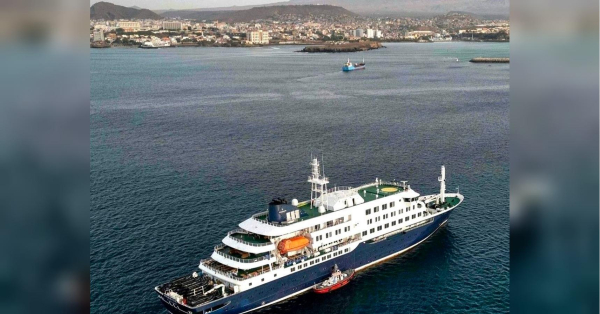
The MV Hondius cruise ship, which departed Ushuaia in southern Argentina on March 20 and was due to end its voyage in Cape Verde on May 4, has been hit by an outbreak of hantavirus in the middle of the Atlantic Ocean, killing three people. Five Ukrainian citizens are also on board, part of the ship's crew. They have not shown any signs of the disease.
While stationed on St. Helena, 23 people left for different countries
“The health condition of 5 Ukrainian citizens, members of the MV Hondius crew, is satisfactory, no signs of illness have been detected in them,” the Ukrainian Foreign Ministry said in a statement.
VIDEO OF THE DAY
According to one of the passengers on board, people did not report possible infection when they left the ship during a stop on the island of Saint Helena in the South Atlantic on April 24. We are talking about at least 23 people who left for different countries, writes the New York Post.
Contact tracing began late, although specialists compiled a list of passengers, crew members, and their contacts who left the ship at various stages of the route.
ADVERTISING
“Passengers who left the ship were informed of the hantavirus case by the ship’s operator and were asked to report any signs and symptoms,” a company spokesperson said in a statement to the New York Post.
A total of five people were evacuated from the ship due to symptoms of hantavirus. Two of the evacuees tested positive and are undergoing treatment in South Africa and Switzerland.
Three more people suspected of having the disease were transported to medical facilities in Germany and the Netherlands.
ADVERTISING
Quarantine on board near the Canary Islands
The ship is heading to the Canary Islands of Spain. Arrival is scheduled for May 9. Upon arrival, all passengers and crew members will be medically screened.
Passengers and crew remain in a 45-day quarantine on board. The WHO and Oceanwide Expeditions said the ship is due to arrive in the Spanish resort town of Tenerife, where passengers will be able to disembark.
The head of the Canary Islands government, Fernando Clavijo, has expressed concern that passengers could spread the virus among local residents. Spanish authorities have called the claims “irresponsible” and said the risk of infection is assessed as extremely low and that Spanish citizens are on board.
Source of infection on board
The WHO said the patients likely have a rare strain of Andes virus, which can be transmitted from person to person. The fatality rate for this strain can reach 40%. Experts say that despite this, hantavirus is much less contagious than COVID-19.
ADVERTISING
“Transmission requires close contact with the body fluids of an infected person,” explained Ali Khan, dean of the College of Public Health at the University of Nebraska Medical Center , adding that this is not about brief contact.
According to Argentine investigators, the source of the infection on board may have been a Dutch couple who may have been infected by rodents during a birdwatching excursion in Ushuaia a few days before the ship left port on March 20.
It is known that a 70-year-old man died on April 11, almost two weeks before the ship docked at St. Helena. His wife, who later also died of the infection, went ashore with her husband's body and almost two dozen other passengers. A 69-year-old passenger boarded a commercial flight to South Africa. From there, she wanted to fly to Amsterdam, but was removed from the flight due to her condition. She died on April 26 from hantavirus in a Johannesburg hospital.
A 78-year-old German woman later died. According to the ship's operator, Oceanwide Expeditions, several seriously ill passengers were transferred to medical teams in the Netherlands. Among those evacuated was an on-board doctor, who was previously assessed as serious but has since improved.
One passenger from Switzerland, who returned home with his wife, tested positive for hantavirus. He was initially hospitalized in Zurich, but the initial test came back negative, as the virus can remain latent for up to eight weeks.
France is also investigating a possible case of infection in a person who was not on board the ship.
According to Dutch TV channel RTL, on May 7, a flight attendant from the Dutch city of Haarlem was hospitalized with suspected infection after contact in Johannesburg with a 69-year-old Dutch citizen who later died from the virus.
Also, a 65-year-old German citizen who was on board the Hondius tourist ship and had been in contact with the deceased German woman was taken to the University Hospital in Düsseldorf.
There is no natural reservoir of Andes virus in Europe.
A well-known infectious disease physician and virologist, Yevhen Dubrovsky , commenting on the situation on the cruise ship, said that “this is not a classic “crowd virus” like measles, flu, or Covid.”
“This is not the kind of pathogen that easily flies between people in the subway, cafe or airport. This is a complex virus with a difficult route of transmission. It is difficult for them to get infected. And it is not so easy to transmit from person to person. Only with very close contact: within the family, between partners, between people who have been together for a long time. This does not mean that it is enough to simply walk next to a sick person. However, it was the cruise ship that became the ideal place where all the conditions fatally converged in one place,” he wrote on his page on the social network.
According to him, in the current case of Andes virus, another point is important.
“There is no natural reservoir of Andes virus in Europe. That is, the virus has no obvious way to “establish itself” in the European rodent population and start a new natural transmission cycle. This is very important for the forecast,” Dubrovsky added.
The most likely scenario, in his opinion, is that there will be no global catastrophe. It will be a localized, complex, international incident.
“Passengers and crew will be tested. Contacts will be tracked. They will clarify who, where, and when could have been infected. Perhaps the number of confirmed cases will increase. But from what is known now, there is no reason to talk about any new pandemic,” Dubrovsky noted.
What is known about hantavirus?
Hantavirus is a dangerous infection carried by rodents. The virus can cause serious damage to the lungs, kidneys, and heart, and some forms of the disease have a high mortality rate.
According to the WHO, humans are most often infected after contact with the urine, saliva, or feces of infected rodents. The virus can also enter the body through dust in closed or poorly ventilated spaces.
Among the main symptoms of hantavirus:
- High temperature;
- Headache;
- Muscle pain;
- Nausea and vomiting;
- Abdominal pain;
- Cough and shortness of breath.
In severe cases, the disease can quickly lead to breathing problems, fluid buildup in the lungs, or kidney failure.
There is currently no specific treatment or officially approved vaccine for hantavirus. Doctors use supportive care and ongoing medical supervision.
Human-to-human transmission of the virus is very rare, with the exception of the Andes virus in South America, where isolated cases of infection through close human contact have been reported.
It was previously reported that a highly fatal virus is spreading around the world. The World Health Organization has reported the Nipah virus.