
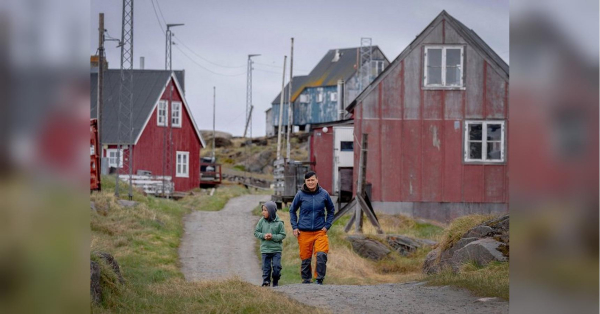
The debate over the Arctic is heating up more than ever as US President Donald Trump continues to push for Greenland to become part of the United States. But while Trump's demands for the US to seize territory belonging to one of its closest and most trusted allies has puzzled the world, the race has been going on for decades. And Russia has long been winning it. There is no doubt that Moscow has had a dominant presence in the Arctic region, writes CNN.
VIDEO OF THE DAY
And while the Arctic makes up only a small part of the global economy — about 0.4%, according to the Arctic Council, a forum representing Arctic states — Russia controls two-thirds of the region's GDP and has been expanding its military presence in the Arctic for decades, investing in new and existing facilities in the region.
According to the Simons Foundation, a Canadian non-profit organization that monitors Arctic security and nuclear disarmament, there are 66 military installations and hundreds more defense installations and outposts in the wider Arctic region. According to publicly available data and research by the Simons Foundation, 30 of these are in Russia and 36 in NATO countries with Arctic territory: 15 in Norway, including one British base, eight in the United States, nine in Canada, three in Greenland and one in Iceland.
And while not all bases are created equal—experts say Russia currently cannot match NATO’s military capabilities—the scale of Russia’s military presence and the pace at which Moscow has expanded it in recent years are of serious concern.
ADVERTISING
The Royal United Services Institute (RUSI) said Russia has invested significant resources and effort in recent years to modernize its nuclear submarine fleet, which is the backbone of its military power in the Arctic. As it continues to wage war in Ukraine, Russia has also improved its radar, drone and missile capabilities.
The accession of Finland and Sweden to NATO in 2023 and 2024 effectively divided the Arctic region into two roughly equal halves: one controlled by Russia and the other by NATO. Trump has repeatedly stated that the United States “needs” Greenland for national security reasons, citing Russian and Chinese ambitions in the Arctic. He has argued that Denmark, which has sovereignty over the world’s largest island, is not strong enough to protect it from threats emanating from those two countries.
Although China is not an Arctic country, it has made no secret of its interest in the region. The country declared itself a “Near-Arctic state” in 2018 and outlined a “Polar Silk Road” initiative for Arctic shipping. In 2024, China and Russia began joint patrols in the Arctic, part of a broader cooperation between them.
ADVERTISING
But security is not the only reason for the growing interest in the Arctic. The region is transforming faster than any other region in the world as the climate crisis deepens, warming about four times faster than the global average. Sea ice is melting rapidly. But while scientists warn that this could have incredibly devastating consequences for the natural world and the livelihoods of the people who depend on it, many argue that melting sea ice could also open up huge economic opportunities in terms of mining and shipping.
In terms of mining, there is a possibility that the melting ice could expose previously unexploitable lands. According to the Geological Survey of Denmark and Greenland, the island, in particular, could be a “hot spot” for mining coal, copper, gold, rare earth elements and zinc.
However, researchers say that extracting Greenland's minerals will be extremely difficult and expensive, as many of the island's mineral deposits are located in remote areas beyond the Arctic Circle, where there is a polar ice sheet and darkness reigns for most of the year.
The idea that these resources can be easily extracted for the benefit of the United States, founder and senior research fellow at the Arctic Institute, Malte Humpert , called in a conversation with CNN journalists “absolutely crazy.”
ADVERTISING
While Trump has recently focused on the security aspects of Greenland, his former national security adviser Mike Walz told Fox News in 2024 that the administration is focusing on Greenland “for its critical minerals” and “natural resources.”
It was previously reported that analysts explained why Trump's policies are leading to the self-destruction of the United States.