
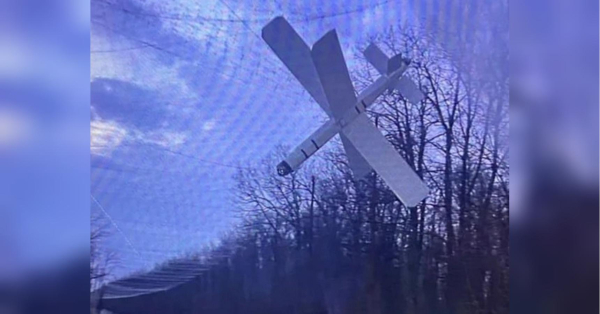
Russian drones have been attacking Ukrainian army supply lines and rear bases, often threatening to cut off frontline units. But they have also targeted hospitals and civilian transport. One city that has been hit by drone attacks is Kherson and what Ukrainians call the “roads of life” that connect it to the outside world — routes that are largely immune to Russian attacks.
VIDEO OF THE DAY
“On average, the Russians launch about 2,500 drones into our communities every week. As a result of these attacks, 120 people have died in the Kherson region this year,” Alexander Tolokonnikov, deputy head of the Kherson Military Administration , told CNN in November 2025.
The UN Human Rights Monitoring Mission in Ukraine confirmed that 2,514 civilians were killed and 12,142 injured in war-related violence in 2025, many far from the front lines. Over the past year, more and more nets have been installed to protect against Russian drones. Hospital courtyards, generators and shopping streets in the city are now protected. On open roads, poles are used to create a canopy of netting, writes CNN.
“Work is currently underway to strengthen the roads — dozens of kilometers of routes are already protected by nets,” Tolokonnikov said, explaining that a wide range of nets have been tested for their strength. “Thanks to a combination of measures and bold decisions, our military is now able to destroy 80-95% of the drones that the Russians launch into our communities.”
ADVERTISING
The nets are trucked across Europe by various volunteer groups. One of the largest, Life Guardians, is run by Klaas Pot in the Netherlands . His team has sent over 8,000 tons of nets to Ukraine, about half of the total received. Pot started by collecting nets to use as camouflage for Ukrainian soldiers.
“I knew these nets had more potential because they were already being used to combat drones,” Pot told CNN. “I know that, for example, the road between Kherson and Mykolaiv is particularly dangerous, and they made it a 'road of life' there. And at least part of it is protected by the nets that our team collected.”
Thousands of tons of nets sent by European fishermen and farmers end up in the hands of Ukrainian soldiers, who use them for various purposes on the front lines, depending on the strength of the material.
ADVERTISING
Tulip nets are made from warp-knitted polyethylene and are lightweight and durable. They typically cover the bulbs in the ground and are mechanically raised to optimize harvesting. They can interfere with small FPV drones and quadcopters, which are used by the thousands on the front lines and beyond.
Fishing nets are stronger than tulip nets, Pot said, and are therefore more commonly used to protect tanks and artillery. Now, he explained, they are also being used to protect Ukraine’s energy infrastructure, which is under almost daily attack by Russian drones.
Other groups across Europe have joined the initiative. The Change group in Sweden is collecting nets that fishermen have not used due to EU fishing quotas, sending around 400 tonnes of them to Ukraine to date. Norwegian Voluntary Aid has sent salmon nets that are usually recycled after use. And in the UK, the Pickups for Peace group has included fishing nets from Scottish ports such as Fraserburgh in its regular humanitarian convoys to Ukraine.
During a visit to France in November, Ukrainian President Volodymyr Zelensky thanked a group of French fishermen who collect old nets from deep-sea vessels that catch tuna and other fish. The group, called Kernic Solidarités, has already sent 280 kilometers of heavy-duty horsehair nets to Ukraine.
ADVERTISING
“There were several cases when the guys caught Lancet drones in their nets,” the fighters say.
The Lancet can carry two to three kilograms of explosives and can reach speeds of up to 150 kilometers per hour during an attack. The fishing net holds it back, it simply stops it.
As stocks of surplus nets in the Netherlands and Denmark run out, Pot is looking for other opportunities to continue working.
“The project is far from complete, and we will expand across Europe,” he said. “All of our partners have the same motivation — to help Ukraine and get on the right side of history.”
It was previously reported that an enemy drone destroyed a bus in the Dnipropetrovsk region – 15 people were killed and seven injured.