
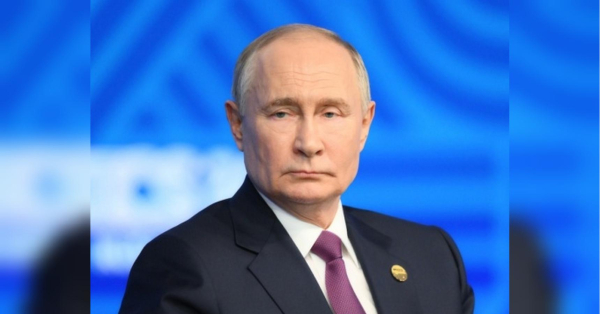
When Putin spoke to Trump the other day, he sought to ensure a “rapid political and diplomatic resolution” to the war in Iran. But the war has not been all that bad for the Russian leader. Analysts say Moscow could emerge as the clear winner in this war in the Middle East, and it has come at a crucial time for the Kremlin leader. Antonio Costa, the president of the EU Council , told EU ambassadors that “so far there is only one winner in this war – Russia,” writes The Telegraph.
VIDEO OF THE DAY
A little over a week ago, the Kremlin faced serious questions about whether it could sustain a war effort that was draining the Russian economy. But almost overnight, after American and Israeli bombs first struck Iran, the solution to all its problems seemed to take shape. That means Ukraine will suffer. As Russia profits and attention is diverted, Kyiv will be praying for an end to the war abroad so that it can end at home.
In recent months, international energy sanctions, low global oil prices, and price caps by the European Union and the United Kingdom have created a severe financial constraint for Russia, which five years ago received 45 percent of its federal budget from oil and gas revenues. In January, Russia's oil and gas revenues halved compared to the same month a year earlier, falling sharply to levels last seen in 2020, during the COVID pandemic.
Moscow’s economic problems have become so acute that it has been forced to sell its gold reserves and tap consumers and small businesses to raise funds, causing the cost of living to skyrocket. Now, the virtual closure of the Strait of Hormuz and the partial shutdown of oil production in the Persian Gulf have led to a sharp rise in oil prices. While Russian oil prices hovered below $40 a barrel in December, they have now almost doubled to $76.
ADVERTISING
On Thursday, Washington announced it would lift sanctions on Russian oil at sea for 30 days in a bid to stabilise global energy markets, a major boost to Moscow's fortunes. Some 130 million barrels of Russian oil are believed to be stuck at sea.
After the U.S. Treasury Department announced last week that it would allow India to buy Russian oil for 30 days without sanctions, Indian companies bought 30 million barrels in less than a week, roughly equivalent to the country’s entire monthly imports in February, Bloomberg reported. Since the start of the conflict in the Middle East, Russia has been earning up to $150 million a day from oil sales and could accumulate up to $4.9 billion more by the end of March, according to calculations by the Financial Times.
The closure of the Strait of Hormuz could also cut off up to a quarter of the world's monthly supplies of liquefied natural gas. Faced with rising prices, Europe may be forced to reconsider its plan to phase out Russian gas by 2027.
ADVERTISING
“Of course, if Russia has more money and manages its deficit, it will have much less pressure domestically to end the war,” said Dr. Tatyana Stanova, a senior fellow at the Carnegie Russia Eurasia Center . “If Putin has more resources to address his domestic financial problems, he can be more confident in the course he has chosen.”
However, some analysts have argued that without a prolonged crisis, Russia is unlikely to receive significant strategic dividends.
“The fallout from the US-Israeli attacks on oil prices could help Russia,” said Oleksandr Kolyandr, a senior fellow in the Democratic Resilience Program at the Center for European Policy Analysis . “But the current temporary surge, filtered through sanctions relief and an unfavorable exchange rate, is unlikely to change the fundamental arithmetic.”
According to analysts and Ukrainian officials, Moscow is already massing its forces ahead of a planned spring-summer offensive. Russia's own military supplies are unlikely to be threatened, as the Russian Federation has moved to a system of localized production after relying on imported equipment and expertise from Iran.
ADVERTISING
The battlefield consequences are likely to be felt in air defense, where the American-made Patriot system is the backbone of Ukraine’s defense against Russian ballistic missiles. Washington has been stingy with its Patriot supplies to Kyiv. More Patriot missiles were used in three days of fighting in the Middle East than Ukraine has received in more than four years of war, President Zelensky said on March 5.
However, despite the discomfort of powerlessness in the face of US military adventures, experts argue that Moscow's partnership with Tehran has never been anything more than a matter of convenience, and Russia is unlikely to be deterred by these upheavals.
It is also possible that Russia will gain more from the deterioration of transatlantic ties between Europe and the United States than it will lose from the loss of significant support from its allies.
Previously, “FACTS” wrote that, according to analysts, Trump “gave” money to Putin for the war against Ukraine.