
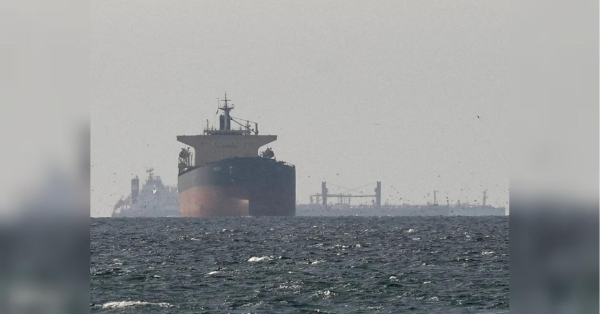
As the US-Israeli military operation against Iran and Tehran’s regional military response continue, missile attacks, drone swarms, airstrikes and maritime threats are disrupting commercial shipping throughout the region. The blockade of the Strait of Hormuz affects about 20 percent of the world’s oil transit and 20 percent of liquefied natural gas. It also halts production of a lesser-known chemical: 41 percent of the world’s sulfur is exported. While the United States produces a significant amount of sulfur for its domestic market, the near-total shutdown of shipping through the Strait of Hormuz, which accounts for about 50 percent of the world’s seaborne sulfur trade, has strained an already tight market. This makes domestic procurement extremely competitive while threatening imports of certain ultra-high-purity grades needed for industrial production, the Institute for Modern War writes.
VIDEO OF THE DAY
Affects everything from the F-35's avionics to the guidance system of any interceptor or missile
The supply disruption matters because the United States consumes about 90 percent of its sulfur in the form of sulfuric acid, and sulfuric acid provides the production that supports not only economic function but also modern military operations. It is needed for everything from copper in the electrical grid to semiconductors in precision munitions. So the impact of the current disruption in the Strait of Hormuz is not limited to the gas station.
For military planners and strategists, the imminent loss of sulfur is a pre-logistics crisis. This problem focuses on the material and chemical fundamentals that determine whether logistics can function to provide the necessary military materials to maintain military readiness. In peacetime, dependencies such as sulfur have been easy to overlook. Understanding this pre-logistics dimension is important because it forces planners to look beyond supplies and delivery and instead ask a more fundamental question: Do we have the essential industrial and chemical resources needed to restore combat capability in a protracted conflict?
Copper is the clearest example of why this is now a military issue. Sulfuric acid is central to the hydrometallurgical leaching and extraction processes that convert low-grade ores into high-purity cathodes. This industrial detail has strategic implications because copper is a designated strategic material, embedded in transformers, motors, and communications equipment that keep bases running and defense plants functioning. The current sulfur shock is becoming a copper issue, and this copper issue risks quickly becoming a readiness and sustainability issue.
The same pre-logistics logic applies to nickel and cobalt. Both are subject to intensive processing with sulfuric acid, such as the high-pressure acid leaching method used to extract them from laterite ores. These materials are critical for high-temperature alloys in jet engines and, more importantly, for lithium-ion batteries that power various drones and tactical-grade electronics. The vulnerability of industrial chemistry comes much earlier, but it determines how quickly things can be built and scaled up under the pressure of ongoing warfare.
ADVERTISING
Semiconductors further amplify this reality. Ultra-high-purity sulfuric acid is indispensable for cleaning and etching the silicon wafers needed to make the most advanced microchips, directly impacting everything from the F-35's avionics to the guidance system of any interceptor or missile.
The new reality requires a broader review of military planning that must begin immediately.
The central problem facing U.S. military planners today is not just that sulfur matters, but that its supply chain is fundamentally broken from a defense perspective. Sulfur is largely a byproduct of the processing of sulfur ores and crude oil, not a commodity that can be scaled independently in a defense emergency. Furthermore, while much of sulfuric acid is produced involuntarily as a byproduct of the smelting of sulfide ores such as copper and zinc, this secondary source is tight and woefully inadequate to meet a massive military surge. This means that supply is responding to hydrocarbon production and basic smelting operations, not to urgent military demand for copper or semiconductors. This is the byproduct trap, and it is what makes this pre-logistics bottleneck so dangerous: it is upstream of military production and unresponsive to our demand signals. As sulfuric acid availability declines, the consequences are inevitable: copper mining slows, battery pipelines become congested, and semiconductor production suffers.
Read also: The world economy is under attack: how the war in Iran is reshaping the global gas and oil market
ADVERTISING
The strategic lesson of the Middle East conflict is not just that sulfur matters. It is that modern warfare is fundamentally dependent on industrial conditions that military planning has too long treated as background noise. The time to think about logistics before war begins is over; the consequences are already here. The logistical bottlenecks hidden within civilian supply chains are no longer theoretical vulnerabilities but active limitations on American combat power. The painful lesson is that critical limitations arise precisely where the military is most disconnected from the commercial systems that are, in essence, the industrial metabolic processes that make its power possible.
This reality requires a broader review of our military planning that must begin immediately. Combatant commanders and industrial base officials can no longer afford to think only in terms of stockpiles and contracts for augmentation; they must now map out dependencies that determine whether augmentation is even possible. But defining the problem is only the first step. The Department of Defense must translate this understanding into action by exploring strategic reserves of the necessary reagents, despite the dangers of storage, and by actively funding research into alternative sulfur-free leaching technologies that completely bypass the byproduct trap.
Previously, former Ukrainian Foreign Minister Dmytro Kuleba named the worst consequences of a war between the US and Iran.
ADVERTISING