
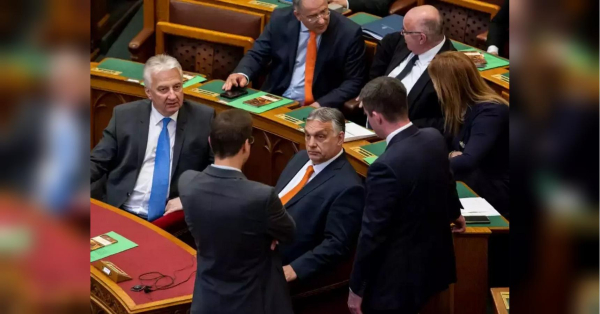
Soon, Hungary, whose funds have been frozen by the EU, will hold elections for the prime minister. Ukraine is closely following the political processes in its neighboring country. After all, the pro-Russian rhetoric of the current leader Viktor Orban, who declared Ukraine an enemy of Hungary, and his personal dislike of Volodymyr Zelensky (it is mutual. — Author ) have significantly deepened the crisis in Ukrainian-Hungarian relations. And the latest incident with the detention of Oschadbank's collection machines along with employees certainly does not contribute to their improvement. Moreover, Ukrainians clearly sympathize with Orban's opponent, Peter Magyar. And against the backdrop of the latter's support by Hungarians who are seeking change, Orban's defeat is becoming more than expected.
VIDEO OF THE DAY
Orban's people in key positions may block the work of the new government
Hungarian Prime Minister Viktor Orban has installed loyalists in key government offices who could thwart any new prime minister’s budget and legislation. So even if opposition leader Peter Magyar wins Hungary’s election this month, he will face a grueling test trying to effectively govern the country through the complex legal and political minefield Orban has laid out, Politico reports.
The publication recalls that during his 16 years in power, Orban has secured tight control over critical state institutions, which means that his supporters will still have decisive powers to thwart the budget plans of the Magyar party and overturn legislation through the politicized constitutional court.
So, the challenge for Magyar will be to find a way to govern successfully. After all, the changes introduced by Orbán and his party can only be overcome if Magyar and his Tisza party can gain a surprise two-thirds majority.
ADVERTISING
“The Orban government and the ruling Fidesz party are betting that Tisza will fail due to lack of experience and will not be able to govern,” the publication notes.
Currently, polls show that Magyar can only get a simple majority.
Magyar needs 2/3 votes to change the country
“For Tisza to run the country, they need some kind of coherent vision for the country’s development, and they need some kind of coherent political community behind them. They only have one thing in common: they want to throw us out of power. That may or may not be enough to actually remove us from power, but it’s definitely not enough to run the country,” Hungarian EU Affairs Minister János Bóka told Politico.
ADVERTISING
Magyar's first task will be to craft a budget capable of financing his expensive campaign promises, which include increasing public spending on things like healthcare after years of underinvestment.
But the problem is that Fidesz has drained the coffers, reaching 50 percent of its 2026 deficit target by February after introducing massive campaign subsidies to win voter support.
Hungarian President Tamás Sulók is also close to the Fidesz party and will remain in office until 2029. He may, in particular, call early elections if the government is unable to adopt a budget.
“The Fiscal Council and the president can only be removed from office by a two-thirds vote of parliament,” the publication says.
ADVERTISING
Magyar will also face similar challenges trying to unfreeze 18 billion euros in frozen EU funds, as he will need to implement reforms demanded by Brussels by an August deadline.
Fidesz appointed 15 of its judges
Any laws that the Hungarian government tries to pass may be unconstitutional by the higher courts.
“Due to the bias of the Supreme Court, or at least its president, as well as the Constitutional Court, this will be a very difficult battle for Tisza,” said former judge Adrienne Lazo , who resigned in November 2024 in protest of the lack of independence of the judiciary.
Orban made impeachment of the president virtually impossible
In December 2025, Orbán's lawmakers strengthened the veto power of President Sulyok, who was appointed in 2024 for a five-year term. Kim Lane Scheppele, a professor of constitutional law and elections at Princeton University, commented to the publication that Orbán had planned for the worst-case scenario in case of his defeat and made the impeachment of the president virtually impossible.
The president can also block legislation by returning it to parliament or referring it to the Constitutional Court, which can declare it unconstitutional, potentially nullifying any reform efforts by Tysa.
Meanwhile, Hungarian journalists have published audio recordings of conversations between Russian and Hungarian Foreign Ministers Sergei Lavrov and Peter Szijjarto, suggesting that Hungary acted in the Kremlin's interests in the European Union.