
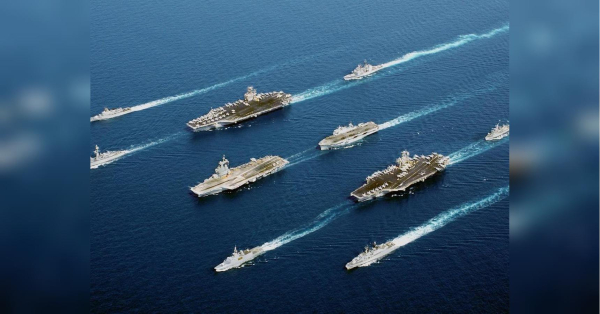
The United States is boosting its naval forces against Iran by deploying a third aircraft carrier to the Middle East. In doing so, US President Donald Trump is increasing the firepower for a potential strike on Iran during or after an extended ceasefire. He is also tightening a naval blockade aimed at crippling Iran economically.
VIDEO OF THE DAY
Officially, the US says the naval blockade is aimed at stopping ships heading to or from Iranian ports. It is intended to deprive Tehran of crucial oil export revenues. Trump has also ordered the military to intercept any ships that have paid Iran’s dues. In practice, this means that US Navy personnel monitor, escort or intercept these ships and, if necessary, board them, as recently happened with the Majestic X.
What makes this particularly significant is that the incident occurred off the southern coast of Sri Lanka, far from the Strait of Hormuz, which is the main problem. Trump is likely also concerned about sovereignty over this vital waterway. From his point of view, it is unacceptable for Tehran to dictate the terms and decide which ships are allowed to pass. In addition, he intends to increase pressure on Tehran and force the Iranian leadership to sit at the negotiating table, N-TV reports.
Even before the war began, Iranians were facing a serious economic crisis. Economic pressures led to renewed mass protests in late December, which were brutally suppressed by Iran's security apparatus. The war has added to the strain on society. In major cities, residents report skyrocketing prices and growing hopelessness.
ADVERTISING
Iran is a major oil and gas producer, with China as its main customer. However, the US sanctions regime against the country makes it difficult to sell at market prices. During the active hostilities, the Israeli military attacked the important South Pars gas field in the Persian Gulf, as well as petrochemical and steel plants.
There is little official Iranian data on the impact of the US blockade, but Tehran's loss of oil revenues is a key factor.
“Compared to the number of ships that were passing through the strait before the blockade — about six to seven ships a day — the volume has decreased significantly,” said Rosemary Kalanick, director of the Middle East program at the Washington-based Defense Priorities think tank .
ADVERTISING
But the number of ships is only part of the equation. Iran will no longer be able to sell its oil because its storage facilities are almost full. If oil wells have to be shut down as a result, it will be difficult to reopen them in the long term. US Treasury Secretary Scott Bessant hinted at this in a post on X: “The blockade will lead to the so-called ‘shutdown’ of Iranian oil facilities, and the naval blockade will target Tehran’s revenues.”
Kpler, a leading international analytics company specializing in the collection and processing of real-time data on commodity markets, energy and maritime transport, estimated in a recent analysis that Iran’s oil storage facilities are only about ten days away from being filled. According to analytics company Vortexa, the US naval blockade will have little impact on China, the main buyer of Iranian oil, in the medium term. A significant part of the oil is already being sent to customers outside the blockade zone.
Iran's oil industry could be at risk from a naval blockade. The country's Islamic Revolutionary Guard Corps also derives revenue from the sector. However, huge losses in revenue in recent years, for example after US President Trump tightened sanctions on Iran during his first term, have not led to any change in positions in Tehran.
“Economic pressure alone will not force Iran to make concessions that it has not already made under military pressure,” said Hamidreza Azizi, a research fellow at the German Institute for International and Security Affairs .
ADVERTISING
We should add that Iran has offered the Americans, in exchange for opening tanker traffic through the Strait of Hormuz, to extend the ceasefire and postpone discussions on nuclear issues.