
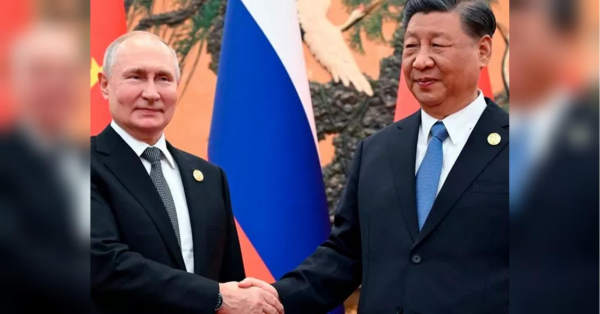
When US President Donald Trump visited Xi last week, he was treated to lavish banquets with gold tableware and a visit to an ancient temple. Xi reportedly mentioned his friend Putin's name to Trump last week as the two leaders strolled through Zhongnanhai, which is usually off-limits to foreign visitors, joking about how Putin had visited Beijing's political sanctuary before, the BBC reports.
VIDEO OF THE DAY
While some in Washington may have hoped that Trump could wean Beijing off Moscow, such hopes appear to be little more than wishful thinking.
China and Russia have described their ties in recent years as “a friendship without limits.” The relationship is highly uneven, and any deals struck between the two countries will likely be on Chinese terms, says Alexander Gabuyev, director of the Carnegie Russia Eurasia Center, a think tank. “Russia is completely in China’s pocket, and China can dictate the terms,” he says.
This dynamic continues in many sectors, not least in the economy. China is Russia's largest trading partner, while it accounts for only 4% of China's international trade. China exports more to Russia than any other country, and its economy is much larger than Russia's.
Years of Western sanctions have gradually pushed Moscow into deeper trade ties with Beijing. Tech giant Huawei, which was sanctioned by the US and forced out of 5G networks in the UK after a British government investigation, has taken advantage of the absence of Western companies to become a key pillar of Russia's telecommunications industry.
ADVERTISING
Since Russia’s full-scale invasion of Ukraine in 2022, Moscow has become increasingly dependent on Chinese components for its military machine. A recent Bloomberg report found that Russia imports more than 90% of its sanctions-busting technologies from China, a 10% increase from the previous year.
Moscow has few viable alternatives to Beijing, which offers the scale of demand and market and is integral to Russia's survival. If China were to reduce its trade with Russia, given its rift with the West, it would make it much more difficult to achieve Russia's foreign policy goals.
Read also: “We will stabilize the world”: Xi and Putin announced a new “just world order”
ADVERTISING
However, Moscow's great advantage and buffer against pressure from Beijing is its ability to defend its position.
According to Marcin Kaczmarski, a lecturer in security at the University of Glasgow , China is aware of how great this asymmetry is and does not want to provoke any negative reaction within Russia or among its elites.
“I would say that the bottom line of Chinese policy towards Russia is a policy of self-restraint,” he says. “China is not putting pressure on Russia.”
Gabuyev says that even if China tried to force Russia to act, it is “not exactly the kind of country that would immediately agree to it.”
ADVERTISING
He cites Xi’s visit to Moscow in 2023, during which the Chinese leader reportedly urged Putin not to use nuclear weapons in Ukraine. Just days later, Russia announced it would deploy nuclear weapons in Belarus, which some saw as Moscow’s deliberate resistance to external pressure and a reminder to the world of its independence.
Russia's bitter war in Ukraine may make it burdensome on all sides, but it also presents an advantage for Beijing as it considers its options for a potential invasion of Taiwan.
“Russia has a lot to offer in terms of some military technologies, such as niche equipment that it can still sell and testing some Chinese equipment or components,” says Gabuyev.
Whenever China and Russia disagree, a simple truth underlying their relationship becomes clear: neither country should follow the other because their relationship is not a formal alliance.
Bobo Law, former deputy head of mission at the Australian Embassy in Moscow , says it is this strategic flexibility, rather than the rigidity of a military alliance, that gives the partnership its resilience.
“This is not an alliance, but a flexible strategic partnership,” he says, which has endured despite repeated predictions of its collapse.
Western analysts tend to portray the China-Russia partnership in one of two ways: either as an “axis of authoritarianism,” united largely by their desire to defeat the West, or as a fragile brotherhood constantly teetering on the brink of collapse.
Unlike Western countries, which sanction and punish based on different values, including human rights, Russia and China do not judge each other's actions.
Despite their camaraderie at the highest political levels, Charles Parton, a former British diplomat in China, is cynical about the natural cultural affinity between ordinary Chinese and Russians.
“Do Chinese people want to study in Moscow, settle in Moscow and buy apartments in Moscow? No.” He believes that if Russians had a choice, they would prefer to invest in the West and buy apartments in Paris, London or Cyprus, rather than, say, Beijing.
Not everyone agrees. Gabuyev says people-to-people contacts are growing rapidly, partly because of Western sanctions and stricter European visa policies that are pushing Russians to China. It has become much easier for Russians to travel to China. The reciprocal visa-free regime means that you can take any of several daily flights from Moscow to major Chinese cities in just a few hours.
Earlier, it became known about China's secret assistance to Russia in its war with Ukraine.